
Beiträge aus Print und Web
Presse
Mainz 2016 Straßenkunst
Cellesche Zeitung Dezember 2014
Cellesche Zeitung Nov. 2014 über die Ausstellung in der Galerie Koch
Autor: Klaus Zimmer, am 05.12.2014 um 09:52 Uhr Cellesche Zeitung:
Bernhard Vogel und „sein“ Italien in der Galerie Koch in Hannover
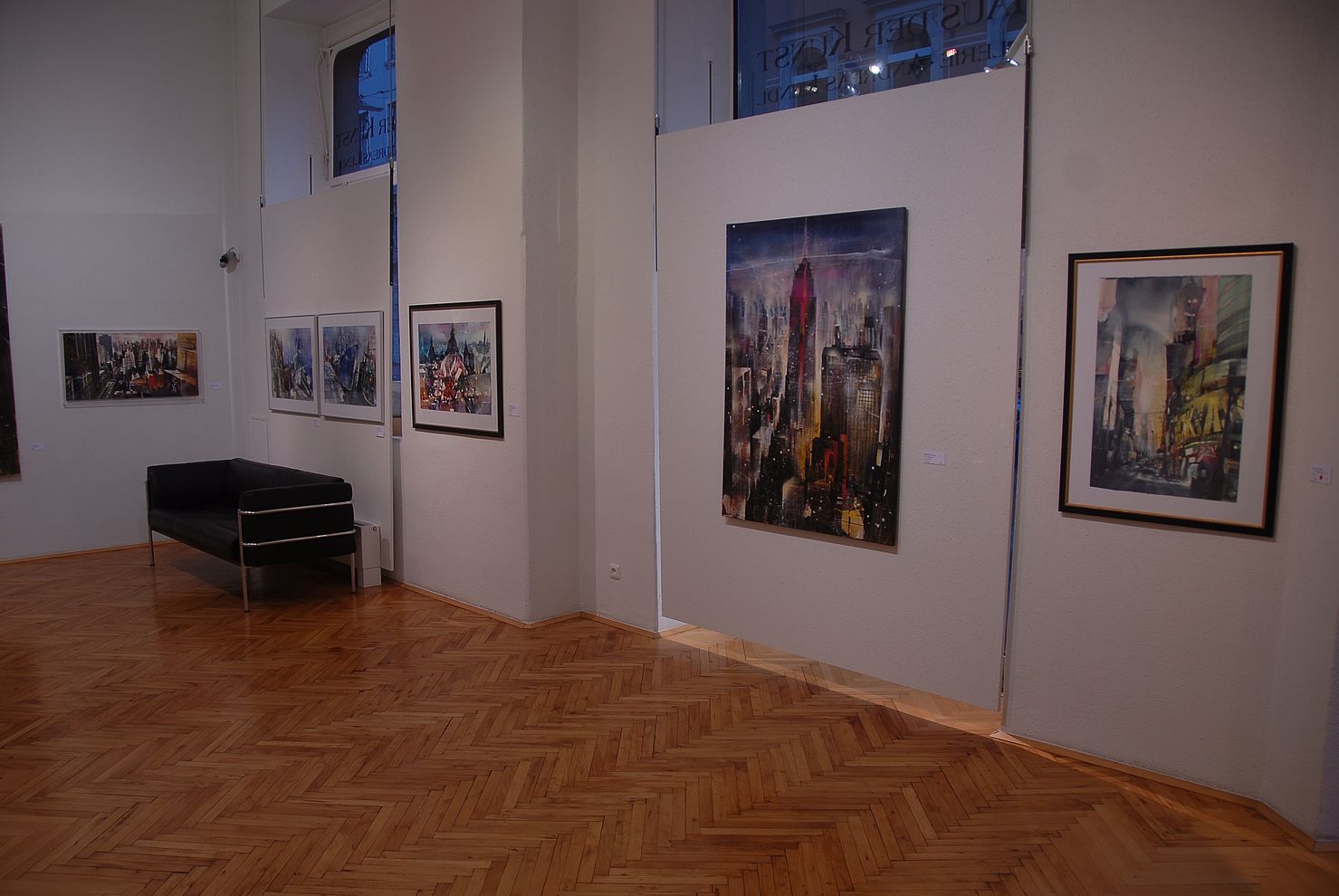
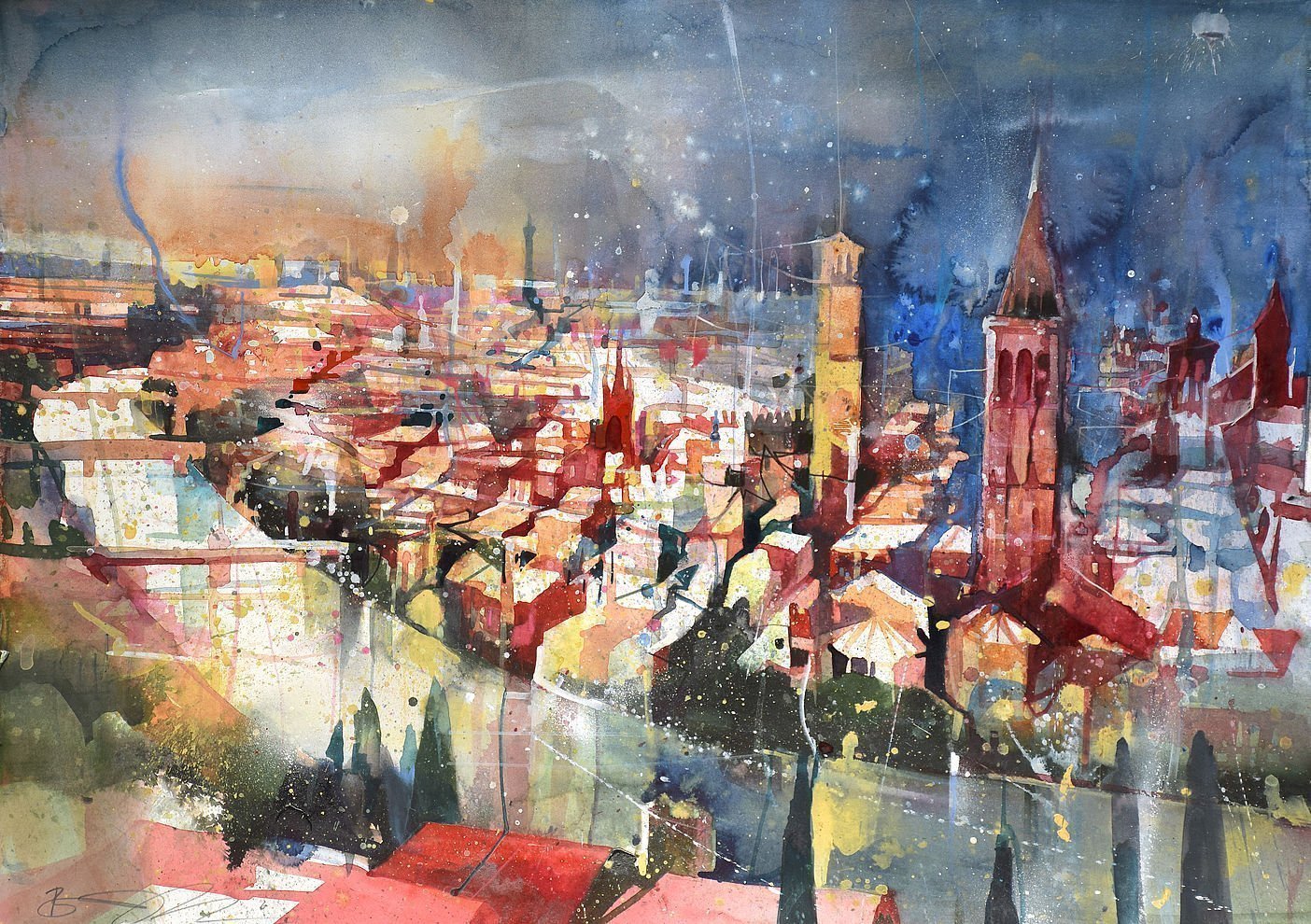
Sprechen die Aquarelle von Bernhard Vogel, an den Wänden der Galerie Koch, nicht für sich selbst? Bedarf es der einführenden Worte, um das im Grunde Unsagbare erklären zu wollen? Man spürt es gleich: Hier setzt sich ein Künstler mit langjähriger Erfahrung und ganz individueller Handschrift mit den Details seines Gegenübers auseinander, erfasst in großen, darum nicht groben Farbbahnen, Feldern und Flecken das Sichtbare, fügt jedem Ding, ob Architektur oder Landschaft, sein Eigenleben hinein und komponiert daraus das überzeugend musikalisch anmutende „Made in Italy“ hinzu.
Der 1961 in Salzburg geborene Bernhard Vogel ist ein begnadeter Kolorist. In rascher Abkürzung, zuweilen bis zum Chiffre, um durch den Pinselschlag die Dichtigkeit des Erlebens zu bewahren, sind solche Arbeiten auf dem Papier fast selbstständig gewachsen, nicht selten auch zur Überraschung des „Autors“. Das Spiel mit den Farben ist für Vogel das zentrale Anliegen, führt zu diesen Akkorden, die festlich aufrauschen.
Es dürfte auch nicht leicht sein, ein Parallelbeispiel für eine vergleichbare Doppelmeisterschaft zu finden. Bernhard Vogel malt grundsätzlich mit abstrakten Werten. Diese können aus Farbpigmenten oder aus Materialien und "Mischprodukten" bestehen.
In der besonderen, äußerst erfolgreichen Ausformung der "Kunst des Klebens" wird das triviale Fundstück aus Wellpappe, Plakaten, Fototrash und Zeitungsausschnitten transformiert in etwas anderes, das sich ganz den malerischen Intentionen beugt. Der billige Alltagsmüll aus Drucksorten aller Art verwandelt sich in einen kostbaren Träger des Räumlichen. Der Künstler bringt das Betrachterauge dazu, den materiellen Unwert umzurechnen in einen Aktivfaktor der visuellen Verführung. Diese Kunst der suggestiven Stoff-Verwandlung beherrscht Vogel wie kein anderer. Wie sonst ließen sich derartig fluchtende Straßenabgründe und Hochhausklippen hervorzaubern, wie sie typisch sind für die aktuelle "Downtown"-Serie. Städte und besonders die klassischen Orte Amerikas, sind Vogels Lieblingsobjekte, um seine Virtuosität im Verspannen und Aufreißen des Raumes zu demonstrieren. Aber es müssen nicht Wolkenkratzerbarrieren und die ozeanischen Tiefen dazwischen sein, um die gebaute Stadtwelt zu einem "Sexparadies" des fühlenden Auges und der sehenden Fingerspitzen zu machen. Auch aus den alten Stadtherzen des gemütlichen, alten Kontinents kitzelt der Künstler das Abenteuer für die Wahrnehmung heraus. Vogels angespannter Gestaltungsgeist führt ihn zu den hoch positionierten Erregungspunkten des Augenschweifens. Der Künstler blickt nicht in die Stadt, sondern streift mit Vorliebe über deren Panorama. Der befreiende Horizont bleibt als Magnet des Schauens und des Sehnens immer spürbar. Je mehr die Himmelszone eingeengt wird, desto stärker wird das Ziehen in die Ferne - über Dächer und Blickhemmungen hinweg. Wie in japanischen, extrem hochformatigen "Pfostenbildern" stürzt der Blick ins Unendliche und reißt sich zugleich am nahen Detail auf. Zwischen diesen Polen entsteht das durchlässige und zugleich aggressiv herausfordernde Phänomen Stadt. Vogels Stadtansichten sind gefährlich. Ihrem Sog kann sich niemand entziehen.
Rede Ute Halbach 2012
Rede Ute Halbach Ausstellung KSN Northeim Februar 2012
KSK Northeim, Bernhard Vogel, 19. Februar 2012-02-18
Sehr geehrte Damen und Herren, liebe Kunstfreunde, ich darf Sie zunächst herzlich begrüßen.Vielen Dank, lieber Jochen Röwer, für diese wohl formulierte Einführung. Nicht nur, dass uns die Begeisterung für die Kunst verbindet, es ist auch die Begeisterung speziell für Bernhard Vogel.
Es hat mich deshalb besonders gefreut, dass es Dein Wunsch war, in den letzten Wochen Deines beruflichen Schaffens noch einmal eine Ausstellung mit Bernhard Vogel in diesen Räumen durchzuführen. Ich habe durch unsere jahrelange Zusammenarbeit Dein besonderes Engagement für die Kunst und das Anliegen der Kreissparkasse Northeim, Kunst und Künstlern ein besonderes Forum zu bieten, schätzen gelernt.
Dieser Funke ist auch auf Bernhard Vogel übergesprungen. Es bedurfte beim zweiten Mal denn auch keiner großen Überredungskünste, ihn zu bitten, die Reise von Salzburg nach Northeim auf sich zu nehmen, um heute hier zu sein. Vielen Dank dafür, lieber Bernhard. (Kleine Pause)
Gestatten Sie mir zunächst, ein paar biografische Daten des Künstlers aufzuführen: Bernhard Vogel wurde 1961 in Salzburg geboren. Er ist verheiratet und Vater von vier Kindern. Nach bestandener Matura sollte er eigentlich den elterlichen Betrieb über- nehmen. Mit einem Schmunzeln kann hier angemerkt werden, dass er ironischerweise durch das Fach „Bildnerischer Erziehung“ durchfiel. Doch schon beim Malen für die Maturamappe, so sagt er, spürte er eine innere Stimme, die sich dann meldet, wenn etwas Entscheidendes passiert. Es waren kleine Gefühls-botschaften, die ihn verwunderten, die er aber nicht so ernst nahm.
Durch einen Motorradunfall und die Begegnung mit dem Medium Aquarell bei einem Malkurs mit Irma Raphaela Toledo begann etwas, das ihn bis heute in den Bann zieht, Begeisterung, Überschwang bis zum Fanatismus.
„Ich war so dem Malen verfallen, das sich Menschen in meiner Umgebung nur noch wunderten. Ich war nur glücklich, wenn ich malen durfte,“ so der Künstler. Dies ist bis heute geblieben. Und das bemerkt man an seinen Bildern. Bereits 1987 gewann er in Salzburg seinen ersten Kunstwettbewerb mit etwas anderen Salzburger Ansichten. Es folgten weitere Preise, Ausstellungen in ausgesuchten Galerien und Ankäufe von Museen im europäischen Ausland. Nebenher ist er noch Dozent an der Reichenhaller Kunstakademie und er veranstaltet mit Kollegen und Künstlernachwuchs Seminare, die ihm, so wie er uns noch gestern Abend voller Begeisterung schilderte, helfen, seine Sinne zu schärfen, sich selbst auch zu überprüfen und seinen Stil weiter zu entwickeln.
Wie geht der Künstler beim Malen vor: es ist weniger der klassische Weg mit Vorskizzierung, wo immer machbar nimmt er zunächst die Stimmung vor Ort auf, lässt das Motiv meditativ auf sich wirken, dann folgt er seiner Intuition, beginnt unmittelbar mit dem Aufbringen der Farben, mit dem Aquarellieren, dem kreativen Prozess. Wer mal Aquarell gemalt hat, (nicht,Jochen?) weiß, wie anspruchsvoll das ist, weil jeder Strich sofort sitzen muß.
Das Zustandekommen des kreativen Prozesses beschreibt der Künstler so: „Eiskristalle auf 2000m Höhe entstehen zu sehen, die wie Lebewesen in einem satten Ultramarinblau ihre Spuren ziehen. Bei schwüler Hitze in den Straßenschluchten von New York sich von aufheulenden Sirenen und einem permanenten Getöse beflügeln zu lassen. In Nevada Farben mit rotem Wüstensand zu vermischen und dabei Indianer kennen zu lernen. Beim Malen im Schilfgürtel des Neusiedler Sees den Flügelschlag eines Silberreihers zu studieren und den richtigen Sekundenbruchteil festzuhalten. Beim Straßenrap in Brooklyn zu neuen Farbmischungen angeregt zu werden. Einen streunenden Hund auf Santorin, der mir das Malwasser ausgetrunken hat, zu verscheuchen. Das Quaken eines Frosches in einem toskanischen Tümpel zu interpretieren. Morgens um Drei in Las Vegas vor dem Plaza-Hotel grelles Neonlicht einzufangen und den ganzen Irrsinn irgendwie zu Papier zu bringen. Das sind die Inspirationen, die ich für das Entstehen meiner Bilder brauche.“
Das Ergebnis sehen wir vor uns: äußerst ausdruckstarken Aquarellmalerei mit sehr eigenem Stil. Da entstehen aus Farben und Licht, verschobenen Ebenen und mystisch vernetzte Strukturen Motiven, die optische Reize setzen, Dynamik erzeugen, Phantasie anregen, Sehnsüchte schaffen. Ganz eigene, expressive Ansichten von Stadtbildern, Häuserfluchten, Panoramen und Stillleben.
So könnnen wir teilnehmen an zahlreichen Reiseerlebnissen von New York bis nach Venedig, von Rügen bis Regensburg. Und wir erfreuen uns an STilleben mit sehr eigenem Charakter. (zeigen)
Für mich besteht die herausragende kreative Leistung des künstlerischen Schaffens von Bernhard Vogel in der mutigen Interpretationsweise seiner Motive, verbunden mit einer wirklichen Risikobereitschaft, nicht nur „abzubilden“, sondern wirklich etwas Neues entstehen zu lassen und uns zu neuen Ansichten zu verhelfen.
Emil Nolde sagte: „Ausflüge ins Traumhafte, ins Visionäre, ins Phantastische entstehen jenseits von Regeln und kühlem Wissen. Es sind freie, herrliche Gefilde und Gebiete voll Reiz und Schwarm in lichtem geistigen Erleben, wer nicht träumen und staunen kann, kommt nicht mit.“
Für Bernhard Vogel freut es mich, dass die Anzahl seiner Sammler in den letzten Jahren weiter gestiegen ist ist und dass er hierdurch die wie für jeden Künstler bedeutende Anerkennung erfährt.
Ich selbst begleite ihn über acht Ausstellungen in mehr als 20 Jahren. Und ich muß sagen, jedes Mal bin ich neugierig über seine neuen Geschichten, die er mit seinen Bildern erzählt und seine weitere Entwicklung.
Und jetzt bin ich auch im 40. Jahr meiner Tätigkeit als Galeristin auf Ihre Reaktion gespannt und neugierig. Ich wünsche Ihnen noch anregende Gespräche und einen schönen Ausklang des Vormittages!
Anton Gugg
Im Sog der Städte
Im Sog der Städte / Ausstellung "Downtown" Festpielausstellung
Anton Gugg: IM SOG DER STÄDTE, Bernhard Vogels „Downtown“-Collagen
Wie nähert man sich als bildender Künstler dem faszinierendbedrohlichen Phänomen Stadt – jener umfassenden zivilisatorischen "Problem- Größe", die gleichermaßen als Moloch und Mutter auftritt. Ein großer Teil der Menschheit lebt in rasant wachsenden Megacitys von undurchschaubaren und unbeherrschbaren Strukturen. Prognosen sagen eine steigende Verdichtung und Ausweitung der Riesenstädte zu nur noch scheinbar urbanen, in Wahrheit jedoch dschungelhaften "Giga-Geschwulsten" voraus. Bald wird die Stadt einzige Produktivquelle und Hauptkrisenzone des globalen Lebens sein. All diese widersprüchlichen, die Fantasie provozierenden Aspekte beschäftigen den Salzburger Aquarellisten Bernhard Vogel, einen großen Mal- Reisenden zu Brennpunkten des Städtischen. Die Zahl der aquarellierten Ansichten alter und neuer Stadtkerne- und Zonen ist Legion. Man kann sagen, dass es diesem Künstler gelingt, sehr bürgerlichen Thema wie dem Blumenstillleben und der Vedute neue malerische Brisanz zu verleihen. Kaum hätte man es für möglich gehalten, dass die bildlich-dekorativen Beherrscher des Salons ihre Staubschicht abschütteln und sich noch einmal als fesselnde gegenständliche Vorwürfe erweisen. Ein Hauptgrund für die ü b e r r a s c h e n d e Frische und Modernität speziell von Vogels Städtebildern mag die Tatsache sein, dass der Künstler außerhalb des Stimmungsmäßigen und Realistischen agiert. Selbstverständlich gibt es einen Wiedererkennungswert des Motivischen. Darauf wird ein klassischer Maler mit traditionellem Grundverständnis niemals verzichten wollen. Dennoch erschöpft sich nichts im bloß Beschreibenden und im Impressionistischen. Vogel interessieren in erster Linie Konstellationen aus räumlichen und flächigen Zusammenhängen. Seine Vorgangsweise beruht nicht auf passiver Einfühlung, sondern auf aktiver Konstruktion. Genau dieser eher sachliche "Ingenieursgeist" in malerischen Belangen erlaubt es dem Künstler, vom Medium der Wasserfarbe ohne irgendeine Verkrampfung im Handwerklichen zur Collage zu wechseln. Die künstlerische Glaubwürdigkeit leidet nicht beim Parallellauf von konzeptiven Planungen und praktischen Bildmacherstrategien, die sich eigentlich ausschließen müssten.
Das Zustandekommen des kreativen Prozesses beschreibt der Künstler so: „Eiskristalle auf 2000m Höhe entstehen zu sehen, die wie Lebewesen in einem satten Ultramarinblau ihre Spuren ziehen. Bei schwüler Hitze in den Straßenschluchten von New York sich von aufheulenden Sirenen und einem permanenten Getöse beflügeln zu lassen. In Nevada Farben mit rotem Wüstensand zu vermischen und dabei Indianer kennen zu lernen.
Beim Malen im Schilfgürtel des Neusiedler Sees den Flügelschlag eines Silberreihers zu studieren und den richtigen Sekundenbruchteil festzuhalten. Beim Straßenrap in Brooklyn zu neuen Farbmischungen angeregt zu werden. Einen streunenden Hund auf Santorin, der mir das Malwasser ausgetrunken hat, zu verscheuchen. Das Quaken eines Frosches in einem toskanischen Tümpel zu interpretieren. Morgens um Drei in Las Vegas vor dem Plaza-Hotel grelles Neonlicht einzufangen und den ganzen Irrsinn irgendwie zu Papier zu bringen. Das sind die Inspirationen, die ich für das Entstehen meiner Bilder brauche.“
Das Ergebnis sehen wir vor uns: äußerst ausdruckstarken Aquarellmalerei mit sehr eigenem Stil. Da entstehen aus Farben und Licht, verschobenen Ebenen und mystisch vernetzte Strukturen Motiven, die optische Reize setzen, Dynamik erzeugen, Phantasie anregen, Sehnsüchte schaffen. Ganz eigene, expressive Ansichten von Stadtbildern, Häuserfluchten, Panoramen und Stillleben.
So könnnen wir teilnehmen an zahlreichen Reiseerlebnissen von New York bis nach Venedig, von Rügen bis Regensburg. Und wir erfreuen uns an STilleben mit sehr eigenem Charakter. (zeigen)
Für mich besteht die herausragende kreative Leistung des künstlerischen Schaffens von Bernhard Vogel in der mutigen Interpretationsweise seiner Motive, verbunden mit einer wirklichen Risikobereitschaft, nicht nur „abzubilden“, sondern wirklich etwas Neues entstehen zu lassen und uns zu neuen Ansichten zu verhelfen.
Emil Nolde sagte: „Ausflüge ins Traumhafte, ins Visionäre, ins Phantastische entstehen jenseits von Regeln und kühlem Wissen. Es sind freie, herrliche Gefilde und Gebiete voll Reiz und Schwarm in lichtem geistigen Erleben, wer nicht träumen und staunen kann, kommt nicht mit.“
Für Bernhard Vogel freut es mich, dass die Anzahl seiner Sammler in den letzten Jahren weiter gestiegen ist ist und dass er hierdurch die wie für jeden Künstler bedeutende Anerkennung erfährt.
Ich selbst begleite ihn über acht Ausstellungen in mehr als 20 Jahren. Und ich muß sagen, jedes Mal bin ich neugierig über seine neuen Geschichten, die er mit seinen Bildern erzählt und seine weitere Entwicklung.
Und jetzt bin ich auch im 40. Jahr meiner Tätigkeit als Galeristin auf Ihre Reaktion gespannt und neugierig. Ich wünsche Ihnen noch anregende Gespräche und einen schönen Ausklang des Vormittages!
Dresden-Berlin-Venedig
Weltrelikte im Geflecht der Farben zur Aquarellistik Bernhard Vogels
Anton Gugg: Buchtext Dresen-Berlin-Venedig, Galerie der BASF Schwarzheide
Aquarellmalerei entsteht an der Schnittstelle des malerischen Abbildungs-Begehrens und der freien künstlerischen Fantasie. Der Hauptantrieb zur Kultivierung der an sich "armen" Kunst der Wasserfarbenmalerei speist sich aus dem Willen, den Eindruck einer bestimmten Landschaft, die Atmosphäre einer ganz besonderen Stadt mit möglichst wenig Reibungsverlust kompositorischer oder maltechnischer Art auf ein Blatt Papier zu bannen. Unüberschaubare Heere von Freizeitmalern folgen der Illusion, das "Traumbild" ihrer momentanene Begeisterung mit ein paar Tropfen gefärben Wassers und wenigen Pinselschwüngen und Tupfern fixieren zu können. Sie wollen sich nicht die Einbildung eines individuellen, unverwechselbaren Künstlertums stören lassen und verdrängen die zweite wesentliche Bedingung der Aquarellmalerei, ohne die das "dürftige" Handwerk feuchter, flüchtiger Farbspuren auf Papier wenig mehr als Anmaßung meisterschaftlicher Abstraktionsqualitäten bleibt.
Aquarellmalerei erhebt sich von dekorativer Dilettantentätigkeit zur Kunst erst dann, erweisen sich die "Effekte" - seien es simpel oder kompliziert auftretende - als Ergebnis echter gestalterischer Prinzipien. Der Grat zwischen "Klekserei" und Malerei ist gerade in der Wasserfarbenkunst enorm schmal und oft genug steht auch der geübte Kunstbetrachter ratlos vor Schöpfungen, die ihn einerseits sofort begeistern, denen er andererseits aber nicht trauen will - gerade weil sie ihn auf der Stelle in Flammen des Entzückens setzen. Die Farbe ist in der Aquarellmalerei wie in keiner anderen Disziplin direkte Lichtträgerin und verkörpert an sich das Kompositionsvermögen. Das stellt die denkbar höchsten Ansprüche an ihre "Phänomenologie". Wasserfarbe ist die nächste Verwandte der Glaskunstfarbe. Das macht sie gewissermaßen "absolut", aber auch angreifbar für jeden, der nicht an die unmittelbare mystische Kraft des Farbigen glaubt, sozusagen Rationalist ist.
In der Kunst des Salzburgers Bernhard Vogel sind beide Komponenten bedeutsamer Aquarellmalerei - die atmosphärisch-emotionale Aneignung der sichtbaren Realitäten sowie die Transformation des visuellen "Trivialbefundes" in ein abgehobenes ästhetisches System - auf ideale Weise ausbalanciert. Wahrscheinlich ist es dem vielköpfigen Gefolge der Malschüler nicht immer vollkommen klar, was ihm beim Blick über die Schulter des Meisters auf zahlreichen "Trainingsreisen des Sehens und Festhaltens" tatsächlich geboten wird - nämlich die Umwandlung des "banalen" Anblicks mehr oder weniger berühmter Städte und Stätten in ein eigenständiges Geflecht aus aquarellistischen Reizen, in dem der nostalgische Blick das vielgeliebte Bekannte entdeckt. Glücklicherweise ist Bernhard Vogel resistent gegen neugierige Enthüllungsversuche eines Kreativvermögens, das ihn zu einem der bekanntesten und erfolgreichsten Könner seines von sogenannten Meistern heillos überschwemmten Faches gemacht hat.
Vogel hat als Landschafts- und besonders Städtemaler dort begonnen, wie alle von Lichterscheinungen gefesselten Künstler den Höhepunkt der Kunst orten. William Turner - der Magier der Sonnengeburten und Gestirnsdämmerungen über düster glühenden Fluten, zittert in den frühen, aus dem "Schleierprinzip" entwickelten Arbeiten nach. Bald jedoch weicht der "Duft der Farben" jenen sich verdichtenden Ordnungstrategien, die das Bild immer mehr von den oberflächlichen Verführungsqualitäten des flüssigen, hochtransparenten Farbmaterials emanzipieren und letztlich in eine ästhetisch äußerst komplexe Collagetechnik führen.
Bernhard Vogel begibt sich heute mit Vorliebe zu Orten des Aufbruches und der dramatischen Veränderung. Berlin ist so ein Magnetpunkt, aber auch Dresdens restaurative Baustellen mit ihrem optichen Gespinst aus Kränen und berühmten Denkmalssilhouetten fasziniert den Maler, der nach beinahe zwei Jahrzehnten künstlerischer Tätigkeit mehr Bildfeld-Analytiker als Stimmungsimpressionist ist, wie man das von einem "Veduttisten" erwarten könnte. Im Grunde baut Vogel - trotz seiner enormen Popularität als vergleichweise naturalistischer "Abbildner" - an einer Gegenwelt zum Klischee der Stadtansicht. Man erkennt Motive und Architekturen - schön und gut - aber das eigentlich Faszinierende an diesen Aquarellen ist die Dichte von visuellen Texturen und die ist unabhängig vom Gegenstand der Darstellung. Vogel verwandelt Blumenmotive in ein Labyrinth von Helligkeiten und Schatten. Er "porträtiert" Cities am liebsten aus der Perspektive eines Aussichtsturmes und betont so das Geflechthafte der Formen. Er fühlt sich dort gefordert, wo andere aus "ästetischen" Gründen die Nase rümpfen. Der Bauch einer Maschinenhalle in Schwarzheide ist für Vogel genauso ergiebig wie der "Bellottoblick" auf das Elbflorenz oder die Palastspiegelungen der Serenissima - jenes dunstigen Urbanwunderwerkes, das spätestens seit den Dokumentaristen und Impressionsten des 18. Jahrhunderts und erst recht seit dem unübertroffenen Farb-Parfümeur namens Turner Traum und Albtraum jedes Venedig-Malers ist.
Bernhard Vogel hat heute eine gestalterische Freiheit erreicht, um die ihn Konkurrenten nur beineiden können. Der geborene Aquarellist braucht eigentlich gar keine Wasserfarbe mehr. Er benützt das Medium der Durchsichtigkeit gelegentlich sogar "gegen den Strich". Von der zartesten Andeutung bis zur opaken Blickbarriere aus vielen Farbschichten reicht das Spektrum des Farbeinsatzes. Nahtlos geht das "Wasserfarbenbild" über in "Mixed Media" - der anderen Domäne Bernhard Vogels. Gewellte, geriefelte Papierreste, tropfende Farbverläufe über Fotofragmenten und noch viele andere Kombinationen des Materiellen schließen sich in einem homogenen Ganzen zusammen. Vogel malt gewissermaßen mit "Abfällen", stuft die Wirksamkeit der einzelnen Farb- und Formstimmen exakt nach seinen Vorstellungen, instrumentiert extreme Raumkonstellationen perfekt mit "schrägen" Oberflächenreizen. Was auf der Leinwand sitzt, lässt den Blick in die Bildtiefe stürzen. Solche "Falltüren" und "Kunststücke" machen jede Komposition zum Abenteuer. Ein Hauch davon weht auch in den traditionellsten Aquarellen des außergewöhnlichen Salzburger Künstlers.
Alles wird Landschaft
Auf das Motiv kommt es schon längst nicht mehr an in der Aquarellistik Bernhard Vogels. Was den Künstler heute erregt, ist die durchdachte Dramaturgie formaler Elemente, die nicht mehr eng an das Gegenständliche gebunden sind. Vogel wird immer ein an nahen Dingen, an Stadt-Physiognomien, an bestimmten Landstichen und Menschengesichtern interessierter Maler bleiben. Die puren Spiele der plätschernden Wasserfarben und die diffusen Seelenlagen, die sich angeblich in Pfützen und Rinnsalen spiegeln, überlässt er zur gefälligen Untersuchung anderen. Alles, was Farbe in den Augen anderer so ausdrucksstark macht, so reizvoll entfesselt, widerstrebt seinem konstruktiven Naturell. Farbe gehört diszipliniert, in Bahnen gebracht. Das angebliche Vehikel des Emotionalen muss auf Schienen gesetzt werden. Dieses Rohmaterial, in dem so viel beunruhigender Sprengstoff verborgen ist, soll geschliffen werden wie ein trüber Stein, der danach nach präzisen Regeln funkelt. Das Ungefähre und Verfließende, das Andeutende und nicht ganz Erfasste, eben die vielfach vorgeblendeten Schutzschilde des Dilettantismus, sind dem Künstler ein Graus.
Bernhard Vogel ist ein Anti-Wasserfarbenkünstler nach landläufigem Verständnis. Er bedient nicht die vulgärimpressionistischen Erwartungen, er agiert niemals affirmativ zu Motiven und Stimmungen. Er ist ein Erzieher zum strukturierten Sehen. Wie ein Kristallschleifer holt er auf seinen Reisen das Unerwartete aus dem visuellen Alltagsgeröll, das jeder zu Gesicht bekommt und mit dem die meisten doch nicht mehr sehr viel anfangen können. Es ist doch alles schon zu Tode gepinselt und geknipst und die Standardforderungen de Moderne wie Wahrhaftigkeit der Empfindung in den Scherben der aufgebrochenen Form wirken antiquiert. Keine guten Voraussetzungen für alle Liebhaber der schnellen, diebischen Aneignung von Welt-Souvenirs - seien es rasch hingewaschene Nachbilder schöner Städte, Blumen oder Gesichter. All dem setzt der Künstler ein bemerkenswert vom herkömmlich Aquarellistischen emanzipiertes Gestaltungsmodell entgegen.
Für Bernhard Vogel sind die Ansichten des allzu Bekannten wie des Unbekannten gleichermaßen interessant und ergiebig. Er porträtiert Venedig nicht anders als eine Industrieanlage, ein attraktives Blütenarrangement, einen Alpenzug, eine toskanische Hügelmelodie oder eine nördliche Flacherstreckung. Für ihn gilt es, das Vorgefundene - sei es im augenblicklichen Erleben und Einfühlen auch noch so reizvoll und stimmungsträchtig - von allem Floskelhaften und Gefühligem zu reinigen, aus dem Nebel des Subjektiven zu schälen. In einem strikten Prozess der räumlichen und farbigen Neuordnung entstehen durchbrochene, ineinander verschränkte Schichtungen aus Licht und Farbe, die manchmal besonders behandelt wird.
Bernhard Vogel blickt in die Welt und man erkennt das, was er gesehen und gemalt hat. Das wird wahrscheinlich immer die traditionelle Basis bleiben. In diese ohne jeden Zwang und jede Vordergründigkeit eingezogen ist aber ein besonderes Form-Farbgerüst, das aus jeder Ansicht mehr macht als einen mehr oder weniger anmutigen Abdruck der Wirklichkeit, als der Aquarellmalerei häufig missverstanden wird.
Bernhard Vogel verwandelt alles in überlegen konzipierte Landschaften aus Elementen, die sich den Anschein des Realistischen geben. In Wahrheit ermalt sich Bernhard Vogel eine eigenständige Fantastik aus räumlichen Staffelungen und Verwerfungen, farbigen Barrieren und Durchlässen, Lichtführungen und Lichtschranken. Bernhard Vogels winterliche Bergkämme und norddeutsche Sommerheidezonen sind nicht stimmungslos, aber das Atmosphärische entsteigt nicht naturalistischen Niederungen. Es geht längst nicht mehr um Motive, sondern um komplexe Malkultur, deren Distanziertheit der kulinarischen Erlebbarkeit nicht im Wege steht.
Die intelligenteste der Künste
Buchtext Bernhard Vogel Radierungen/Etchings 1988-2002, Anton Gugg
Druckgrafik wird die anspruchsvollste Herausforderung an Hand, Auge und Hirn des Künstlers und des Kunstbetrachters bleiben. Auf diese Aura des "Speziellen" und "Elitären" wird stets gepocht, wenn es gilt, die scheinbar mangelnde Popularität alles Gedruckten etwa gegenüber der Malerei mit einem ideellen Mehrwert zu kompensieren. Liebhaber der Druckgrafik formieren sich zur Aristokratie des Kunstpublikums, das sich gleichsam mit den leisen Tönen der Differenzierung begnügt und insgeheim auf die lauten Vergnügungen der großen Malerei herunterblickt. Immer wieder wird der Vergleich des Druckgrafischen mit "Kammermusik" für ein kleines, auserlesenes Publikum bemüht, um den besonderen Anspruch von Holzschnitt, Stich, Radierung und Steindruck zu untermauern. Die oft geknüpfte assoziative Verbindung etwa zwischen einem Streichquartett und einem Print-Kunstwerk liegt nahe, führt aber völlig in die Irre. Druckkunst diente stets der Verbreitung von Bildideen. Der Adressat alles Gedruckten ist nicht der Einzelne, sondern die Masse. Und gerade in der imaginären Künstlerrede an ein kaum abschätzbares, anonymes Publikum unterschiedlichster soziologischer Schichtung und Bildung liegt die Faszination des Druckgrafischen. "Vermassung" der Kunst ist aber nicht gleichbedeutend mit Verflachung des Künstlerischen - ganz im Gegenteil. Druckwerke waren und sind weder billiger in der Ästhetik noch bescheidener in den Mitteln als ein Ölgemälde, das im Gegensatz zur "dürren Kammermusik" gern als volltönendes "Orchester" bezeichnet wird. Beliebte musikalisch-visuelle Vergleiche dieser Art führen zu Missverständnissen. Eines gilt für die Druckgrafik uneingeschränkt: Ihre Verbreitung korrigiert nicht die allgemeine Unkenntnis über Techniken und Wesenarten selbst bei sogenannten Kunstkennern. Wie Tief- und Flachdruck entstehen, bleibt für viele ein Geheimnis. Noch immer wird unter der Bezeichnung "Stich" alles Gedruckte subsummiert und für viele Kunstfreunde sind die Bezeichnungen Originalgrafik und Reproduktion spanische Dörfer. Nur der Künstler scheint zu wissen, was an konzeptiver Denkleistung und handwerklicher Disziplin nötig ist, um über den Weg der Druckplatte, der Papierbehandung und der Presse ein überzeugendes künstlerisches Ergebnis zu erzielen. Die Druckgrafik fordert Intellekt und Intelligenz des Künstlers heraus wie keine andere Diszipin. Nicht aus Zufall haben nur die allergrößten Geister die Druckgrafik weiterzuentwickeln vermocht und in ihr die beeindruckendsten Leistungen hinterlassen.
Die Radierung als Höhepunkt der Druckunst
Die Technik der Radierung ist die ausgefeilteste Methode, aus einer "gewaltsamen" Zwiesprache von aggressiven Werkzeugen und widerspenstigem Metall die zartesten und ästhetisch vielschichtigsten Bildresultate hervorzulocken. Der Umgang mit Kupfer, Asphalt, Stift, Stichel und Säure markiert den Höhepunkt in der Verfeinerung und Ästhetisierung der druckgrafischen Methoden. Mit der Radierung - deren technische Prinzipien von breiten Kreisen der Kunstfreunde vielleicht am wenigsten unter den Möglichkeiten des druckgrafischen Spektrums verstanden werden - ist es ab dem 17. Jahrhundert gelungen, die in sich gebrochene, ohne forcierten Kraftaufwand und rein aus dem zeichnerischen Duktus der Hand entstehende Linie ohne Materialwiderstand in Metall zu senken und in weiterer Folge mit malerischen Raumwirkungen sowie dramatischen Lineareffekten zu kombinieren. Rembrandt, Goya und Picasso haben aus diesen tragenden ästhetischen Aspekten der Radierung bis dahin nicht Gesehenes, Unübertroffenes und zugleich Schulbildendes geschaffen. Nur Dürer hat mit seinen Kupferstichen Schatten geworfen, aus denen kein späterer Künstler herauszutreten imstande war. Nur dem Nürnberger Meister war es gegeben, allein aus der Kraft der reinen, klar gestochenen Linie Maßstäbe der "Versinnlichung" und des Visionär-Methaphysischen vorzugeben, die von keiner Gipfelleistung späterer Drucktechniken gesprengt worden sind.
Die Radierung bringt die Befreiung des Druckgraphikers von der "Arbeit". Sie öffnet den Tiefdruck auch für das Spekulative, gewissermaßen nur Angedeutete. Musste der klassische Kupferstecher mit seinem Stichel die Metallplatte regelrecht aufreißen - indem er einen Graben aushob und das überschüssige Material entfernte - so hinterlässt der Radierer seine leichte, wendige, zu jeder Flüchtigkeit befähigte Zeichenspur lediglich in der wachsweichen Aspaltschicht auf der Metallplatte. Die "Arbeit" leitet dann eine Säure, die durch die Schichtverletzung die Zeichenspur ins Metall ätzt. Das ist ein "Quantensprung" in der Übertragung des grafischen Impulses in die Technik der Vervielfältigung. Erst die Radierung bringt für den Künstler die Möglichkeit, der Linie die Zartheit und "Geschwindigkeit" einer Federzeichnung zu verleihen, die Linie spontan zu brechen oder schwellen zu lassen, klar umrissene und modellierte Volumina in Impression, das heißt, in Andeutung zu verwandeln. Der Stecher denkt in plastischen Körper und begrenzten Räume, der Radierer bewegt sich hingegen in der Region der Reflexe und des Atmosphären. Die Kunst der Radierung fördert das Traumhafte, Unwirkliche - sie ist vom Wesen her Imagination. Alles Frühere ist Kampf um Konkretion, um das Greifbare. Zwischen dem "Alten Testament" des Tiefdrucks - Holzschnitt und Kupferstich - und dem Nuancenreichtum der neuen Druck-Äthethik liegt eine ganze Welt. Diesseits flutet das Licht, setzt alles in Bewegung und lässt die Vergangenheit dunkel erscheinen.
Ein neuer Zweig am alten Baum der Radierung
Das Zusammenwirken von deckenden Stoffen in unterschiedlichen Zuständen, feinen Zeichenspitzen, chemischen Substanzen und verschiedenen Farben setzt so etwas wie ein weit vorausblickendes "Regietalent" voraus.
Der Künstler muss berechnen können, welche Töne sich aus Farbüberlagerungen, aus der Kombination mit Linienätzung sowie der direkt in die Platte gravierenden Kaltnadel ergeben, welche Mischeffekte in welchen Grenzen verlaufen. Die Radierung in ihrer entwickelten Form - das heißt mit Einbeziehung der Aquatinta-Flächenätzung - verklammert alle ästhetischen Möglichkeiten der Druckgrafik - indem sie die Tiefenschärfe und optische Wucht des Tiefdrucks mit den malerischen Finessen der viel später entstehenden Flachdrucktechnik der Lithografie verbindet. Sie bezieht aus den historischen Wurzeln der Vervielfältigungsmethoden die Kraft der "Bezeichnung" und lässt zugleich verfließende, konturlose Übergänge zu.
Genau dieser Bogen an Differenzierungsmöglichkeiten zwischen scharfer, linearer Begrenzung und aquarellistischer Wirkung zieht eine "pittoreske" Gestalternatur wie Bernhard Vogel auf besondere Weise an. Radierung und Aquarell scheinen sich dabei wechselseitig zu bedingen - gerade durch ihre vergleichbaren ästhetischen Ergebnisse und ihre diametral entgegengesetzten technischen Realisierungsschritte. Beide Bilderscheinungen sind geprägt von der Anschaulichkeit des scheinbar Flüchtigen und überaus Zarten, aber der Weg zu diesen "verwechselbare" Ergebnissen könnte unterschiedlicher nicht sein. Vogel bewegt sich mit Vorliebe im Farbmedium des Flüssigen und Augenblicklichen. Er kultiviert die Kunst des "richtigen Pinselaufenthaltes zur richtigen Zeit am richtigen Ort des Papieres". Andererseits fühlt er sich herausgefordert, als Druckgrafiker den Horizont aller aquarellistischer Entfaltungs- und Entwicklungsmöglichkeiten zu überblicken und Wirkungen im voraus zu disponieren. Die Radierung dient unter diesem Gesichtpunkt auch als Rückversicherung, die eingesetzten Mittel - in welchen Medium auch immer - gleichsam unfehlbar im Griff zu haben. Solche kontrollierende Absicherung des eigenen Vermögens lässt tief in eine Künstlerseele blicken, der alles Zufällige zutiefst fremd ist. Vogel gilt als Inbegriff des Aquarellisten. Er arbeitet stets vor dem Motiv und findet es nicht irrtierend, auf seinen Malreisen von vielen Schülern permanent beim Gestaltungsprozess beobachtet, in jeder seiner Bewegungen, seiner Pinselsetzungen studiert zu werden. Auch diese Immunisierung gegenüber einer Außenwelt, die nur auf die Lüftung des Künstlergeheimnisses aus ist, sagt viel über die psychische Konstitution und die Grundlagen der Schaffensfähigkeit dieses außergewöhnlichen Maler-Radierers aus. Was für die neugierigen Blicke der Lernenden der Ausdruck purer Spontaneität und reinster Unbekümmertheit sein mag, enthüllt sich von einer distanzierten Warte als Kulminationspunkt von Abstraktionsvermögen und konstruktiver Intelligenz.
Bernhard Vogel radiert seine Hauptthemen Landschaft, Städteansicht und Blumenstilleben auf dieselbe Art und Weise wie er seine Aquarelle zu Papier bringt. Lange bevor sich das Bild für fremde Augen aus der momentanen Gelegenheit heraus realisiert, hat der Künstler Horizonte festgegelegt, den Bildaufbau grafisch verstrebt, Räumliches und Flächiges instrumentiert, Farbmischungen abgestimmt, das Netz der Lichtflecken geknüpft und den Niederschlag der Schatten verteilt. Das ist vom gesamtkompositorischen Plan her anspruchsvoller als es dem Laien bewusst sein kann. Es geht darum, Asphaltpulver auf die Metallplatte aufzubringen und anzuschmelzen, um zu gleichmäßig körnigen Flächenstrukturen zu gelangen. Dazu kommen feine Strichätzung und die samtigen Akzente der Kaltnadel, jener Durchpflügung der Platte mit scharfer Spitze, an deren empfindlicher Gratbildung sich die intensivsten Farbreserven festsetzen.
Bernhard Vogel atmet wie jeder schöpferische Zeitgenosse eine Luft, deren Sauerstoffgehalt durch das Personal der Kunstgeschichte so gut wie verbraucht ist. Alles ist bereits erfunden und gesehen, gestaltet und zitiert worden. Selbstverständlich ist auch bei Vogel die Radierung das, was sie immer war - die Königsdisziplin des Drucks, die nach wie vor über ein unvergleichliches, von den alten Genies ausgebautes Arsenal an Gestaltungsmöglichkeiten verfügt. Vogels Radierungen ein neuer, frischer Zweig an einem besonders hohen, breitkronigen Baum der Künste. Mit allen Regeln des Handwerklichen geht er durchaus selbstbewusst die schönen alten Themen der Kunst an. Er porträtiert Landschaften, berühmte Städte und Blumengestecke. Er weiß auch, dass auf diese historischen Stichworte die edelsten Gedichte und kunstvollsten Arien gesprochen und gesungen wurden und ist sich bewusst, dass alles, auch das Radierte, nicht aus dem langen Schatten der ganz Großen heraustreten kann. Diese "Gefangenschaft" im Rückblick und Vergleich mit den Heroen einer langen, ruhmvollen Gestaltungsgeschichte bringt ihn jedoch nicht von seinem bildnerischen Eigensinn ab. Dieser Wille setzt sich stets durch und bringt das hervor, was genenell kennzeichnend für diesen Künstler ist: Die intelligente Bewältigung komplizierter Aufgabenstellungen für das Auge und die Wahrung von Distanz zu den atmosphärischen Verlockungen des Gegenstandes. Gewiss findet man in Vogels Landschaften "gewisse" selbst erlebte und deshalb geliebte Stimmungen wieder. Aber in erster Linie bestechen die Druckgrafiken ebenso wie die Aquarelle als souveräne Lösungen der Problemstellung "Ansicht". Das abstrakte Denken des Künstlers trägt zur Klärung des Bildes bei und drängt das rein Motivische in den Hintergrund. Bei diesem Vorgang präziser Bildformulierung hat die Radierung im Werk des Künstlers den vielleicht entscheidendsten Anteil. Sie ist für Bernhard Vogel so etwas wie Etüde der visuellen und grafischen Sicherheit und Geläufigkeit. Der Begriff der Übung hat dabei nichts Abwertendes. Gerade in solchen strengen Exerzitien schaffen Meister ihre ästhetischen Konzentrate.
Das Geheimnis einer Person
Buchtext Bernhard Vogel FACE2FACE 2004 - Zur Porträtmalerei Bernhard Vogels
Unter den obsolet gewordenen klassischen Bildgattungen kommt der Bildniskunst eine besondere Stellung zu, was die Aussagekraft über die Krise des zeitgenössischen Menschenbildes betrifft. Viel zu nahe sind die wissenschaftlichen Entschlüsselungstechniken des Physischen und Psychischen dem Forschungsobjekt Mensch gerückt, viel zu dominant ist die dokumentarisch geprägte, fotografisch-filmische Grundwahrnehmung des berechenbar gewordenen Gegenübers, als dass ein Bildnis noch glaubwürdiges Gefäß für das Mysterium des Du, für das Geheimnis des noch unentdeckten Lebens sein könnte.
Lange Zeit war das Porträt Hauptinstrument der Erforschung der sichtbaren körperlichen und seelischen Wahrheit. In der Rückschau auf "alte" Gesichter ist die Bildniskunst in Umkehrung ihrer ursprünglichen Enthüllungsfunktion ein Mittel der Versiegelung. Die stets erbärmliche Existenz des Einzelnen wird im Typus des Porträts aufgehoben. Das Gesicht mit seinen mehr der weniger abstoßenden anatomischen Gegebenheiten samt den psychologischen Veredelungs- und Schürfspuren des ehrgeizigen Porträtisten leiht sich vom klassischen Götterbild eine Erhabenheit und Entrücktheit, die dem Modell niemals zukommt. Nur in diesem Punkt sind Fotografie und Malerei ident.
Bildnisse von der Palette und aus dem Kamerakasten erschleichen sich gleichermaßen das Rätsel der hohen, fast göttlichen Undurchdringlichkeit. Das Porträt verwandelt das Tier in eine sakrale Macht. Man meint, einen Menschen zu kennen. Vom Foto und von der Leinwand blicken jedoch fremde und zugleich nahe, vertraute Personen. Genau in diesem "sphingischen" Zwiespalt liegt der zentrale Reiz jeglicher Porträtkunst.
Bei den aquarellierten Bildnissen aus der Hand Bernhard Vogels fällt sofort auf, dass der Künstler das Geheimnis der scharf beobachteten Person unangetastet lässt. Das nicht Darstellbare, Abbildbare eines Individuums ist das eigentliche Thema einer dunkel grundierten Körper- und Gesichtsauffassung, die weder expressiv, noch impressionistisch oder realistisch ist. Auch dem Psychologisierenden geht der Künstler aus dem Weg. Bernhard Vogel versucht nicht, hinter die Fassade der seelischen "Signalgeber" zu dringen, er schaut den Dargestellten nicht auf den Augengrund.
Vogel hält sich an die Signifikanz des Äußeren. Er studiert markante Linien und optische Flächenzusammenhänge, graviert sie gewissermaßen mit exakt realisierten Verläufen auf dem Papier nach. Er entfacht eine raffinierte Dramaturgie der Farbgrate, der Licht- und Schattenpartien.
An dieser beherrschten und beherrschenden Haltung gegenüber den Objekt der Betrachtung entsteht eine erschreckende Dämonie, die mit dem Undefinierten - einer Art Leere zu tun hat. Vogels kalter Porträtblick lebt gleichsam vom "Toten". Ein ungewöhnlicher Menschenzugang, weit weg von den üblichen Peinlichkeiten eines unterstellten Seelenlebens. Der Maler malt nichts zur Hülle dazu, er sichert diese für das Bild, indem er sie nicht anders behandelt als ein Stillleben oder eine Landschaft.
Bernhard Vogel kommt dem Modell nicht werbend, einfühlend, mit der Heimtücke des selbstgefälligen Menschenkenners entgegen. Er stellt auf malerisch anspruchsvolle Weise lediglich fest, interpretiert nicht und legt keine mögliche, aus persönlichen Verfassungen entstandene Diagnose in das andere, das fremde Gesicht.
Augen, oft als beredte Tore ins Menscheninnere beschrieben, spielen keine Hauptrolle in den Bildnissen. Vielmehr ist es die "monolithische" Erscheinung einer Schädelform, das Raubtierhafte eines Profils, das Spannungsverhältnis zwischen Kopf und Rumpf, das knappe Auskunft gibt über eine Persönlichkeit.
Vogel erfasst das Anonyme in der Maske des Typischen. Seine Menschen sind zugleich versiegelt und durchsichtig. Es sind fleischliche Gewächse auf dem Seziertisch des Blumen- und Städtemalers. Das gibt ihnen etwas Gespenstisches, etwas Überzeichnetes und Überspanntes. Diese Porträts kommen nicht den Erwartungen eines Menschen entgegen, der sich im freundlichen Rampenlicht sehen will. Man erkennt sich nicht gern in diesem Spiegel der "tragischen Monster".
Bernhard Vogel behandelt Gesichtszüge und Körpereigentümlichkeiten wie die Merkmale einer bizarren Landschaft. Er bleibt als Maler so distanziert wie möglich und fördert so das Groteske im scheinbar Normalen zutage. Der Betrachter identifiziert niemanden, auch nicht das Ich im eigenen Spiegelbild. Er fühlt sich angerufen von etwas Unbekannten.
Bernhard Vogel weiß, dass der Zwang zur Ähnlichkeit und zur Auskundschaftung des "eigentlichen" Menschen, wie sie die traditionelle Auffassung vorschreiben, sinnlos geworden ist. Die Gegenstrategie des Künstlers ist vielversprechend. Sie führt den Maler nicht ins Reich der anmutigen, romantischen Menschenlegenden, sondern zu einem lange bekannten, künstlerisch meist ignorierten, tief beunruhigenden Kern der modernen Existenz - zu einer Art von bleiernem, lauerndem Nichts. In diesem "Unraum" bleibt der Mensch gefangen in seiner Einsamkeit. Alle großen Maler der Modene haben das Einzelwesen so beschrieben.
Wolfgang Graninger
Bernhard Vogel - Ein Meister kalt/heißer Schönheit
"MENSCH, WAS DU LIEBST, IN DAS WIRST DU VERWANDELT WERDEN,
GOTT WIRST DU, LIEBST DU GOTT, UND ERDE, LIEBST DU ERDEN." - Angelius Sillesius
- und wieder ist Salzburg in der beneidenswert glücklichen Lage, einen immer heller leuchtenden Stern am Kunsthimmel als Botschafter neuer Aquarell- und Malkunst in die Länder des Erdkreises zu entsenden. Nur nicht verzweifeln, denn ich muß weit ausholen, um das Wesen des Jungstars nach und nach vor das innere, dann vor das äußere Auge zu bekommen, denn Künstler machen bekanntlich nichts anderes als ihr Wesen in Kunstwerken zu manifestieren.
Natürlich verrät auch das äußere Erscheinungsbild des Menschen Bernhard Vogel typische Wesensmerkmale seiner Kunst : hart-sensibel, trocken-männlich, intellektuell, realitätsbezogen, sportlich-drahtig, hyperaktiv, eiskalt-beobachtend (wie einst der berühmte ADOLF MENZEL in Berlin), als gäbe es keine Gefühle, nur Sehen - Sehen - Sehen-
Man täusche sich nicht. Hinter dieser "modernen Fassade" kauert, in sich versunken, ein sehr verletzlicher Mensch oder ein kleiner Junge, der nach wunderschönen Farben, nach Wohltaten des Sonnenlichts und heilender Menschenliebe Ausschau hält. Wäre dieser innere Mensch nicht so wissens- und lebensgierig, hätte er kaum das Bedürfnis sich malend mitzuteilen. KUNST ENTSTEHT AUS PERSÖNLICHEN DEFIZITEN. Denn hätte man alles, würde man dem Überfluß nichts Neues hinzuzufügen haben.
Ende der 80er Jahre ist Vogel mit erstaunlich sicher gemalten Aquarellveduten bekannt geworden; so bekannt, daß die Graue Eminenz für Aquarellmalerin, Herr Hofrat Dr. WALTER KOSCHATZKY, auf ihn aufmerksam geworden ist und die hektischen Aquarellausstöße schriftlich und mündlich, also von höchster Stelle, beglaubigt hat.
Mister Vogel ist fast immer unterwegs und versucht Kunstinteressierte auf Aquarellsymposien in die Mysterien der Wasserfarbenmalerei einzuführen. WER LEBEN SPENDET, BEKOMMT LEBEN ZURÜCK.
Nicht der Animateur, der Künstler soll vorgestellt werden. Auch malt er gern in Städten (Salzburg - Venedig - London - New York), die berühmte Kollegen vor ihm künstlerisch ausgeweidet haben, vielleicht auch deshalb, um sich mit ihnen zu messen. Kunstproduktion ist immer auch sportlicher Wettkampf, kein Vorsichhindämmern und Träumen. Ehrgeiz ist vonnöten, um sich in den Schlangengruben der Galerien zu behaupten. Und er tut es sehr gut, unser Star, zum Leidwesen jener, die nicht so rasch produzieren und verkaufen können.
Ich glaube (wenn auch nicht immer), daß schnelles Schaffen ein Wesensmerkmal des Genies ist. (Man denke an Mozart, Rossini, Makart). Schön wär´s, bekäme Salzburg, natürlich unter veränderten Vorraussetzungen, einen neuen Makart.
"SCHÖN NENNEN DIE LEUTE SEHR OFT, WAS IHNEN GEFÄLLT, UND DAS IST RELATIV." - Georg Christoph LICHTENBERG
Ich behaupte hinter vorgehaltener Hand, daß die Qualität eines Bildes vom Grad seiner Schönheit (=Vollkommene) abhängig ist. Wer anderer Meinung ist, möge es anhand anerkannter Meisterwerke beweisen. Die Bandbreite des Schönheitsgrades ist nach oben hin offen - und riesengroß. Vogels beste Arbeiten sind im oberen Drittel der Schönheitsskala angesiedelt. SCHÖNHEIT UND WAHRHAFTIGKEIT SCHLIESSEN EINANDER NICHT AUS.
Anerkennend sage ich: Vogel ist ein Meister kalt/heißer Schönheit, der eher die Sinne als das Herz zu bezaubern vermag. Eine Parallele zum älteren Kollegen GOTTFRIED SALZMANN ist augenfällig. Ein Vergleich, Salzmann - Vogel, wäre ein faszinierendes Dissertationsthema. Ich habe Angst, der Text könnte zu sehr an der Oberfläche verweilen und dringe zu wenig in die Tiefe der Materie ein. Andererseits sollte man dem Betrachter Mühen und Freuden, selbst fündig zu werden, nicht ersparen. Auf, entdecken wir gemeinsam die Schönheit in Vogels Werk! Anlaß der Erstellung des neuen Kunstkataloges ist die fruchtbare Ausbeute eines New York-Aufenthalts.
Was wir zu sehen bekommen, ist eine bis jetzt eher verschüttete Seite des Künstlers, der sein chaotisches Triebleben in die New Yorker Straßenschluchten sozusagen "hineingeschmissen" und somit transformiert hat. Das brodelnde Natterngezücht menschlicher Triebe entspricht haargenau dem Charakter dieser Megastadt, die alles Menschenwürdige verschlingt, sollte man sich nicht in Acht nehmen. Faszinierender Großstadtexpressionismus überschwemmt die Malflächen. Nur staunend können wir abwarten, bis auch in uns der Entschluß reift, dieses verkommene Weltwunder der Zivilisation zu betreten und zu erforschen. Nur ein vorsichtig-ängstlicher Sammler kann so reden, der noch 100 Jahre JUNGE KUNST sammeln möchte.
Man wird säuerlich lachen, wenn ich zusammenfassend sage: Herr Vogel ist zuallererst ein wunderbarer introvertierter Mensch, erst dann Künstler und "Telepath", denn er malt Blumen, Landschaften und Städte nicht wie sie jetzt aussehen, sondern wie durch Zauberhand bannt er die geheimnisvolle Fülle ihrer Vergangenheit auf Leinwand und Papier. Weil ich die Bilder so "vergangenheitstrunken" sehe, kam der frag-würdige Vergleich mit Makart zustande, den ich nach wie vor (zur Belustigung vieler?) aufrechterhalte.
Den aphoristischen Text überdenkend, bin ich froh, die Freiheit der Subjektivität nicht nur schreibend ausleben zu können, auch darüber, daß Kunst eine der letzten Enklaven ist, wo dies noch möglich ist. LIEBEN WIR UNSERE KÜNSTLER! Sie sind keine Goldesel, die nur materielle Reichtümer in Aussicht stellen. Es sind zitternde Menschen, die noch IDEALE haben.
Celle 2006 - Faszinierende Einblicke
Katalogtext Galerie Halbach Celle 2006
"Nur im Weiterschreiten liegt Leben und Creation, nie im Beharren." - Willi Baumeister (1889-1955)
Der 45-jährige Maler BERNHARD VOGEL hat seit 1993 zum fünften Mal das Vergnügen und die Freude, in der GALERIE HALBACH in Celle neue Werke zu zeigen.
Wer den Namen Bernhard Vogel hört, denkt unwillkürlich an ausdrucksstarke Aquarell-Stadtlandschaften, üppig expressive Blumenstillleben und mystisch gemalte und collagierte Mixedmedia-Großstadtbilder. Gegenden und Motive, die es dem Künstler angetan haben und die er immer wieder in Abständen malt, sind im Katalog abgebildet. Natürlich auch ganz neue Motive.
Die Abbildungen leuchten und wirken suggestiv. Sie müssen nicht einzeln besprochen werden. Sie spiegeln unverwechselbar/überzeugend Reichtum und Vielfalt seines Innenlebens wider. Die zunehmende Breitenwirkung seiner Werke zeigt, dass es viele Malereifreunde gibt, die in der Lage sind, in den Bildern das Abgründige und malerisch Wunderbare zu sehen, zu erkennen. So genannte „seichte Gewässer“ sind nicht sein Metier. Virtuose Pinselführung allein wäre auf Dauer zu wenig, um kommende Generationen zu überdauern. Ich kann es nicht lassen darauf hinzuweisen, wie präsent in Vogels Bildern der metaphysische Hintergrund ist. Eine exakte Abbildung der Motive allein wäre zu wenig.
Mögen die abgelichteten Exponate in uns reges Interesse, viel Freude und unbezähmbare Sammelleidenschaft wecken.
Cities 2006 - Städte, Städte, Städte
„Schliesse dein leibliches Auge, damit du mit dem geistigen Auge zuerst siehst dein Bild. Dann fördere zu Tage, was du im dunkeln gesehen, dass es zurückwirke auf andere von Aussen nach Innen.“ - Caspar David Friedrich (1774 - 1840)
Es gibt immer weniger Künstler, die Stadtlandschaften, Stadtansichten, Stadtmotive vor Ort aquarellistisch neu gestalten, obwohl das Thema Stadt mit diversen Architektur-Stilepochen eine nie versiegende Themenquelle ist.
Für „sehende“ Künstleraugen ist es ein Faszinosum, wo tausende, hunderttausende Menschen in ganz alten, neuen, hypermodernen Gebäudekomplexen- sozusagen Tür an Tür- arbeiten, wohnen, leben, lieben, leiden, schlafen. Jede Stadt hat eine historisch gewachsene Vergangenheit, einen Stadtkern, eine spezivische Umgebung und Atmosphäre.
Während des Erdendaseins haben viele Menschen den unwiderstehlichen Drang, in dieser oder jener „Traumstadt“, zumindest zeitweise, leben zu wollen. Bei Betrachtung der Buchbilder könnte diese Sehnsucht in uns wieder aufsteigen, da oder dort ein neues Leben zu beginnen.
Bernhard Vogel malt seit Beginn seiner Karriere mit hellwacher Begeisterung und Intuition Städtebilder in Europa und Übersee. Und nun überrascht er uns wieder mit 50 Städte-Aquarellen. Unter Berücksichtigung motivischer Charakteristika malt er Städte so, wie er sie sieht: Ungewöhnlich – abgründig – seelentief.
„Wenn ich beim malen denke, ist alles verloren.“ - Paul cé Zanne
Diesen Satz könnte auch Bernhard Vogel gesagt haben. Für Augenmenschen gibt es keine hässlichen Städte, denn in sogenannten Scheußlichkeiten und Bausünden ist auch verborgene Schönheit enthalten. Bernhard Vogel besitzt die seltene Gabe, hinter dem „schönen Schein“ mystische Tiefe darzustellen. Es ist faszinierend mitanzusehen, wie er auf weisse Büttenpapiere Stadtansichten hinzaubert, jedoch das „WIE“ ist nicht erlernbar.
„Jeder Künstler ist seine eigene Akademie.“ - Max Liebermann
Die sichtbare Stadt ist für den Salzburger Künstler nur Anlass, Wunsch- und Seelenbilder neoromantisch/expressiv zu malen. Es sind im weitesten Sinn des Wortes Abbilder seiner selbst. Es wäre nicht ehrlich, in einem anderen Stil, mit einer anderen Handschrift zu malen. Erfreuen wir uns jetzt, morgen und übermorgen, also immer, an Bernhard Vogels genial gemalten Städtebildern.
Abschließend: Das Abenteuer „Städtebiler“ ist für Bernhard Vogel ein Lebensthema. Es sind spannende Malexpeditionen im europäischen Raum mit gelegentlichen Abstechern in die Vereinigten Staaten. Seit 10 Jahren begleite ich den Künstler auf Malreisen und musste feststellen, dass er als Städtemaler ein Be-rufener, ein Aus-erwählter ist. Er wird auch in nächster Zeit Städte, die seine Neugierde wecken, malen, solange sie ihn künstlerisch faszinieren. Als Sammler seiner Bilder komme ich oft in Bedrängnis, welche Stadtansicht wird dieses Mal das Rennen machen. Als Wahlsalzburger bleibe ich dann (nicht immer ) bei einem Salzburgbild hängen. Sammeln ist für Sammler ein lebensnotwendiges Elixier. Mit einem Wort: Ich dürste immer nach neuen Städtebildern von Bernhard Vogel.
Stillleben 2006 - Faszinierende Stille im Reich der Dinge
„Der Verführer unserer Augen ist also das umunsherum.
Ihm gibt sich das Auge hin und wird obendrein bezahlt mit wunderbaren Bildern dieser fliessenden vergänglichen Welt, wo keins dem anderen gleicht.“ - Horst Janssen (1929-1995)
Stillleben-Aquarelle bewirken in uns eine scheinbare Verlebendigung von Objekten wie Flaschen, Vasen, Schalen, Fundstücke, Kuriositäten et cetera. Das magische Scheinleben lebloser Dinge ist auch ein philosophisch-metaphysisches Thema.
Der 45-jährige Salzburger Maler BERNHARD VOGEL verleiht den zusammengestellten Dingen eine wundersam durchlichtete Atmosphäre.
STAUNEN – GRÜBELN – NACHDENKLICHKEIT – erfasst uns beim Anblick, denn so diesseitig-jenseitig schön sind die kleinen und großformatigen Wasserfarbenbilder.
Für Bernhard Vogel ist es ein neues abgründiges Thema: SEIN UND SCHEIN. Der Stilllebenmaler schenkt den Gegenständen ein zeitloses Scheinleben.
Der deutsche Maler KLAUS FUSSMANN schreibt 1998:
„Wer Stillleben malt, begeht die Nagelprobe, denn hier ist der Maler ganz auf sich selbst gestellt; Die Dinge können ihn nicht retten, töpfe und Flaschen bleiben unscheinbar. Im Stillleben gibt es keine Handlung, keine Erzählung, und es nützen keine surrealen Effekte.“
Wer die Stilllebenserie betrachtet, wird feststellen, dass Bernhard Vogel die oben erwähnte Nagelprobe vorzüglich bestanden hat. Ist es nicht seltsam, dass beim Anblick der Buchbilder der Eindruck entsteht, für die gemalten Objekte gäbe es weder Zeit noch Alterungsprozesse?
Jedes Bild besticht durch köstlich irisierende Scheinrealität. Die künstlerische Ambivalenz zwischen Hier und Dort, Diesseits und Jenseits macht Vogels Stilllebenbilder leuchtend, mystisch, zeitlos.
Für den Künstler sind Stillleben eine nicht unerhebliche Themenerweiterung. Er sagte unlängst, er könne nur dann Stilllleben malen, wenn er unbedingt Lunst dazu verspüre, denn ohne Mallust gäbe es kaum befriedigende Ergebnisse. Die inspirierende Anordnung sorgsam ausgesuchter Objekte ist ebenfalls von Bild zu Bild erforderlich. Die seltsam geheimnisvolle Ausstrahlung toter Dinge ist mitentscheidend, ob sie im Auge des Künstlers Aufnahme findet oder nicht. Nicht alle Buchbilder sind still. Einige gebärden sich lebensprall durch kraftvoll leuchtende Farbakkorde. Vogel´s Lieblingsfarbe Blau - Sympol für seeliche Unendlichkeit - ist in vielen Abbildungen vorherrschend. Die Stilllebenmalerei ist keine grelle Tageskunst. Sie besitzt die Fähigkeit uns nachdenklich zu stimmen. Gehe ich zuweit, wenn ich behaupte, ich sehe darin Grenzzwischenräume zwischen Hier und Dort, Hüben und Drüben ? Mit diesen metaphysischen Ausblicken wünsche ich den Liebhabern von Stillleben viel Freude mit den Werken von Bernhard Vogel.
Bergbilder 2005 - Neue malerische kostbare Bergbilder
Text zum Buch "Bergbilder II" von W. Graninger
Über die wunderbare Alpenwelt, die sich in den Aquarellen widerspiegeln, mit Begeisterung zu schreiben, ist nicht leicht, denn das Thema ist für ein Geleitwort zu umfassend und zu groß. Man könnte jedoch sagen, die abgelichteten Bilder sagen mehr als tausend Worte.
Nicht nur für sensible Städter, die im Flachland oder Voralpenland leben, können gelegentliche Ferienaufenthalte und Wanderungen in den ÖSTERREICHISCHEN - und SCHWEIZER HOCHALPEN unvergessliche „ naturmystische“ Erlebnisse hinterlassen. Zum Beispiel: Sich zusehends verdichtende, unheimlich dramatische Wetterumschwünge, die herrliche Alpenszenerien von Minute zu Minute ins Fantastisch-Visionäre verwandeln. Tatsache ist auch, Menschen auf Bergeshöhen fühlen sich dem riesigen Himmelsgewölbe (real und metaphysisch) näher als der Erde, die uns trägt.
Auch für BERNHARD VOGEL, der bekannte Städte-, Landschafts-, Blumen-, Stillleben-, Porträt- und Gebirgsmaler, sind Malaufenthalte in den Alpen intensive Kreativtage mit wunderbaren Malergebnissen. Welcher Maler ließe sich nicht von überwältigenden Alpen-Sehenswürdigkeiten inspirieren? Und doch, es gibt nur wenige zeitgenössische Maler und Malerinnen, die sich künstlerisch überzeugend mit der Alpenwelt auseinander setzen. Bernhard Vogel ist und war nie bestrebt, ein naturalistischer Maler zu sein.
Motive sind Vorwand, existentielle Gemüts- und Seelenregungen in traumhaft irisierenden Farblasuren auf strahlend weiße Büttenpapiere zu bannen. Für den Bekanntheitsgrad eines Künstlers ist eine unverwechselbare Handschrift Voraussetzung. Vogel malt, wie er malen muss, ohne sich an prominenten Malern der Vergangenheit oder Gegenwart zu orientieren. Trotzdem: Jeder bekannte Maler steht in der langen Tradition internationaler Malerei.
Was uns an den sogenannten Bergbildern, die in freier Natur entstanden sind, so sehr fasziniert, ist auch die betörend atmosphärische Wiedergabe der jeweiligen Örtlichkeit. Meines Erachtens, müsste jeder Städter, der sie zu Gesicht bekommt, ein Alpen-Fan werden. Die malerische Naturwiedergabe, ein Spiegelbild schwankender Seelenzustände. Es ist immer ein beglückendes Erlebnis, mit Vogels Bergbildern konfrontiert zu werden.
Ich bespreche nun einige Bilder:
WINTERLANDSCHAFT BEI HUMMERSDORF Seite 50
Klirrende Kälte, gleißendes Mittagslicht, ruhig daliegender Bergriese im Hintergrund, Bäume und blutiges? Sträuchergestrüpp im Vordergrund bilden die Szenerie des expressiven Winterbildes, das man sicher nicht so bald vergisst.
SCHEUNEN BEI HUMMERSDORF Seite 39
Sehr alter Bauernhof mit riesiger Scheune rechts bei Tauwetter und Schneegestöber. Ein durchlässiger Holzzaun und ein knorriger Baum umschließen das unheimliche Areal. Man könnte sagen, wir sehen wie durch Tränen hindurch dieses wunderbare Winterbild.
ZELL AM SEE, BELLEVUE Seite 23
Der spiegelglatte grünglasige See in der Mitte, dahinter die Stadt zwischen einem gewaltigen Bergmassiv und die nackten pechschwarzen Kastanienbäume im Vordergrund verdichten, vernetzen sich souverän zu einem staunenswert hochexpressiven Gebirgsaquarell.
SAALBACH IM WINTER Seite 19
Kalter Himmel, Pulverschnee im gleißenden Wintersonnenlicht. Der nur scheinbar behütete Ort, geduckt im Tal, zu Füßen sachte ansteigender Berge. Es ist eine naturnahe Ansicht- und doch ein wunderbar ergreifendes „Seelengemälde“.
DUNKLER BERGRÜCKEN, KAPRUN Seite 54
Hauptakteur ist der in der Mitte des Bildes hingelagerte dumpf-rostbraune Berg mit expressiv-stacheligen Ausläufern ins Tal hinein. Das danebenliegende Bergmassiv in Taubengrau und Fliederfarben ist eine passende Folie für den Hauptdarsteller des genial gemalten Wasserfarbenbildes.
SAALBACH HINTERGLEMM Seite 29
Ein wahrhaft erholsamer Blick ins Tal, ins Zentrum des Bildes, wo alles in betörender Bläue kulminiert und Berge und Himmel in Eintracht miteinander kommunizieren. Es ist ein modernes „Winter-Andachtsbild“ für gestresste Menschen.
Portrait 2004 - Menschenbildnisse
Diese Porträt-Aquarellserie wird visuell nicht nur bei Malereifreunden nachhaltige Eindrücke hinterlassen. Ihr Charakteristikum: REALITÄTSBEZOGENE LUZIDE EXPRESSIVITÄT.
Ich schreibe als Maler-Langzeitmodell und Porträtsammler über Bernhard Vogel´s Menschenbildnisse. Ein neuer Themenbereich seines Schaffens. Jene Persönlichkeiten, die sich ohne Wenn und Aber malen ließen, sind selbstbewußt mutig. Schwankende Gemütszustände, schwelende Melancholie, einengende Frustration, Heiterkeit, helle und dunkle Charaktereigenschaften bannt der Künstler souverän aquarellierend auf strahlend weiße Büttenpapiere. Das psychologische Abbilden komplexer Persönlichkeitsstrukturen „mit Malerklaue“ ist schwieriger und aufschlussreicher als eine geschönte idealisierte Gesichtswiedergabe. Die Mahnung eines berühmten Mystikers lautet:
M E N S C H W E R D E W E S E N T L I C H !
Daß sich Künstler beim Malen auch selbst miteinbringen, ist natürlich und bekannt. Totale Objektivität des Darzustellenden gibt es nicht. Wer jemals von prominenter Hand gemalt oder gezeichnet wurde, kann den dualistischen Entstehungsprozeß eines Porträtbildes bestätigen. Das Thema Porträtmalerei ist kaum auslotbar, weil jedes Modell ein beseelter ein-maliger autonomer Mikrokosmos ist. Ohne sensitives Hindurchschauenkönnen bis ins Zentrum der Individualität, kann es keine überzeugenden Menschenabbildungen geben. Ich lasse mich immer wieder porträtieren, um zu erfahren, wer ich sei, wie ich mich verändert habe, wie ein anderer Mensch mich sieht.
Die malerische Auseinandersetzung mit der „Krone der Schöpfung“ ist wahrhaft aufregend stimulierend.
Einige Anmerkungen, wie man sich als Modell fühlt, wenn man stundenlang sitzend oder stehend gemalt wird. Es ist ein lautloser Gedankenaustausch zwischen Künstler und Modell. Der Maler spürt sofort, wenn das Modell unaufmerksam, geistesabwesend oder nicht bei der Sache ist. Es kommt vor, dass intensive Gemütsregungen, Gedanken oder Sehnsüchte des Modells sich im Bild manifestieren. Das beendete Bild kann beim Modell oder Auftraggeber Erstaunen, Entzücken, auch blankes Entsetzen auslösen. Es ist riskant, von einem bedeutenden Maler gemalt zu werden.
Trotzdem drängende Fragen: Wann ist die nächste Sitzung? Wann ist das Bild fertig? Wann kann ich es erwerben? Wann kann ich es meinen Freunden zeigen? Wann gehört es mir ganz allein? Jeder kunstliebende Menschenfreund müsste ein begeisterter Porträtliebhaber und Porträtsammler sein. Lautlose Dialoge und flüchtige Blickkontakte mit hervorragenden Porträts an den eigenen Wänden sind unverzichtbare Erlebnisse, die ich keineswegs missen möchte.
Egon Schiele schrieb 1911: "Ich male das Licht , das aus den Körpern kommt." Dieses Zitat ließe sich auch auf Bernhard Vogel´s transparente Aquarellporträts anwenden. Ich kenne nichts Vergleichbares im zeitgenössischen Kunstschaffen.
Lübeck 2003 - Lübeck und andere Stadtansichten
„Du weißt, wie sehr sich der Mensch über seine eigenen Werke täuscht, so dass du begierig sein solltest, mit Geduld die Meinung anderer zu hören.“ - Leonardo Da Vinci
Im neuen Ausstellungskatalog der Galerie KOCH-WESTENHOFF sind erstmals Lübeck-Aquarellansichten von Bernhard Vogel abgebildet. Sie sind im Frühjahr 2003 bei heftigsten Regengüssen und nur ab und zu bei Sonnenschein entstanden. Die Anregung, Lübeck, das Zentrum norddeutscher Backsteingotik, zu malen, hat Bernhard Vogel mit Freude aufgegriffen. Als langjähriger Vogel-Sammler zweifle ich nicht, dass die Exponate mit Begeisterung angenommen werden. Kunstbesessene wissen, dass ohne Kunstbegeisterung nichts Bedeutsames gelänge, weder Malen, Kunstsammeln, noch Kunstvermittlung.
Vogels Aquarellkunst ist nicht nur traditionsgesättigt. Eine „geniale Ader“ zu besitzen, ist eine unverdiente Gabe. Sie nimmt den Künstler in die Pflicht, täglich neue Bilder für nimmersatte Kunstfreunde zu schaffen – und verantwortungsvolle Kunstsammler müssen täglich entscheiden, ob dieses oder jenes Bild, das sie erwerben möchten, sammelnswert und eventuell museumswürdig ist. Es wäre pure Zeitverschwendung, sich mit „gefälliger Tageskunst“ auseinander zu setzen. Es ist schwierig genug, geniale Kunst von perferkt gekonnter Kunst zu unterscheiden. Manche Aquarellenthusiasten glauben, mit „hingewehter Aquarellmalerei“ schnell reüssieren zu können. Irrtum. Die leichteste Kunsttechnik entpuppt sich im Nachhinein als die schwierigste.
Die Lübeck-Aquarelle sind auch eine Huldigung an die berühmte Hansestadt. Sie sind, wie alle Vogel-Aquarelle, eigen-artig, eigen-ständig, eigen-sinnig, eigen-mächtig, eigen-tümlich visionär. Der zweiundvierzigjährige Salzburger wagte es – nach MUNCH und KOKOSCHKA – die atmosphärisch dichte und architektonisch betörende Inselstadt zu malen, besser gesagt, zu porträtieren, Unsichtbares sichtbar zu machen, das bei flüchtiger Betrachtung selten oder überhaupt nicht wahrgenommen wird. Ich gestehe, ich bewundere und bin immer wieder fasziniert von genial gemalten Bildern, die ewig jung und zeitlos sind. Die Frage, wie modern oder zeitgemäss Vogelbilder sind, ist sekundär, sie erübrigt sich von selbst, denn künstlerische Qualität ist immer aktuell.
Als schreibender passionierter Kunstsammler, Begleiter und Freund des Künstlers auf Malreisen und bei internationalen Malseminaren, Vogel ist auch ein begnadeter Seminarleiter, gerate ich in Verdacht der Schönfärberei. Mitnichten. Schließlich ist der Künstler sein schärfster Kritiker. Werke, die für die Veröffentlichung freigegeben sind, wurden von ihm „abgesegnet“.
Ein knappes Geleitwort ist das beste. Alles, was der Künstler zu sagen hat, ist an und in den Bildern ablesbar. Abschließend möchte ich Paulus zitieren: „Der Mensch erntet, was er Sät“.
Berlin 2003 - Landschaften
Thema der diesjährigen Bernhard Vogel Ausstellung in der renommierten Berliner Galerie Schneider lautet lapidar Landschaften.
Landschaftsmalerei birgt auch heute noch genügend effiziente Gestaltungsmöglichkeiten, neuartig-unverwechselbare Landschaftsbilder zu kreieren. Neben sogenannten reinen Aquarellen gibt es auch solche, die von Villen, Kirchen, Schlössern, Burgruinnen et cetera „durchwachsen“ sind. Manche Galeristen sagen, das Aquarell ist durch neue Medien ins Abseits geraten. Auch wenn es so wäre, Aquarellfreunde in der ganzen Welt sehnen sich geradezu nach genialen dramatisch-emotional gemalten Landschaftsaquarellen.
Vogels Aquarellkunst, eine Synthese aus Neoromantik-Neoexpressionismus –Neorealismus, ist eine überzeugende Synthese, denn sie schliesst visuelle und emotionale Langeweile und Gleichgültigkeit aus. Vergessen wir alle Ismen, erfreuen wir uns an der vielseitigen Schönheit und berührenden Gemütstiefe der dargebotenen Exponate.
"Schönheit 'an sich'? Nein, Schönheit, die über sich hinausweist." - Christian Morgenstern
Die Europäischen Landschaftsaquarelle bergen zwei Schwerpunkte:
BERLINER – und SYLTER LANDSCHAFTSBILDER. Die Ergebnisse der Sommer-Malreise 2003 könnte man zusammenfassend als „aquarellistische Wirklichkeits-Verzauberung“ bezeichnen. Bernhard Vogel ist kein Abmaler. Motive sind stimulierende Ausgangspunkte für nicht wiederholbare Schöpfungen. Die jeweils spezivische Tagesstimmung wurde mehr oder weniger expressiv wiedergegeben. Nun interpretiere ich einige Aquarelle, wie ich sie sehe. Andere Betrachter sehen sie vielleicht anders.
AN DER HAVEL Seite 17
Die Baum-Sand-Wasserszenerie eines wunderbar milden Juninachmittages hat Bernhard Vogel in ein kühl/heiss erregendes Traumbild verwandelt. Es scheint, als sei die Rückkehr in die Alltagswelt nicht mehr möglich, denn einmal im Zauberreich, immer im Zauberreich der Natur, der Fantasie, der Träume.
DIE GLIENICKE BRÜCKE Seite 15
Im Park von Schloss Babelsberg mit Blick auf die ehemals politisch brisante Hängebrücke vergangener Dezennien. Der Gewitterhimmel und die „Blut weinende“ Rotbuche sind Hauptakteure in dieser nur scheinbar idyllischen Havel-Landschaft.
SANSSOUCI Seite 22
Ausgangssituation: Park und Schlossanlage im gleissenden Sonnenlicht. Vogel taucht die weltberühmte Ansicht in ein gespenstisch flackerndes Lichtermeer. Die glänzende Fassade ist verschwunden. Zurückgeblieben ist ein wie von unsichtbaren Händen reaktiviertes Energie- und Geisteszentrum. Ein visionäres Bild!
SYLT, WATTENMEER BEI KEITUM Seite 13
Ein breit hingelagertes volltönendes „nordisches“ Stimmungsbild, das mit Musik von JAN SIBELIUS verglichen werden kann. Wenn sich das Meer zurückzieht, blickt man auf den nackten Meeresuntergrundrand. Eine malerische Herausforderung, beklemmend-intensiv.
SYLT MUNKMARSCH Seite 11
Die weithin ausschwingende Meeresbucht mit der für Sylt typisch überdachten Häuserreihe als krönende Silhouette und der malerisch prachtvoll abfallenden Meeresböschung, mit dieser Szenerie ist dem Künstler ein bewundernswertes „aquarellistisches Gemälde“ gelungen.
BLICK INS FUSCHERTAL Seite 42
Ein grandios monumental anmutendes Winterbild aus den österreichischen Alpen. Dass Vogel auch ein Meister expressiv-realistischer Winterbilder ist, hat er mit dieser genial gemalten Ansicht erneut bewiesen.
LAVENDELFELDER BEI SAIGNON PROVENCE Seite 39
Ein gleichwertiges südliches Gegenstück zum vorausgegangenen Winterbild ist dieses farbintensive Lavendelfeld mit der dahinterliegenden weiss aufleuchtenden Häusergruppe. Dass Malerei wahrhaft „berauschend“ sein kann, kann anhand dieses wunderbaren Bildes nachvollzogen werden.
PIEMONT, LANDSCHAFT BEI MORRA Seite 27
Der weisse Weg “im malerischen Wunderwerk” schlängelt sich ins Zentrum des Bildes. Es ist der “geheimnisvoll atmende” in hellen Pastellfarben getauchte Hügel. Verglühende wie “Goldklumpen” aussehende Rebstöcke säumen den Weg. Ist der Hügel ein ausserirdischer Bezirk oder ein prähistorischer Grabhügel ?
BERLIN, REICHSTAG Seite 19
Ein riesiger sich stetig verdüsternder “Turner-Himmel” wölbt sich über das geschichtsträchtige nationale Bauwerk, das nach und nach zu versinken droht. Bei diesem kosmisch grandiosen Aquarell, Bauwerk und Himmel verschmelzen miteinander, hat der Künstler Bernhard Vogel sich selbst übertroffen.
Hannover 2002 - Von Lissabon nach Rom Aquarellimpressionen 2001
„Wir können uns nicht darauf verlassen, dass eines Tages gute Bilder gemalt werden, wir müssen die Sache selbst in die Hand nehmen." - Sigmar Polke
Achtzehn europäische Städte-, Landschafts- und Blumenaquarelle von Bernhard Vogel sind in diesem Katalog der Galerie Koch abgebildet.
Früher hätte man gesagt, Reisen bilden. Weltreisende damals hatten genügend Zeit und Muße sich zeichnend und malend der Schönheit diverser Reiseziele topografisch genau zu vergewissern. Heute ist es etwas anders. Fast alle Menschen sind irgendwann, irgendwo, irgendwie unterwegs. Entfernungen spielen keine Rolle mehr. Die ganze Welt strömt täglich über TV in jeden Haushalt. Warum sollten Künstler sich der Mühe unterziehen Stadtmotive vor Ort noch zu malen? Für Bernhard Vogel sind Motive „inspirierende Ideenträger" für unverwechselbare expressive neoromantische Bildkompositionen. Es ist bereits die vierte Vogel-Ausstellung in der renommierten Galerie Koch.
Manche Insider möchten wissen, ob sich die Malweise seit der ersten Ausstellung 1993 wesentlich verändert hat. Man könnte anmerken: Die künstlerische Handschrift wurde entschiedener, expressiver, dualistischer, dramatischer. Dagegen berührende lyrische Zwischentöne und traumhaft subtile Märchenhaftigkeit treten immer seltener in Erscheinung.
Ich behaupte, Vogels Malweise ist total europäisch. Vollmundig gesagt, er ist ein Vollblutmaler mit abgrundtiefer Seele. Diese knappen Hinweise und das Bildmaterial sollten genügen, sich mit dem Werk des Salzburger Künstlers noch mehr als bisher auseinanderzusetzen.
Wieviele lebende Maler gibt es, die in ihren Bildern soviel Schönheit und Gemütstiefe aufzuweisen haben? Oder anders gefragt: Welche Bilder besitzen soviel seelische Substanz, um als Lebensbegleiter fungieren zu können? Es könnte doch sein, dass ein Vogel-Aquarell diesen Anforderungen entspräche.
Dresden 2001 - Expressive Ergebnisse einer Malreise
Buchtext Dresen-Berlin-Venedig
Vorliegende Aquarelle sind im Frühjahr 2001 in stundenlangen Sitzungen bei extremen Witterungsverhältnissen entstanden. Als Augenzeuge konnte ich die sukzessive Entstehung jedes Bildes unmittelbar miterleben. An wechselhaftes Wetter, Straßenlärm und Zuschauer hat sich Vogel längst gewöhnt. Abends werden die Malergebnisse einer neuerlichen Prüfung unterzogen. Sollte der Ausblick aus dem Hotelzimmer allzu verlockend sein, wird auch nachts gemalt. Anschließende Spaziergänge sind entspannend, das Stadtfluidum meditierend in sich aufzunehmen.
DRESDEN
Da liegt nun vor uns das wiederaufgebaute „Elb-Florenz“ mit vergangenheitsgesättigten Achchitekturinseln inmitten der Plattenzweckbauten einer überwundenen bankrotten Staatsideologie. Vogel malt die restaurierte „Perle“ an der Elbe so, als befände sie sich seit Anbeginn in wahrhaft betörender Melancholie. Ihr in sich ruhender Zauber findet in der expressiven Dresden-Serie einen bislang unvergleichlichen aquarellistischen Niederschlag.
SCHWARZHEIDE – B A S F
Außerirdisch anmutende metallisch glänzende Aderngeflechtskonglomerate- umgeben von Kieferwäldern und kreuz und quer verlaufenden Autobahnen- überziehen das riesige Werksgelände. Vogel war begeistert, die auch für Laien staunenswerten Industriegroßanlagen, die gewissermaßen auch Kunstwerke sind, auf seine Art und Weise malen zu dürfen. Er gab ihnen Farbe, Beseeltheit, Stimmung, Eigenleben. Unnachahmlich hat er sie malerisch mit „Gefühlsschichten“ verhüllt, denn nüchterne Sachlichkeit ist nicht sein Anliegen.
VENEDIG
Der Abschluß des Buches zeigt stimmungsintensive Venedig-Ansichten. Warum ausgerechnet Venedig? Jährlich zieht es Vogel in das „Seelenlabyrinth“ der Lagunenstadt, um sich malend zu regenerieren. Andererseits ist Venedig für jeden Menschen die Traumstadt schlechthin, die es in 100 Jahren so nicht mehr geben wird. Die verglühende Prächtigkeit Venedigs verbal zu preisen, wäre müßig. Nur geniale Bilder können den Schmelz dieser Stadt einigermaßen wiedergeben. Vogels Venedig-Bilder zählen zu den schönsten, die ich kenne. Dem Vorstand der BASF-Werke Schwarzheide als Mäzen und Initiator sei Dank, die Malreise, das Buch und die Ausstellung so großzügig gefördert zu haben.
BERLIN
Vogel zieht es immer wieder nach Berlin, um den rasanten Wiederaufbau z.B. am Potsdamerplatz dokumentarisch festzuhalten. Er ist glücklich, seit Mitte der Neunzigerjahre als Maler dabeigewesen zu sein. Als Kontrast dazu malt er mit Hingabe historische Gebäudekomplexe, Kirchen, Plätze, Schlösser, Brücken, sogenannte „Preußische Kulturdenkmäler“. Die nüchtern rationale Stadtatmosphäre findet sich nur bedingt in den neuen Berlinbildern wieder, denn der Künstler kann sein Wesen, seine Handschrift nicht verleugnen. Als wachsamer Begleiter und Freund bei vielen Malreisen bekomme ich direkte Einblicke in die jeweilige seelisch/geistige Tagesverfassung des Malers. Nur staunend kann ich den Entstehungsprozeß jedes Bildes mitverfolgen. Vogel sieht Berlin anders. Er besitzt die Gabe, alten und neuen Stadtmotiven eine strahlend mysterische Aura zu verleihen. Ob seine Art zu malen avantgardistisch oder traditionell ist, spielt dabei keine Rolle. Wunderbar tief und unverwechselbar sind die neuen Bilder- und das sollte genügen.
Wolfgang Graninger
Geb. am 4.1.1934 in Graz
Privatmusikerzieher, Dipl. Krankenpfleger, Kunstsammler, Juror und Mäzen
Schenkungen kompletter Ausstellungen zeitgenössischer Künstler an Albertina Wien und Rupertinum Salzburg;
Gottfried Salzmann, Margret Bilger, H.J. Breustedt, Walter Pichler, Ernst Len, Tone Fink, Wilhelm Schnabl, Josef Kern, Kafri
1990 Berufstitel „Professor“
seit 5 Jahren Aufbau einer Bernhard Vogel-Sammlung
München 2000 - Neue Münchner Bilder
Es ist mir immer vergnüglich, über eine Bernhard Vogel Ausstellung zu berichten.
Als kritischer Sammler und Beobachter der Kunstszene möchte ich meiner Begeisterung -im wahrsten Sinne des Wortes- für die in diesem Katalog abgebildeten Städtebilder freien Lauf lassen. Helle Begeisterung zu begründen - zumal jeder Mensch sehr differenzierte Qualitäts- Vorstellungen von Malerei bzw. Kunst hat - ist sicherlich sehr schwer. Da ich kein Buch, sondern lediglich ein knappes Vorwort schreiben will, wird das Ansinnen, wesentliches über Bernhard Vogels Bilder zu sagen, nur scheinbar leichter.
Der heute 39jährige Künstler wurde während der letzten zehn Jahre als Aquarellist in vielen Einzel-Ausstellungen und Publikationen europaweit bekannt. Vor einigen Jahren hat er, eher spielerisch, die Collage-Acryltechnik für sich entdeckt und hat in dieser Technik seine Metropolen-Bilder geschaffen. Bilder voller Kraft und Sinnlichkeit, immer eine perfekte Komposition der Phantasie. Konsequent setzt er mit seinem Münchenzyklus sein großes Thema „Metropolen“ fort. Es gibt keinen „Zickzackkurs“, keine Stilbrüche im Werk dieses Künstlers. Nahtlos, ja logisch füge sich die Bilder in sein bisheriges Schaffen ein.
Er ruht in sich selbst und lotet immer aufs Neue seine imaginären Gefühlstiefen aus, er ist - pauschal gesagt - ein moderner Romantiker.
Bernhard Vogels Münchenbilder werden erstmals in der Galerie Terminus gezeigt. Die Überraschung ist gelungen, das Flair der Münchenansichten ist faszinierend und atemberaubend wie der Künstler die altbekannten Stadtmotive interpretiert.
Ich hatte das Glück, bei der Entstehung einiger Münchenaquarelle dabeigewesen zu sein. Ausnahmsweise wurde Bernhard Vogel gestattet, von der Ringgalerie des Kaufhofes am Stachus Münchens prachtvolles Panorama zu Malen. Ich muß gestehen, bei diesen für mich unvergeßlichen Sitzungen bin ich zum Münchenfan geworden. Wenn man stundenlang die Motive gewissermaßen „inhaliert“. Als Maler hat er sozusagen die „Seele“ dieser faszinierenden Stadt in seinen Bildern festgehalten und wie mir der Künstler versicherte nicht zum letzten Male.
Hannover 99 - Souveräne Aquarellmalerei
"Die Persönlichkeit allein spricht im Kunstwerk."- Karl Stauffer - Bern
Da ich erst seit drei Jahren Vogel-Aquarelle sammle, könnte es anmaßend sein, einen persönlichen Text über die vitale Aquarellkunst des Weltbürgers beizusteuern. Ich bin Sammler, kein Kunsthistoriker. Ich wäre glücklich, wenn sich meine fundierte Begeisterung auch auf junge unbefangene Menschen, die die Werke Bernhard Vogels noch nicht kennen, übertragen ließe.
Künstler und Galeristen staunen, daß ich mit Nachdruck, sozusagen inbrünstig-obsessiv, Vogel-Aquarelle sammle. Auch der Künstler möchte wissen, warum, weshalb.
Sammler sind wie riesige Fässer ohne Böden. Sie sind ständig der Kunstvöllerei verfallen. Sie horten Kunstgüter, das Allerfeinste, das Künstler, mehr oder weniger glückhaft, ihrem Unterbewußtsein entreißen. Da ich nichts verheimlichen kann, werde ich die Frage, warum ich Vogel-Aquarelle sammle, klar und deutlich beantworten. Meine ersten Aquarellräusche hatte Anfang der 70er Jahre der in Paris lebende Aquarellist Gottfried Salzmann entfacht. Meine Salzmannsammlung habe ich der Albertina in Wien und dem Rupertinum in Salzburg geschenkt. Nach 25 Jahren trat Bernhard Vogel mit ganz anders gearteten Aquarellen in meinen Gesichtskreis und entfachte erneut unvergeßliche realistisch-metaphysische Aquarellwonnen.
Aquarelle sind keine Nebenprodukte der Malerei. Es sind eigenständige Farben- und Lichtzaubereien, die nicht jedermanns Sache sind. Aus Übereinandergeschichteten und verfließenden Farbschleiern tönt unsagbares Singen, sie wecken Sehnsüchte und Träume, die das sogenannte normale Leben nicht bieten kann. Vor allem die frühen Aquarelle wecken Sehnsüchte, sie berücken mich durch das Neben- und Miteinander uralter und jungenhafter Seelen- und Gefühlssubstanz, die mich immer wieder fasziniert und seltsam berührt, als würde ich in längst verloren geglaubte Paradiese blicken. Manche technische und kompositorische Unsicherheiten nimmt man gern in Kauf, weil die Gefühlsvisionen in irisierenden Farben übermächtig und innovativ sind. Es sind keine Gedankenkonstrukte, keine Originalitätssucht, keine Eitelkeit, als wollte er sagen, seht, so bin ich, ich kann nicht anders. Die Aquarellbilder der letzten Jahre zeichnen sich durch gereifte Souveränität aus. Sie entsprechen genau dem Ist-Zustand des Künstlers.
Ich hatte das unvergeßliche Glück ihn auf etlichen Malreisen in Europa zu begleiten und konnte beobachten, wie einige Aquarelle, die im Buch abgebildet sind, entstanden sind. Gebanntes Innehalten vor dem Motiv. Eruptiver Start. Die Pinselspitze gleitet zielsicher über das Papier. Ich staune, denn Farben und Formen sind nicht jene, die das Motiv vorgibt. Es wird nicht abgemalt. Das Motiv ist nur ein inspirierender Ideenlieferant, nicht mehr und nicht weniger. Während der Nachdenkpausen können die Farbschichten trocknen. Er raucht, trinkt Kaffee, plaudert vergnügt mit übersensiblen Maladeptinnen, berät und korrigiert ihre Arbeiten. Nach drei bis vier Sitzungen ist das Aquarell fertig. Alle staunen. Wie ist das möglich? Die Zeugung eines Aquarells ist ein faszinierender Vorgang.
Wenn ein Sammler kontinuierlich Werke eines Künstlers sammelt, besteht fast immer eine Identifikation mit dem Wesen des Künstlers, ein Gleichklang der Gefühle, der Weltanschauung, denn verwandte Seelen finden einander wie von selbst. Da die wenigsten Maler auch Schriftsteller sind, können nur die Werke Auskunft über die Substanz des Künstlers geben. ”An ihren Früchten sollt ihr sie erkennen.”
Wer die abgelichteten Aquarelle lange genug betrachtet, wird charakteristische Wesenszüge des 38jährigen Salzburgers entdecken. Heftige und beruhigende Energien ringen im Werk nach Vorherrschaft und unverwechselbarer Eigenart. Vogel zählt, salopp gesagt, zu den erfolgreichsten Produzenten disziplinierter Aquarellräusche. Er ist kein elitärer Spezialist, er malt für alle Bevölkerungsschichten. Seine Aquarellsprache ist allgemein verständlich. Er ist ein Ärgernis für jene Kollegen, die sich schämen, nur ein Maler zu sein. Es kümmert ihn nicht. Er geht, wie von unsichtbarer Hand geleitet, zielsicher seinen Weg. Wenn er nicht mehr malen könnte, würde er dahinsiechen, denn Malerei ist sein Leben.
Bernhard Vogel ist bereits so bekannt und populär, daß ich es nicht für nötig erachte, eine Einführung in das Werk zu geben. Ich habe fünf Aquarelle ausgewählt, um Höhen und Tiefen mit Intuition und Gefühl auszuloten, den Mund für köstliche Aquarellhappen wässerig zu machen, jedoch Verstand und Kritik nicht gänzlich außer Acht zu lassen, da für viele Menschen das ständige Kritisieren eine Lieblingsbeschäftigung ist.
Malerei ist eine sinnlich/metaphysische Angelegenheit, eine Brücke, die indirekt/direkt nach drüben, in eine andere noch unbekannte Welt führt. Wer von Kunst besessen ist, weiß, wovon ich rede. Eine ”geniale Ader” zu besitzen, ist eine seltene Gabe, mitunter eine Bürde, die sich nicht wie Flöhe abschütteln läßt. Bernhard Vogel besitzt diese ominöse Ader und steht somit immer öfter im Mittelpunkt divergierender Interessen. Alles, was er produziert, gelangt unweigerlich an die Öffentlichkeit.
LANGHE & ROERO (PIEMONT)
Für Piemont-Kenner ist es ein wiedererkennbarer Landschaftsausschnitt. Die in Dämmerschlaf versunkenen Hügelketten sind in abgeschattetes Olivgrün getaucht, während die weitausladenden Weingärten im Vordergrund von einer brünstigen Lichtorgie umzingelt werden. (Ich denke unwillkürlich an Musik von Alexander Skrjabin.) Die Farbenfieberglut zerteilt ein weißer Weg, der allmählich im Bauch der ”suggestiven Seelenlandschaft” versickert.
SIENA (PIAZZA DEL CAMPO)
Altertümlich-brüchiges Häusergewirr säumt die Rundung und Weite des leeren Platzes. Gebrochene Farbakkorde versetzen uns in eine schier unentrinnbare Traumsituation. Der eingezäunte Platz gleicht einer Richtstätte, wo Unerhörtes geschah oder noch geschehen wird. Dem unbewohnten? Palazzo links entströmt unerbittliche Bedrohung, die im gekrümmten Straßenpfeiler (genau in der Mitte des Vordergrundes) kulminiert. Es ist eher eine Stadt der Verstorbenen als der Lebenden. Die Helligkeit rechts verheißt unsägliche Hoffnung. Der berühmte Platz wird von Dunkelheit und Helligkeit sozusagen in die Zange genommen. Es ist eine visionäre Topografie.
BEI NOFETTA (APULIEN)
Ein balladeskes Erlkönig-Stimmungsbild ? Nebel überschwemmt den uralten Olivenhain, dessen knorrige Stämme und agressiv/gezacktes Geäst umso gespenstischer in Erscheinung treten. Die kühl/kalte Farbskala wird nur selten von wärmenden Farbschleiern belebt. Es ist ein unheimliches Aquarell! Man denkt an psychische Zustandsbilder, an Schizophrenie, Jugendliches Irresein, an überhastete Aufbrüche ins Jenseits u.s.f. Die Konfrontation - malerisch/grafisch- ist an diesem ”romantischen” Aquarell besonders gut ablesbar.
MÖRBISCH (BURGENLAND)
Weltabgewandte geduckte Häuserreihen am Rande der Welt, eine verzauberte Örtlichkeit in Blau. Es besticht der unerhörte Reichtum an Poesie, Phantasie und sich verzehrende Sehnsucht nach einer ganz anderen Welt als jene, die wir zur Genüge kennen. Wieder ein Meisteraquarell, welches in der Lage ist, die Seele an den Wurzeln zu packen und in Regionen mitzureißen, wo es kaum noch ein Zurück gibt.
GIOVIAZZO (APULIEN)
Die Häuser- und Schiffsszenerie verbindet ein magisches Band: Scheinbare Ruhe - atmosphärische Transparenz - wunderbare Geschlossenheit. Die arktisch anmutende Stimmung würde eine plötzliche Sonneneinstrahlung im Nu zerstören und in die hart konturierte mediterrane Wirklichkeit zurückversetzen, die der Künstler, gemäß seiner Vorstellungskraft, sofort wieder malerisch verwandeln würde. (Photorealismus wäre für Bernhard Vogel ein ungenießbares Fremdwort!) Die in sich ruhende Hafenansicht ist ein Beispiel für wunderbare Wasserfarbenmalerei, die man unentwegt in sich hineinschlürfen möchte, so strark ist die Sogwirkung.
Natürlich könnte man aus den subjektiv besprochenen Stichproben weit mehr herauslesen. Auch die eingangs angesagte Kritik fällt aus, da es nichts zu kritisieren gibt. Irgendwie tröstet mich der Gedanke, daß ich nicht der einzige Sammler bin, der ständig nach neuen und älteren Vogel-Aquarellen Ausschau hält, um die Sammlung zu erweitern, eine Sucht, die mit dem Ableben des Sammlers erlischt. Über die müßig-brisante Frage, ob dieser oder jener Aquarellist besser als Vogel sei, mögen Experten und engagierte Kunstfreunde herumrätseln. Ich habe gewählt. Vergleichbares konnte ich bis jetzt nicht entdecken.
Parnassartikel 97 - Der junge Bernhard Vogel
Parnass, November 1997
Der Salzburger Bernhard Vogel, Jahrgang 1961, ist seit 10 Jahren bei in- und ausländischen Aquarellfreunden durch internationale Preise, zahllose Einzelausstellungen und Publikationen bestens bekannt. Durch seine unkonventionelle Art des Malens bekam das vielgerühmte und oft geschmähte "Salzburger Aquarell" Aufwind, einen folgenreichen Verjüngerungsschub, denn Vogel-Nachahmer ließen nicht lange auf sich warten.
Die seit etwa 50 Jahren auch international anerkannte "Salzburger Aquarellschule" (Peiffer Watenphul, Breiter, Hradil, Salzmann, Kruckenhauser) begann sich bis zum Auftreten Bernhard Vogels im Kreise einmal gewonnener künstlerischer Positionen zu drehen. Der Verdienst dieser Gruppe ist für das Österreichische Aquarell unbestritten.
Vogel versucht aus dieser viel bewunderten Ästhetik mit diszipliniert hingefetzten, romantisch traumhaft differenzierten, reich orchestrierten "Symphonischen Stücken" auszubrechen, was ihm auch gelungen ist. Die größten Erfolge erzielte er, man höre und staune, im Aquarellpara-dies England, wo die Nachfrage nach "Mister Bird" aus Österreich enorm ist und seine Aquarellkunst in besten Privatsammlungen vertreten ist.
Ich muß diese eher untertriebenen Belobigungen erwähnen, denn Vogel ist Autodidakt und betrachtet sich keineswegs als Gralshüter "reiner" Aquarelle. Er malt, wie es ihm gefällt. Das jeweils ins Auge gefaßte Motiv wird als Ideenspender angesehen. Was sich dahinter verbirgt, interessiert ihn mehr und wird seinem Gefühlsreichtum entsprechend verwandelt. Es entstehen sogenannte Paraphrasen über vorgegebene Themen, das heißt, die Motive bleiben erkennbar, nur die Umsetzung ist subjektiv. Nur schöne Aquarelle interessieren ihn nicht.
Es ist die innere, unverwechselbar eigenwillig-ambivalente Kraft und Schönheit seines Wesens, das soviele Menschen verzaubert, auch mich. Als Sammler seiner Aquarelle und Farbradierun-gen, die man nicht unterschätzen sollte, bin ich nur scheinbar befangen. Wer mit sauer verdien-tem Geld Vogels Werke sammelt, besieht sich jedes Objektes der Begierde zehnmal, bevor es endgültig erworben wird. Je leidenschaftlicher man einen Sammlungsblock eines bevorzugten Künstlers umkreist und erwirbt, desto genauer, ja durchdringender prüft man "Zeitgenössisches", das noch nicht abgesegnet ist.
Ich könnte es mir leicht machen, indem ich aus etlichen Eröffnungsreden Wesentliches heraus-suche, um es hier wiederzugeben. Ich kann für mich gültige Formulierungen nicht wiederholen. Auch Vogel wäre nach eigenen Angaben nicht imstande, sich selbst zu wiederholen oder eines seiner Aquarelle zu kopieren. Ich kenne Vogel seit genau einem Jahr persönlich und konnte mehrmals beobachten wie ein Aquarell entsteht. (Es gibt Vido-Aufzeichnungen, die direkte Einblicke in den Schöpfungsakt gestatten.) Er ist auch ein hervorragender Pädagoge. Er veran-staltet gerne in aller Herren Länder Aquarellkurse, die stets "überlaufen" sind. Die unbefangene Kreativität und der Umgang mit dilettierenden Aquarlladepten befruchtet auch die eigene künstlerische Produktion. Er ist kein Misanthrop, der von der Welt abgesondert seinen Träumen nachhängt. Er liebt Menschen und sie spüren es. Sehnsucht und Liebe sind die eigentlichen Triebfedern seines Tuns und nicht die Umsetzung vorgefaßter Konzepte. Das Medium Aquarell ist sein ureigenstes Gebiet, wo er sich (zur Freude vieler!) restlos austoben kann. Ohne Lust auf Malerei entstünde kein einziges Aquarell.
Als Berichterstatter soll ich Fakten, nicht Hypothesen auf den Tisch legen. Jede nüchterne Kunstbesprechung erstaunt mich, da Kunst alles andere als nüchtern ist, sie ist eine der wenigen noch verbliebenen Oasen der Kreativität, Träume, Sehnsüchte, Abstürze ins Bodenlose und Aufschwünge zu höchsten Glücksgefühlen. Wer begriffen hat, was Kunst sein kann, müßte mich verstehen.
Ordnungshalber muß ich aus dem Gedächtnis bevorzugte Plätze seiner Aquarellaktivitäten anführen: Salzburg - das Gebiet um den Neusiedlersee - Zell am See - Toscana - Venedig - Rom - London - Schottland - Hamburg - Leverkusen - New York - Kreta - und im nächsten Jahr Andalusien - Peking - Bern usf.
Auch möchte ich nicht unerwähnt lassen, daß Bernhard Vogel nie von Öffentlicher Hand sub-ventionert und gefördert worden ist. Er allein entscheidet, wann und wo er ausstellen wird. Er ist kein Jammerer, der sich ständig über den scheinbar dahinsiechenden Kunstmarkt beschwert. Solange er unbehelligt malen kann, ist er glücklich.
Ich möchte mich bei den Leserinnen und Lesern entschuldigen, daß es kein üblicher Ausstel-lungsbericht ist, sondern ein unvollständiges Psychogramm der Werke des Künstlers. Ich denke, Bildbesprechungen erübrigen sich, wenn man die abgebildeten Aquarelle lange genug auf sich einwirken läßt. Sechs Ausstellungen von September bis Dezember (in Verbindung mit einer Buchpräsentation des renommierten CALLWEY-VERLAGES, BERNHARD VOGEL - AQUARELLMALEREI) in München, Venedig, Wr. Neustadt, Hamburg, Berlin und Graz sind angesagt. Freuen wir uns über das staunenswerte Angebot des Österreichers Bernhard Vogel!
Hamburg 97 - Fasziniert von Hamburgs diesiger Bläue
"Es ist die Sehnsucht, die mich immer wieder antreibt zu malen" - Bernhard Vogel, 1991
Das Faszinosum Hamburg zieht Aquarellisten, auch aus Österreich, magisch an. Mir ist noch nie ein Mensch begegnet, den Hamburg nicht fasziniert hätte.
Wenn am richtigen Ort und zur rechten Zeit KÖNNEN, PHANTASIE und ORIGINALITÄT sich verbünden, können wunderbare Aquarelle entstehen. Ein gelöstes/erlöstes Aquarell ist immer ein Glücksfall, der sozusagen vom Himmel fällt und Kunstfreunde entzückt. Etliche solcher Glücksfälle können hier besichtigt werden. Wenn Wasser zu Wasser, Licht zu Licht, Farbe zu Farbe einander begegnen und sich in Harmonie verbinden, können unversehends kostbare, fragile, lichtempfindliche Originale auch den Künstler selbst beglücken. Es ist immer wieder staunenswert, daß er mit verhältnismäßig wenig Aufwand einen KOSMOS IM KLEINEN nacherschaffen kann.
Der inzwischen allseits bekannte 36jährige Aquarellist aus der Festspielstadt Salzburg möchte mit dieser Werksauswahl der Freien- und Hansestadt Hamburg seine ganz persönliche Reverenz erweisen. Hamburgs Sammlerinnen und Sammler werden mit sicherem Instinkt die "Rosinen" aus dem neuen HAMBURG AQUARELL-REIGEN herauspicken.
Kann man gemalte poetische Gebilde mit hanseatischer Nüchternheit und Gelassenheit erklären? Alles, was mit Stimmung, Stimmigkeit und Komplexität von Natur und Architektur zu tun hat, kann analysiert, jedoch nicht auf einen Nenner gebracht werden, denn das Wesen des Kunstwerkes entzieht sich beharrlich der Vorherrschaft des Verstandes. Selbst die beste Formenanalyse kommt dem mysteriösen Wesen eines gültigen Kunstwerkes nicht annähernd nahe. Ich denke dabei auch an Formanalysen musikalischer Werke. Sie verstärken in keiner Weise den Hörgenuß. So auch bei Malerei. Vogel-Aquarelle sollte man nicht sezieren, sondern allmählich visuell in sie eindringen und seelisch in Besitz nehmen.
Die plötzlich zupackende Inangriffnahme des in Visier genommenen Motivs - es wird vom Künstler als eine zu erjagende Beute betrachtet - wird auf holzfreiem Büttenpapier zerlegt und malerisch aufbereitet, um später den erwünschten Endzustand zu erreichen. Bei der Erstkonzeption vor der Natur dominiert das hart-männliche Prinzip, bei der Ausarbeitung im Atelier eher das gemüthaft weiblich- empfangende. Die fast saloppe Schärfe der Skizzierung vor Ort bringt als Positivum UNMITTELBARKEIT und GEGENWART ins Bildgeschehen. Farbkonvulsionen umspülen das Gerippe der Binnenzeichnung.
Der verfließende, immer überraschende Farbenzauber ist Vogels ureigenste Stärke. Ohne zu erröten, kann von einem POETISCHEN GENIE gesprochen werden. Es muß erwähnt werden: Ich finde es absurd, einen Maler als konservativ zu diskreditieren, nur weil er vor der Natur malt. Naturferne Gedankenkunst allein als avantgardistisch zu bezeichnen, ist schlichtweg anmaßend-dumm. Wer Natur und Städte liebt, wird versuchen sie auf seine Weise ins Bild zu bannen. Vogel sieht mit heutigen, nicht mit gestrigen oder vorgestrigen Augen. Er ist doch kein Maler, der fortlaufend "Alte Hüte" produziert. Jedes seiner Aquarelle ist eine NEUSCHöPFUNG , niemals Kopie.
Resüme:
Vogel-Aquarelle sind keine voluminösen Ruhekissen für stille Genießer. Sie enthalten genügend Dynamik (auch Härte!), die Langeweile nicht aufkommen läßt. Um gegensätzliche Kunst-Positionen zu calmieren, kann gesagt werden, daß sich seine Aquarellkunst und Druckgrafik (!) zwischen den Extremen, konservativ/avantgardistisch, sozusagen in der GOLDENEN MITTE bewegt und somit vielen Sammlern und Kunstkennern Freude bereitet.
The Ecomomist
Watercolours - Mired in the past?
Painting with water should respond to the times. Some lessons for England from an unexpected quarter
AT THE British Royal Watercolour Society's spring exhibition in 1993, one watercolour attracted particular attention: a pleasant view of alpine ski slopes at Klosters. It happened to be painted by Prince Charles, heir to the British throne, who took art lessons from, among others, John Ward, a member of the Royal Academy. The work was competent but, in the view of Chris Beetles, a passionate collector and dealer in London, such “gifted amateurs” have done more harm than good to watercolour as a serious art form...
Walter Koschatzky
Venedig Aquarelle
Es hat eine Zeit gegeben, und sie stand eigentlich am Aufbruch zu unserer heutigen Welt, da galt es für gänzlich unbezweifelbar, daß die kontinuierliche Entwicklung der intellektuellen, forschenden und ordnenden Kräfte des Menschen herausführen werde aus den - vermeintlich - chaotischen Niederungen vorangegangener Zeiten, hin zu einer, alle Nöte mehr und mehr vertreibenden Freiheit des Individuums, zum Licht einer glückvollen Menschheit. Es hat zwar immerhin der niederschmetternden Schläge eines vollen Jahrhunderts gebraucht, um die Haltlosigkeit solcher Utopien mehr und mehr zu erkennen, doch war man sich wohl kaum je zuvor so sehr bewußt wie heute, daß die bestimmenden Kräfte allen Geschehens weit weniger aus dem rationalen Denken, aus Klarheit und Erkenntnis des Vernunftgemäßen, des allgemein Nutzvollen erwachsen, als aus so manchen dumpfen Trieben unkontrollierter Emotion. Angst, Haß, Gier, Selbstsucht und Täuschung scheinen mehr und mehr die Herrschaft an sich zu reißen.
Darüber vermag es wohl kaum hinweg zu trösten, daß niemand so erbittert, so erschreckend und schonungslos wie die Künstler der jüngsten Jahrzehnte es in eine satte, selbstgefällige Gesellschaft dieser Zeit warnend und verzweifelnd immer wieder hinein geschrien hatten. Aber es sind längst die Augen dafür aufgegangen, daß es mit Verdrängung der Wirklichkeit, mit einem Wegschauen von der Kunst unserer Tage und deren Abschieben in ein höchstens belächeltes Eck der Bedeutungslosigkeit, als etwas Sinnloses, sozusagen ein Hobby von Außenseitern, nicht mehr getan ist. Die Welt ist nämlich - weiß man längst - nicht so wie sie eine entfesselte, hektisch ihre Lust suchende und befriedigende Konsumwelt uns rastlos vorspiegeln will, sondern vielmehr wie sie Künstler uns enthüllen.
Nun hat es den Anschein, daß weit von breiter Realität immer wieder Kunstwerke aufkommen, in denen Schimmer der Hoffnung aufleuchten. Vielleicht entspricht dem schon mancher Alltag: da gibt es Sehnsucht nach Stille, Besinnung, Verinnerlichung und mehr und mehr Menschen erleben dies in der Natur. Man sucht deren Unberührtheit. Da gibt es das Erspüren von Schönheit, man findet sie in einem Ausgleich zur Last alltäglicher Anforderung; eine Blüte da, ein Gedanke dort, ein Bauwerk. Und dann gibt es das Berühren der Emotion durch die ungreifbare Vision, ein Anflug des Erinnerns kann es sein, das Auftauchen von Erlebtem, das zu einem Begreifenlassen des Zeitlosen führt, inmitten aller Unerbittlichkeit des Vergänglichen.
Es ist wohl keinem Medium in ähnlicher Weise gegeben wie dem Aquarell all dem zu dienen. Dieses (anscheinend) leichte Hinsetzen von verfließenden Farbflächen (mit deren Wirkung auf die menschliche Psyche) und von Farbräumen, die in das Unbegrenzte und Grenzenlose des Geschauten hineinführen, all das vermag sich den direkten Weg in unsere eigene Erlebnistiefe zu öffnen. Und wenn ein Künstler sein Erleben zu Farben, Klängen und Ahnungen verdichtet hat, so vermögen eben diese, aus einer Bildfläche als Mittler zu unserem Erlebnis zu werden. Alles das Vorangesagte geht mir so beim Betrachten der vor mir liegenden Blätter von Bernhard Vogel durch den Kopf.
Es waren schon seine Salzburg-Aquarelle, die man 1992 publizierte, Werke von hohem Reiz, die neben einer stupenden technischen Perfektion auch die Schönheit der Heimatstadt des Künstlers ebenso subtil wie spontan zu schildern vermocht hatten. Auch die vorangegangenen Toscana-Blätter ließen nicht weniger ansprechend seine Neigung zu italienischer Natur und Kultur erkennen. Mehr noch, sie schon hatten gezeigt, wie sehr er aus Gesehenem Bilderlebnisse zu gestalten vermag.
Nun aber will mir scheinen, erlangt er mit den Aquarellen von venezianischen Blickpunkten eine Stärke, eine Aussage, die dem, was das Aquarell an Vergeistigung erreichen kann, wohl am nächsten kommt. Natürlich liegt da etwas bei den Motiven selbst. Was wundert, daß die Malerei Venedigs von Tiepolo bis Guardi in bis dahin unvorstellbare Bereiche vorgestoßen war, daß ein William Turner eben hier hatte Aquarelle entstehen lassen, die alles sprengten was es bisher gab, und nicht zuletzt unser größter Aquarellmaler, Rudolf von Alt, hier Werke schuf die zum Vollkommensten dieser Kunst gehören. Und auch daran ist vieles, was gänzlich ungreifbar ist: die Seeluft, die Farben, der Himmel und Sonnenuntergänge, die geheimnisvollen Winkel versteckter Palazzi, das Plätschern der Gondeln in den schmalen Seitenkanälen, wie man es erleben kann wenn man den Sight-seeing Herden der Trampelpfade entronnen ist, alles das erst macht Venedig aus.
Erst das, was spüren läßt, wie Generationen hier ihren Fleiß, Unternehmungsgeist, ihre Lebensfreude, Phantasie und Liebe zur Schönheit zum Ganzen einer Wirklichkeit gemacht haben. Das ist es, was die Augen eines Künstlers aufsuchen, was sie in einer verfließenden Vision uns übergeben. Und eben weil wir in unserer Zeit dieser Zeitlosigkeit, dieser Wirklichkeit des Ungreifbaren, dieser Unvergänglickkeit menschlichen Hoffens und Strebens sosehr bedürfen, darum - glaube ich - beglücken uns diese Venedig- Aquarelle vor uns so sehr.
Sieht man genauer zu, fällt auf, daß Bernhard Vogel uns ein Venedig ohne Menschen zeigt, eine beglückend menschenleere Stadt. Vielleicht belasteten ihn die Menschenmassen, die Hast und die Geschäftigkeit des Lebens und Treibens; vielleicht auch die Gier der Kulturkonsumenten wie sie hinter dem hoch gehobenen Schirm einer dahinplappernden Reiseführerin von Attraktion zu Attraktion eilen, von Zeit zu Zeit in einem Faltblatt nachsuchen, ob der gepriesene Palazzo, das geschilderte Denkmal noch am Platze wäre. Vielleicht verachtet er sie, verdrängt es. Ich vermeine allerdings mehr zu erspüren, nämlich daß alle Rastlosigkeit nur Oberfläche ist, die Wirklichkeit aber in der Ruhe des Unvergänglichen liegt. Leider ist Venedig nur allzu vergänglich. Wir alle sind es ja; mit alldem, was wir denken, hoffen und tun.
(HR. Prof. DR. Walter Koschatzky, war Leiter der neuen Galerie Joanneum in Graz und Direktor der graphischen Sammlung Albertina)
Waterman Fine Art
Exhibition 2012 Catto Gallery
Catto Gallery 2012 Watercolours and Mixed Media
Bernhard Vogel - November 2012
Regular visitors to the Catto will be well aware of Bernhard Vogel’s work. He’s been with the gallery for years. And with good reason. Bernhard’s work is heart-stoppingly good in every conceivable measure: the nuanced colour, the striking composition, the visceral textures. It’s simply a joy to stand in front of these amazing canvases.
And yet, although Bernhard remains in effortless control of his craft, there’s a thrillingly loose-limbed dimension to his work. He’s a little like the jazz musician who can disappear into wild experimentation knowing that his technique is so good he can, at any time, return back to the main theme. And no one will see the joins.
Examples abound in the new show. As is customary with Bernhard, flowers are a recurrent theme. But with this artist, the prettiness of the subject matter is countered with what can only be called a controlled ‘messiness’. A good example is Dark Red Peonies wherein beautiful pinks and purples are disrupted by water stains and random Pollock-like splodges and slashes.
Something similar can be seen in St Pauls,London. You can see Bernhard is a master of line and perspective – so good, in fact, he can choose when to ignore them and impose his own compressed structure on London EC1. On this occasion the abstract lines make it look like it was raining when he painted it. Probably was.
Both paintings demonstrate the artist’s enduring fascination with watercolour – a medium he’s been using since a motorcycle accident at the age of 23 forced the lapsed schoolboy painter Vogel to abandon his beloved sports and pick up a paintbrush again. He became involved with a local school of artists who were experimenting in watercolour. It changed his life. He remembers: “I tried everything, and realised my painting could convey drama, mystery and secrets.”
That was back in the 1980s, and Bernhard has been exhibiting and winning awards ever since. Of course, alongside the watercolours, he has brought a level of similarly audacious improvisation to oil. Bernhard is a keen cityscape painter and uses any means he can to put the mayhem of the metropolis up there on canvas. The walls of a skyscraper? He’ll stick on a sheet of cardboard. Those neon billboard ads? Headlines cut from magazines.
Combine these multi-media experiments with glutinous oil and dazzlingly complex compositions and you get unforgettable vivid work. None more so than Peking by Night in which a network of blood-red overpasses snake their way towards a luminescent cityscape. And in the background, a wild turbulent sky.
As Bernhard would say…drama, mystery and secrets.
Ian Gale - "From Rome to London"
Waterman Gallery of Fine Arts, London 1991: Ian Gale (art critic for the "Specatator")
Bernhard Vogel has a rare talent. An instinctive master of watercolour, that notoriously difficult medium, he possesses the enviable ability to interpret light in terms of colour. Harnessing this ability, Vogel creates a private, painted universe in which the viewer, having been enticed by an image's spontaneous appeal is subtly seduced by its underlying sense of contemplative spirituality. Vogel is still a young man, but already his, ever increasing, assurance in the handling of his chosen medium has marked him out as an artist of consummate skill.
Although it is clear that Vogel's works contain an implicit refusal to be classified into any traditional use of watercolour, they are imbued with a distinctive luminosity, of the sort so often attempted by lesser watercolour artists but so rarely achieved. Vogel is able to manipulate this technique as, with an apparent effortlessness he conveys the particular character of every place which has caught his discerning eye, whether it be Venice, New York or his native Salzburg. In the past the artist has taken us through Italy, France and Austria. Now he allows his gaze to wander further afield to Greece, Tunisia, Bali and the United States, from downtown new York to the Nevada desert and the bright lights of Las Vegas. The resulting watercolours do not disappoint.
Vogel is not afraid of colour. So many watercolourists employ their materials with a timidity which denies them fulfilment. Vogel is fearless. He realises that timidity is not a prerequisite for sensitivity. But Vogel does not simply luxuriate in the deep pools of colour which give his work its dramatic intensity. His intuitive draughtsmanship enables the artist to articulate his feelings with a faultless, though sometimes quirky line, redolent of wit and character.
Quite apart from this skill with line, light and colour, Vogel has an unerring eye for composition-always selecting the salient points which will encapsulate his thoughts on the surrounding view. It says much that, notwithstanding their perfect composition, Vogel's images appear pleasantly unconfined, their lack of constraint serving to emphasise their actuality, as, from the edge of the paper the viewer's imagination extends each vignette into the surrounding space.
Despite this ability to particularise, Vogel does not seek to idealise his subject matter. He shows it to us warts and all and does not neglect the tram wires, cars, trains and other apparent "eyesores" which form such an integral part of our modern landscape. He manages to create images of great beauty which at the same time are truthful to the scene before him. While undeniably visual records of a particular moment, his paintings still have a profound sense of timelessness. The tower of a skyscraper or the chimneys of a power station are as faithfully recorded as if they were the spires of a cathedral. Vogel seems to acknowledge the place of the dominant symbol in the modern world.
There is also an abstract quality at play in these works. Every element of Vogel´s paintings adds to their sense of harmony. The trees in a park cast strange, ungovernable shadows. The blocks of their own, as their primary reds and blues bleed into paler themselves take on the peculiar patina of age.
On yet another level the viewer can interpret Vogel´s town streets as mysterious places, which recall the Gothic palaces of the underworld which lurks in every city, however sanitised it might seem to the layman. Vogel sees what is happening beneath the surface and through these pictures he is able to open our eyes. Whether town or village, hillside or desert, Vogel´s watercolours are stage sets for high drama which cannot fail to delight.
Julian Halsby - "From London to Jerusalem"
Waterman Gallery of Fine Arts, London 1998: Julian Halsby ("The Artist" Magazine)
While I was looking through Bernhard Vogel´s watercolours for this new exhibition, I was struck by the number of exact locations that I recognised. One might think that Vogel´s watercolours are based on his extraordinary technique and that the actual subject matter is of less importance, but this is not the case. I immediately recognised the exact spot on Primrose Hill, the little terrace opposite the Salute in Venice where so many artists stop to paint, the view over Jerusalem from the Mount of Olives, the vantage point in Heraklion Harbour looking across towards the castle. I recognised them because I had stopped and painted there myself, and I respected Vogel´s honesty and truth to his subject.
What makes these watercolours so exciting is the balance between realism and decoration. The realism lies in his confident handling of architecture, not only close up but also in the distance as the marvellous skylines of London and Jerusalem reveal. How well he has observed the advertising hoarding in Piccadilly Circus, and how effectively he has handled the boats in Hamburg and Crete. His realism extends to details such as cranes behind Big Ben or the structure of the Dome of the Rock.
Realism is about more than just architecture and detail: it is about atmosphere and light. Vogel creates luminous skies with glowing colours such as in the watercolours of London and Jerusalem.
The sky behind Jerusalem seen from the Mount of Olives is iridescent with a warm ochre glow. It is a sky which Turner would have appreciated. Likewise the rich reds of Venetian buildings glow against the blue water and sky. Vogel records light and atmosphere with great sensitivity.
The decorative aspects of Vogel´s work stem from his marvellous technique, which combines great daring with masterly control. The technique of watercolour is often associated with a rather tentative approach, but in Vogel´s hands it is an energetic and very modern medium. He combines broad areas of wash with a marvellous sense of line. In some places he spatters his paper, in others he floats gouache or chalk over his watercolour to create different textures and depth. He allows his watercolour to pool in some areas, while in others he reverses out or uses salt to eat into the bodycolour and create texture. Vogel combines control and happy accidents, creating an exhilarating sense of freedom. Watercolour is a notoriously difficult medium to handle well, and these works by a master of the technique deserve close study.
This new exhibition shows a young artist, already confident and successful, attempting new ideas and painting new subjects. Unlike so many artists, Vogel does not repeat himself endlessly in order to achieve regular sales. He looks, experiments and explores, and the sense of the new is very much in evidence in this exhibition.
Lady Mary Rose Beaumont - "New Works"
London, January 2000 - INTRODUCTION
Painting cityscapes familiar to a large number of people is a risky business, which could easily degenerate into mere topographical portraits. Bernhard Vogel escapes any possibility of such a charge by his supreme technical skill with watercolour and, more importantly, by the imaginative reinterpretation with which he imbues his subject, be it London, Paris, Amsterdam, Venice, Las Vegas or San Francisco: all are infused with a kind of elusive magic which transmutes them into a world apart.
We Londoners think that we know our city through all her changing moods of sunshine and rain, dank cold days and days of starting brilliance, but through Vogel´s eyes we see the familiar sights afresh. The Houses of Parliament have been painted countless times-on fire by Turner, against incandeseent sunsets by Monet, in wild Fauve colours by Derain and, closer to our own time, by John Piper in ruins after an air raid. All these artists brought their own vision to the Houses of Parliament, and Vogel has rendered them again through his transforming imagination. He has painted them in watercolour from the south side of the river Thames, with Westminster or Lambeth Bridge in the foreground, the Art Deco buildings of Millbank fading into the twilight. His large mixed-media painting, seen across an expanse of river and the shifting hulls of boats, wraps the Palace of Westminster in a golden glow, turning the solid stone into something insubstantial, ephemeral, a magician´s castle.
In like manner Battersea Power Station is seen as a fabulous romantic ruin, a hulk standing out against the sky, whilst the London Eye rises like a Catherine Wheel, splashed and spoked with white paint, from the flotilla of craft clustered at its base. More frenetic are Vogel´s paintings of Trafalgar Square, Piccadilly Circus and Oxford Street, and yet, through his consummate technique, all mundanity is stripped away and dissolved. The facade of Selfridges, seldom seen from this angle and even more seldom remarked, is invested with a classical grandeur. The familiar red double decker bus and even the advertisements for the most banal consumer products in Piccadilly Circus appear exciting and glamorous. Eros himself is melting downwards into his plinth which in turn dissolves into the pavements. It is this deliqueseent quality in Vogel´s watercolours, the very stuff of colour dissolved in water, pushed and pulled across the surface of the paper, and sometimes running like shining ribbons or forming a web, which is the unmistakable hallmark of his style.
Amsterdam and Venice are perfect subjects for a watercolourist, and here again the shades of Turner and Monet are hovering, both artists having been attracted by the ceaseless movement of water and the consequent impossibility of achieving a state image. In Venice Vogel uses strong colour contrasts, a deep iridescent blue and a fading yellow-gold aura in Sant Angelo, Venice, and on the Zattere the turquoise blue gongola poles stand out against the golden glow of the dome behind. The colder northern light of Amsterdam brings objects into shaper focus,resulting in a keener concentration on foreground boats and buildings. At this point it may be pertinent to observe that nowhere in Vogel´s work does the human figure appear. Cities are teeming with people, people are their lifeblood, yet not once do we see a single individual. The human presence is implicit but never visible.
It is safe to say that Paris, City of Light, has been the subject for more painters than anywhere else in the world. The Impressionists loved it and painted it obsessively, to the point where we almost see it through their eyes. Vogel has taken on that heritage and made it his own. His view of Notre Dame has a freshness which makes us see it anew. The low viewpoint from the river, with the brick-red wall running alongside, culminating in the two towers standing like twin phantoms in the late afternoon light, gives us a new perspective on a familiar landmark. The theatrically lit and extravagantly curlicued lamps on the Pont Alexander III, casting long blue shadows, lead the eye, as in a stage set, to the dome of Les Invalides in the far distance. A new take on a recent regenerated area is his depiction of Les Halles. The foreground, entirely composed of contemporary glass buildings, is contrasted with the bulk of the ancient church which dominates the background. It is a night painting, made, like all Vogel´s work, in front of the subject regardless of the weather, as may be seen from the spots of rain on this and many other paintings, thereby consolidating the spontanety and immediacy of the image.
In America Vogel painted in Las Vegas, the gambling capital of Nevada, whose glitter makes Piccadilly Circus look provincial, and in San Francisco, where he captures the essence of that swooping hillside city. Very similar in composition to Montgomery Street, San Francisco, is Princes Street, Edinburgh, viewed from Calton Hill. The street cuts a swathe through the centre of the painting, the clock tower of the Balmoral Hotel looking almost as grand as Big Ben, with beyond it the dark silhouette of the Scott Memorial. The bird´s eye view of a great city gives us an impression of beauty and splendor. Vogel´s special talent is to present us with his own fine vision of his chosen city, all ugly aspects of human despoliation invisible, leaving us with the happy illusion of urban beauty unsullied by dirt and decay. Through imaginative recreation he has transformed the confused architectural conglomerates in which we live into a kind of urban Paradise.
Catto Gallery 6/2003
Judy Green, The Catto Gallery
100, Heath Street NW3 1DP London
Tel: +44-2074-3566-60, Fax: +44-2074-3156-20
E-Mail: [email protected]
A work of art creates illusions; the images are only the material objects of inspiration but it is the painter who gives them individual form and meaning. „Crush the image to pieces and from the debris construct your own picture". This is the key to understanding contemporary works of art and no less an artist than Picasso has shown us how it works in practice.The same approach can be seen in the extraordinary collage and mixed media work of Salzburg painter Bernhard Vogel. In his New York paintings, Vogel superimposes and juxtaposes varnished patches of colours. Collecting fragments of things that recall the experience of the image - torn posters, newspaper cuttings, public transport tickets, scraps and pieces that have a deep and intimate relationship with the image depicted - Vogel introduces them as elements of collage onto a painting that has already been done, producing a fascinating and unorthodox illusion of reality. It is an illusion however, which comes very close to real seeing. The paintings almost vibrate with a life of their own and the viewer feels surrounded by this intense reality. The artist´s breathtaking use of perspective keeps one´s eye almost in involuntary motion, producing a very personal and individual relationship with the work.
No less exciting are Bernhard Vogel´s watercolours - justifiably lauded throughout Europe. Watercolour is a notoriously difficult medium to handle well, and the technique is often associated with a tentative approach, but in Vogel´s hands it is energetic and very modern. Vogel succeeds - where many have failed - in striking a delicate balance between realism and decoration. The realism lies in his confident handling of architecture, not only in close up but also in the distance as the marvellous skylines reveal. But these watercolours convey more than just architecture and detail - they are about atmosphere and light too, wich the artist records with great sensitivity. Turner would have appreciated Vogel´s luminous skies, glowing with warm and iridescent colours. The decorative aspects of the work stem from Vogel´s technique of combining great daring with painterly control. He combines broad areas of wash with an uncanny sense of line, in some places using gouache or chalk over the watercolour to create different textures and depth. Vogel combines control and happy accidents, creating an exhilarating sense of freedom.
Bernhard Vogel, a young artist already confident and successful, is now attempting new ideas and painting new subjects; he experiments and explores, and the sense of the new is very much in evidence for his first exhibition.
Blumenbilder als Kontrast
The Catto Gallery
100, Heath Street NW3 1DP London
Tel: +44-207435-6660, Fax: +44-2074-3156-20
E-Mail: [email protected]
BERNHARD VOGELFLOWERS AND CITYSCAPES 2004
BERNHARD VOGEL, the Austrian water-colourist and etcher was born in Salzburg in 1961. He has attained international fame, not only through his highly-praised townscapes painted in watercolour and created with mixed media but also through the wonderful luminosity of his acclaimed flower paintings, many of which are featured in art books, catalogues and calendars sold around the world. In his book ‘Blumen im Licht’ he explains why he became an artist. A turning point in his life came when he was involved in a bad motorcycle accident.
While recovering he was introduced to watercolours via an arts course with Irma Raphaela Toledo, and fell under the spell. He says, "Painting is a dreamlike excursion out of body and mind. Anyone who has ever experienced this will never readily abandon it". What makes Bernhard’s work so exciting is the perfect balance he achieves between realism and abstraction.
In his architectural paintings, the detail is not only in the close up – the advertising hoarding in Piccadilly Circus, the cranes behind St. Paul’s or Tower Bridge – but also in the far distance, drawing one’s eye across the marvellous skylines and landscapes of London. Describing how he attunes himself to his subject, he says "I am like a cat, that walks up and down apparently without motive, then turns around and around until it sits". Having picked his spot he acclimatizes himself, letting everything – people, cars, light, noise and smell – work on him before picking up his brush. "Apparently trivial details can suddenly become the major theme, the foreground can disappear in favour of the hinterland, or vice versa".
But Bernhard’s highly expressionistic realism is about more than just architecture and detail: it is also about atmosphere and light. He looks, experiments and explores, viz the luminosity and excitement he creates around his flower paintings, suffused with warm ochre glows but at the same time almost threatening to leap right out of the paper. As well as in Holland, there exists in Austria a long-standing tradition of flower painting.
Bernhard’s lush neo-baroque flower arrangements have, in a roundabout way, continued this tradition in a modern mode. Therefore central to this exhibition at The Catto Gallery are the flower pictures and some fascinating ever popular, familiar London scenes. Bernhard Vogel has been showing his paintings in London for fifteen years, attracting new admirers with each new body of work. The Catto Gallery is proud to be part of the Bernhard Vogel tradition.
Catto Gallery 2006
Benjamin Austin, May 2006
Bernhard Vogel discovered his rare talent for art literally by accident. It was whilst he was recuperating from a near fatal motor cycle crash that he first picked up
a brush and found his own unique style of expression initially in the medium of watercolour.
Watercolour has often been seen as an amateur’s medium, the milieu of suburban Sunday afternoon hobbies, rather old fashioned and outdated. But this is far
from the truth, just look at the glorious gems produced by Turner and the contemporary pieces of Hockney. Watercolour is as relevant today as it always has been.
In spite of, or even because of our preconceptions, when an artist such as Bernhard Vogel reinvents the medium, the effect can be startling. Vogel’s work refuses the traditional and resists the academic approach. His work is instinctive, imbued with the vitality of a colourist and the drama of an expressionist. Vogel does not shy away from colour. He is bold and supremely confident in application. He delights in the brilliance of pure colour, taking this socalled polite medium to an extreme. The drips and sloshes, the ‘happy accidents’ heighten the effect, the patches of pure white from the paper create innumerableabstractions enabling him to paint negatively. There is chance and serendipity yet tempered with harmony and balance. There is a raw energy to the work, animmediacy and freshness that cannot fail to excite. This dramatic intensity is coupled with skilled draughtsmanship, the quirky lines, denoting railings or streetlamps, which not only add depth to the composition but also gives a sense of vibrancy to the scene. Vogel’s line and palette is the pulse to a city that is alive, a living breathing organism. What is interesting from an artist’s point of view is when the city appears to be sick and poorly.
In this new series of work, Vogel has produced powerful scenes of Venice, which are mixed media on canvas. These are truly remarkable pieces, where the interest
is not in the mere surface, the play of light and reflections on the canals, but in the psychological aspect of the city.
Here the mood and tone is darker, the primary reds, blues, greens and yellows are in stark contrast to the black poles, buildings and boats, which serve as strong architectural and compositional devices. The surface is built up, layer upon layer, literally and metaphorically adding gravitas to the work.
We sense there is an undercurrent at work here, a gothic element, perhaps a reference to Thomas Mann’s classic ‘Death in Venice’, where Aschenbach in moral and physical decline wanders through the plague ridden city overwhelmed by a doomed love. The internal emotional power of these pieces is undeniable. These
unpopulated scenes have unsettling and somewhat unnerving quality to them. Vogel understands contemporary concerns, where beauty and decay are closely
entwined; he alludes to what is lurking just under the surface. His saturated palette, the surface texture and the use of collage makes for work that is open to
interpretation, thought provoking and ultimately challenging.
The range of subject matter and the experimentation of medium reflects an artist who is constantly exploring and pushing the boundaries of expression. There is
a musical, even operatic, quality to the work, a rhythm and cadence which is at times upbeat and joyous – a visual celebration of colour and life; at others, the
tempo is somewhat sombre, charting the mysteries of the human psyche.
The dynamic quality of this work is unmistakable. Representation in itself holds no interest for Vogel, he favours expressionistic freedom. Abandoning formal
constraints he paints with an unconfined vigour, yet skilfully retains control. Composition is key, even as the work blurs the boundaries between what we see and what we feel. Vogel has the assurance and confidence to be a truly great artist; his reworking of the traditional medium of watercolour and his complex and dense mixed media work reveals an artist with a distinctive voice, assertive and strong. Each piece can be seen a stage set, a tableau from which the high drama unfolds.
U. Eldraeher
Cityscapes
Galerie Fürstenberg, Paris 1992
Bernhard Vogel's cityscapes mirror New York, Paris, Rome, Venice and London from certain atmospheric perspectives . The prevailing light and weather conditions convey the chromatic mood of Bernhard Vogel's water colour paintings since the coincidences of actually observed motifs constitute his point of reference . Nonetheless, thanks to the individual and subjective style developed by the artist, his paintings provide far more than more representational imitations of the individual urban landscapes.
The particularity of the artist's method of painting is already clear from the work he executed as early as 1988/ 98/ 90. Here, the motif is largely subordinated to the fluid character of water colour hues producing transparent, silhouette-like combinations of from which come near to dissolving the motif in liquid pictorial zones . At the same time, more clearly designated representational elements stand out sharply in areas painted with detailed dashes of colour. Single colour zones and the pristine white of the unpainted paper serve to add relief to painted areas which thus become detailed windows or the balustrade of abalcony. Bernhard Vogel's method of painting is based on the conversion and translation of events into a pictorial world which is determined by the degree of diffusion of the motif on the one hand and on the selection and emphasis of individual areas of detail on the other. Furthermore, the chromatic harmony generated by Bernhard Vogel emanates beyond the painted surface into the surrounding space.
In his cityscapes of 1991/92, Bernhard Vogel develops his style of painting yet further. The same hand manages to combine the diffusion of the motif in liquid colour with the perfection of dftail. He achieves this by organising the painted surface in individual pictorial sectors in the fashion of a carpet which is coloured section by section and which becomes more representational and detailed in its individual sections. The motifs created in this way serve as a focal point. At the same time it is irrelevant whether these are located in the foreground or background of the pictorial space. Optically they always thrust themselves into the foreground and thus unify distance and proximity in the plane of the painted surface. Abstraction proeeds from the inaccessibility of Bernhard Vogel's urban landscapes because his foreground are explicitly biurred, diffuse and flat.
The remaining elements also display perfectly plainimetric, abstracted pictorial interconnections in their "smudged" and fluid chromatic compression. From picture to picture, Bernhard Vogel replaces the actually observed, crisply delineated illusionistic forms of the motif with his own flat, layered contexts of coloured areas which take on their own reality. Although Bernhard Vogel's pictures are based on the observed, they still present his own independant vision of the chromatic spectacle, a spectacle which constantly causes the suggested real qualities of the motif to shift into flat expanses of colour. The unpainted white paper base plays a peer role as, perhaps, a roof, a pavement or a similar landscape component or simply as a source of illumination between the colours. The flat painting and the uncolored base form a unifled whole. It is only the implementation of a subjective, dualistic way of painting, which is simultaneously calculated and emotional, ordered and diffuse, fluid and rich in minute detail, which allows Bernhard Vogel to create two- dimensional pictorial worlds with the effect of depth, space, plasticity and light. In Bernhard Vogel's water- colours, these elements are always the result of his subjective vision of the relationships between chromatic areas. at the same time, Bernhard Vogel never fails to astonish with the sureness of his technique in the handling of the water- colour medium, where second- thoughts are scarcely possible, and which tends to drowns a compressed and self- contsined colour structure in a fluid chromatic continuum which, rather than throwing the motif into sharp relief, tends to negate it.
This chromatic interplay projects the tension beyond the pictorial space and combines with the colour chords to form the basis for the atmospheric mood in each individual picture. This atmosphere itself now arlses exclusively from Bernhard Vogel's subjective pictorial language, as do all seemingly real qualities. Out of non- representational pictorial building- blocks free of formulas, this language creates dense, reflexive and autonomous connections for the colour areas and represents observed reality in a new light. Bernhard Vogel's pictorial world exists beside the real world. It takes the latter as its reference point, but without imitating it slavishly. Bernhard Vogel resolves this paradox by substituting recognisable, tactile forms containing individual isolated motifs with a painted chromatic continuum seen, invented and dove.
Siegfried Karrer
Like Fire under the Skin
The "Salzburg Miniatures" Cycle: SIEGFRIED KARRER, Galerie Weihergut Salzburg
About a year ago I remember visiting the painter Bernhard Vogel in his atelier to arrange for a new exhibition. I noticed in one corner a small leaf of hand-made paper. It was a miniature aquarelle. I was immediately taken by it. I had known Vogel´s work as being very highly structured and here suddenly I found a composition where huge blocks of colour stood in stark contrast to each other , giving the impression that light was the main source of form in the picture. There was also a novel and uncompromising use of pure colours. The effect was that of a new dimension, a deeper perspective deriving from the spiritual and originating somewhere between colour-blocks and surfaces. Over and above the basic harmonies reigning between the individual colours new tones were beginning to ring out.
The "Salzburger Miniatures" cycle represents another important step in the development of Vogel´s work. The aquarelle painter from Salzburg achieves special effects of tension by making elaborate use of the miniature and employing highly modified motifs in combination with perspectives that open upwards in distorted intensifications. Very finely structured sections contrast with colour-blocks that fill large areas of the picture. In places the paper is not painted at all, its structure is left untouched. This, together with a very limited range of colours, serve to provide points of repose within the compositions.
Vogel´s development in this direction is closely connected with the kind of paper used. For this cycle he employs small, had-made sheafs of rag-paper, whose texture resembles the skin of animal - a real challenge for the artist. The normal technique of water-colour painting is spontaneous and implies a certain kind of "playing with chance", with colours and contrasts taking shape in a gentle, unconstrained manner. But here the artist has to submit to the concrete laws of painting where every use of paint has to be exact and of fixed purpose because corrections cannot be made afterwards. He first has to subdue the materials and break their resistance; he has to apply many layers of paint and press it, as it were, into the paper until it is ready to absorb it. After drying, the films of paint look like enamel surfaces. Because of the very rough structure of the paper it is practically impossible to achieve straight line, and this results in a very special and charming liveliness of form and pattern.
The "miniature" cycle is a wonderful response to these new challenges. It shows the unique effects that can be achieved by employing new materials and new techniques. There's no question of following a well-beaten path here. A creative process of painting is set in motion which is not - which cannot be - under the complete control of the artist.
The city of Salzburg, where Bernhard Vogel lives, is greatly influenced by its scenic setting. It is dominated by the high mountain peaks rising like sculptured artefacts from the surrounding plain. And the city in turn influences the way of seeing and felling. The "Salzburg Miniatures" cycle is a very beautiful representation of the real essence of Salzburg, eschewing conventional postcard motifs in favour of less obvious perspectives known only to the city's own children. Vogel, painter and native son of this city, knows Salzburg particularly well, and accepting the challenge of a very small canvas he has enthusiastically set about representing this theme in a manner that is both personal and passionate.
Ways to abstraction,
Colours and light,
A knowing, guessing,
Registering of feelings.
Church towers,
Sculptures on roof landscapes,
Meeting familiar forms
Not dead nor petrified.
The viewer feels and sees
Himself as a reflection,
As a part of this city.
Colours flame,
Beneath red roofs
blazes the fire,
Fire under the skin.
The city is in movement, glows,
Buildings become witnesses of the past.
The city becomes the bearer of emotions in the interplay of alternating moods of light. Both the painter and the viewer themselves become a part of the city, identifying themselves in the picture and forming a reflection and testimony of the city's past as it has developed over the centuries.
One of the most beautiful and perceptive comments on landscape aquarelles was made by Walter Koschatzky in his standard work entitled "Die Kunst des Aquarells" (The art of Aquarelles"). He wrote: "The development of the aquarelle brought with it even more: at a point where the flower of art was in full bloom it presented mankind with that which remains and can never pass away - meditation and fulfilment and a deep sense of longing in the perception of the beauty of this world."
Jantje Janßen
Warum ist Köln rot?
Metropolen von Bernhard Vogel
MODERN ART GALLERY
Erbprinzenstr. 4-12 76133 Karlsruhe
Tel. 0721-22741 Fax 0721-27177
Art Profil Artikel 2001
Bekannt als begnadeter Aquarellist ist der Österreicher Bernhard Vogel vielen. Mit seinen Collagen erschließt er sich und uns eine neue Welt. In seinem Buch „ Aquarelle, Blumen, Landschaften und Städte“ (Callwey Verlag, 1999) beschreibt B. Vogel seinen Weg dahin.
Zurück von New York. „Wieder in Salzburg, geschah etwas Sonderbares. Es wollte nicht gelingen, besser gesagt, ich fing gar nicht erst an mit dem Aquarellieren. Zuviel war in mir gespeichert. Mit der Technik des Aquarellierens konnte ich den Sog der Eindrücke nicht auffangen. Rastlos und unsicher wartete ich auf eine Idee, bis mir eines Nachts amerikanische Zeitungen und Zeitschriften auffielen, die zufällig im Atelier lagen. Spontan und ohne Kalkül begann ich Schriften und Zeitungsausschnitte auszuwählen, zuerst noch zurückhaltend auf Leinwand zu kleben und darüberzumalen. Es war der Beginn neuer malerischer Zyklen."
Was ist eine Collage?
Collage heißt im weitesten Sinne „kleben, zusammenkleben“ .Max Ernst und die Dadaisten haben nicht nur malerisch, sondern auch theoretisch den Weg dahin gewiesen. „Collage-Technik ist die systematische Ausbeutung des zufälligen oder künstlich provozierten Zusammentreffens von zwei oder mehr wesensfremden Realitäten auf einer augenscheinlich dazu ungeeigneten Ebene – und der Funke Poesie, welcher bei der Annäherung dieser Realitäten überspringt.“ (M. Ernst)
Schauen wir uns die Collage-Bilder von Vogel an, so sehen wir kraftvolle Transformationen, die zunächst auf dem Prinzip der De-Collage beruhen: einer Sammlung, Fragmentarisierung von Materialien, die einem anderen, alltäglichen und in unserer Wahrnehmung fast „natürlichen“ Umfeld entstammen. Da sind: Ausschnitte aus Illustrierten, Werbetexte, Wellpappe, Stoffe, unterschiedlich dicke Papiere, Pappen, Fasern. Alle diese Materialien sind Träger von Botschaften gewesen, die in einen schlüssigen Zusammenhang gehörten. Herausgerissen, zerstückelt, aus ihrem ursprünglichen Kontext gelöst, sind die Teile – fast sinn( en) – los, leer
Der Künstler ist zunächst Archivar des Zufälligen. Dabei ist die Wirklichkeit in Bezug auf das Archiv sekundär, denn die ursprüngliche Syntax stimmt nicht mehr. Ganz anders für den Künstler: der Collage geht immer ein kreativer Akt der Zerstörung voraus. Der Künstler bestimmt, was selektiert wird, er spielt mit dem Verhältnis Exklusion – Inklusion. Für den Betrachter des Archivs sind es Buchstaben, Farben, Zeichen, Schnipsel, die ihr Signifikat eingebüßt haben. Für Vogel werden sie zur medialen Fläche, zum Träger neuer Botschaften. „Sie waren noch nicht in die Prosa der Welt gefallen. Die Prosa der Welt läßt sich nicht von der Poesie trennen“ ( Lefèbre) Poesie aber ist sinngebende schöpferische Gestaltung. Und der begegnen wir in den Stadtcollagen Bernhard Vogels.
Beschreibt er den Schritt zur Collage für sich als Grenzüberschreitung, so definiert er durchaus die Grenze. Die Stadt als „Metropole“ ist mit den Mitteln des Aquarells fast nicht mehr darstellbar. Denn was Wahrnehmung von Metropolen ausmacht ist Beschleunigung. Verkehrslenkung, Zentralisierung – Dezentralisierung sind dem Zwang zur Beschleunigung und der Verarbeitung von Massenströmen unterworfen.
So wie der Verkehr möglichst um Zentren geleitet oder Stadtkerne als geschlossenes Bild wegen massiver Bebauung nicht mehr als Ganzes erfahrbar sind, so verschiebt sich auch der Blick auf die Stadt: Ihr „Bild“ ist nur noch aus der Ferne, als Skyline abzulesen. Für den Maler verschiebt sich die Perspektive: er muß seinen Blickwinkel auf das Detail lenken, oder aber in die Distanz, d.h. Totale gehen, in die Höhe oder in die Ferne.
Schon Walter Benjamin beschreibt nicht nur die Funktionsveränderung der Kunst seit der Erfindung der Photographie, sondern auch die Beschleunigung und Reduktion der Wahrnehmung, die dem Auge in der Abfolge von Bildern abverlangt wird. Was Benjamin für den Film beschreibt, gilt für die permanente Abfolge von Reizen in Großstädten gleichermaßen. So, wie die Industrieexpansion das Leben in der Stadt verändert hat, verändert Geschwindigkeit die Wahrnehmung der Wirklichkeit. Das Ensemble reduziert sich zum Detail/Monument/ Wahrzeichen und mutiert zum marginalen Zitat. Wichtiger wird die Verarbeitung der Bilderfluten, die heute Metropolen auszeichnen. (Time Square, Picadilly, Arc de Triomph, Potsdamer Platz)
Das Zusammenspiel von Gesetzmäßigkeit (Metropole) und Individualität einer Stadt wiederzugeben, hat B. Vogel in seinen Aquarellen begonnen, in seinen Collagen werden sie konsequent radikalisiert. In der Collage liegt weit eher die Möglichkeit, auf das malerisch - kontemplative Detail zugunsten von Rhythmik, Drive, Rush, Speed, Aggressivität und Lärm zu verzichten. Man könnte meinen, Vogel fügt in der Collage die Dimension Beschleunigung in seine Malerei ein. Was wie Bewegung aussieht, ist Bewegtwerden.
Anders als beim Aquarell taucht weit mehr für den Betrachter die Frage auf: Was ist das Bild? Ist das Bild – die Collage - Fenster oder Spiegel? Ist es In-Bild des Künstlers oder will es „noch“ Ab-bild sein? Denn auch der Malplatz verschiebt sich. Entsteht das Aquarell überwiegend vor Ort, wächst die Collage unbedingt aus dem Archiv/Atelier. Der Schritt vom Aquarell zur Collage ist der Schritt vom Papier zur Leinwand, ein medialer Wechsel, der Vogel die Bildsprache wie auch die malerische Perspektive erweitert. Es ist ebenso ein physischer Wechsel, der vom Sitzen vor dem Objekt (Aquarell – „Be-sitzen“) zur Bewegung im Atelier (Collage – „Auseinander-Setzung“).
Für seine Städtebilder hat er mit den Collagen einen konsequenten Schritt getan. Wunderten wir uns bei seinen Aquarellen über die Souveränität des Malers, so ist uns mit den Collagen der Raum der Werkspur, das Spiel von Nähe und Distanz, von laut und leise, von Witz und Verve, von Dekonstruktion und Konstruktion eröffnet.
Mit seinen deftigen Übermalungen zeigt Vogel uns beides: eine scheinbar alltägliche Oberfläche und ein Geheimnis. Es ist die Suche nach dem Bild unter dem Bild, unter der Oberfläche. Doch dort das „Eigentliche“ zu vermuten ist letztendlich die Subjektivität des Betrachters. Der Künstler komponiert die Oberfläche. Aber er weiß um die Irritation und Suche: er spielt mit dem Sichtbaren und der Vermutung. Der jeweils kräftige Farbduktus, der seine Metropolen- Bilder durchzieht, ist Reduktion auf das Wesentliche.
Darum ist Köln rot! Und New York hat ein kräftiges Gelb, so wie die permanent fahrenden „Yellow Cabs“ eine Farbspur in den Straßenfluchten hinterlassen. Vogels Collagen erinnern an dauerbelichtete fotographische Aufnahmen. Bernhard Vogel, Jahrgang 1961, lebt in Salzburg.
Handschriften des Aquarells
MODERN ART GALLERY
Erbprinzenstr. 4-12
76133 Karlsruhe
Tel: 0721-22741
Fax: 0721-27177
Art Profil Artikel 2003
Die legendären Italienreisen von Simon Fletcher und Bernhard Vogel. Zwei Künstler beschließen eine gemeinsame Mal-Reise zu machen. Es sind diese beiden wohl diejenigen, die das zeitgenössische Aquarell am weitgehendsten geprägt haben. Nach dem Wirtschaftsmagazin „The Economist“ werden sie unter den hochkarätigen Aquarellmalern des ausgegangenen und des neuen Jahrhunderts genannt. Simon Fletcher und Bernhard Vogel.
Ihr Entschluß ist außergewöhnlich: gemeinsam reisen umfasst gegenseitige Anerkennung, Respekt und die spielerische Ebene des Wettstreits, die nur bei einer tiefen Freundschaft möglich ist. Sie begreifen die erste Reise als Experiment, offen für neue Erfahrungen. Dass sie zum dritten Mal zu einer gemeinsamen Malreise aufgebrochen sind, heißt weitaus mehr. Es geht Simon Fletcher und Bernhard Vogel bei ihren Reisen natürlich um das Malen und die gegenseitige Beurteilung – weit mehr geht es ihnen um das Lesen der Arbeit des Anderen.
Da werden Orte, Impressionen, die Farbpalette und das Malwerkzeug zur Sprache, die sie sich gegenseitig entziffern wollen. Nicht das fertige Bild, das der Betrachter und Käufer findet, sondern das Werden eines Bildes wird der Text.
Wo beginnt – wo beendet jeder Maler seine Dramaturgie, wo greift er sich verschiedene Details heraus, erhöht sie, übergeht sie, addiert oder lässt frei. Wie ent- oder verschlüsselt er das Gesehene, beschreibt oder reduziert es, baut einen Spannungsbogen auf. Welcher ist sein jeweiliger „Plot“?
Damit eröffnen sich beide Maler eine neue Ebene: Zuerst bestimmen sie den Ort; das Cinqueterre oder die südliche Toskana. „Von hier aus“, das sind zuerst geographische Orte, die den Betrachter der fertigen Bilder allzu leicht in den Vergleich drängen. Die Maler haben dieses Moment aber gerade suspendiert. Gemeinsam zu malen eröffnet ebenso innere Orte: die der Offenbarung des eigenen Hand-Werks und der eigenen Empfindungen, der einzelnen Kniffe, die sie dem kritischen Auge des Anderen preisgeben. Dazu gehören die individuellen Rituale des Beginnens sowie die kritische Bestimmung des Endes der jeweiligen Malerei.
Bilder sind Briefe an gute Freunde (frei nach Jean Paul). Sie lancieren eine Entführung in die Ferne. Das ist die Ebene des Betrachters. Für Simon Fletcher und Bernhard Vogel wurden die gemeinsamen Malreisen ein Einblick in die Geographie der Empfindungen. Für die Aquarellmalerei sind die Bilder der gemeinsamen Reisen ein großer Impuls gegen die Festschreibung des eigenen Stils heraus in die offene experimentelle Kommunikation. Offensichtlich haben beide Künstler ihre Reisen als große Bereicherung erlebt. Für die Sammler ihrer Arbeiten ist es spannend, diesen Schriftwechsel nachzuvollziehen, wenn wir im Bilde Jean Pauls bleiben.
Erstmals werden die Reisebilder jetzt zusammen gezeigt. Vom 6. November bis 6. Dezember 2003 sind sie in der Modern Art Gallery, Karlsruhe, zu sehen.
Marianne Schenk
Mit Bernhard Radieren... ist immer wie eine Geburt...
Radierwerkstatt Freilassing 2002
Warten auf den richtigen Zeitpunkt - wer bestimmt den eigentlich - das Kind - die Radierung! Wenn unsere Energien zusammentreffen – Bernhards Vorstellung vom Motiv, vom Bild auf der Kupferplatte – seine Begeisterung, Neues auszuprobieren - Ideen druckgraphisch umzusetzen – Malerisches auf die Platte zu bringen – erträumte Strukturen zu verwirklichen – lebendige Vorstellungen aufs glänzende Metall zu bannen - und dann meine Lust, mein Ehrgeiz, den Cocktail der technischen Zutaten zu entwickeln, unter seinen neugierig prüfenden Augen Farben lebendig werden zu lassen – wenn wir dann nach manchmal mühsam langem Prozeß, manchmal ganz spontanem Staunen mit unserer Zufriedenheit über ein Ergebnis übereinstimmen – dann weiß ich wieder, daß ich gerne mit Bernhard zusammenarbeite und woran ich mich im Laufe der Zeit gewöhnt habe;
an die Unpünktlichkeit - wobei auch ich oft im Verzug bin und Bernhard nie ungeduldig mit mir ist – an seine Großzügigkeit am Arbeitsplatz und mit dem Material (ich bin froh, daß ich keine Radiernadeln oder Handschuhe in der Säure finde) - daran, daß er unsere Katzen Binki und Minka viel herzlicher begrüßt als mich und mit Paco, unserem Schäfermischling im Garten Fußball spielt, statt sich um die Platten in der Säure zu kümmern - Und dann der Tag, an dem seine Tochter Lara geboren wurde – an diesem Tag haben wir auch radiert und uns gerade über eine fertige Radierung gefreut, als der Anruf kam, daß es Zeit würde für die Klinik und Bernhard hat sich erinnert, daß mit seinen ersten Radierschritten auch meine Tochter Felicitas ihre ersten Schritte ins Leben getan hat – und jetzt ist sie schon Vierzehn ! Wieviel ist da passiert – wie viel hat das Leben da radiert – ich bin neugierig, ob und wie Bernhard radieren wird, bis Lara vierzehn ist !
Jürgen Weichardt
Galerie Loy 2004 - Jürgen Weihardt über Bernhard Vogel
Anlässlich der Ausstellung "Jahreszeiten" in der Galerie Loy 2004
Nicht sehr häufig begegnen wir in Ausstellungen einem wirklich guten Aquarellisten, obwohl doch so unheimlich viele Autoren und Malerinnen mit dieser Technik vertraut sind. Von ihnen bekommen wir zwar hübsche Bilder, aber eben keine Kunst zu sehen. Zu Recht können Sie, meine Damen und Herren, fragen, was macht die Arbeiten von Bernhard Vogel zu Kunst, worin sind sie anders als Tausende von Aquarellen zu ähnlich thematisierten Motiven?
Schauen wir genauer hin:
Nur dem Titel nach lassen sich die Motive in den Aquarellen Bernhard Vogels mit jenen der Erinnerungs-Aquarellistik reisender Laien in Beziehung setzen. Einzelne Höhepunkte der europäischen Stadtkultur wie Münchens Feldherrnhalle, Venedigs Canales, der Dom in Berlin kann jeder, der mit einem Aquarellkasten bewaffnet ist und sich neugierigen Zuschauern nicht verweigert, abmalen. Doch eben hierin liegt bereits der gravierende Unterschied: Bernhard Vogel malt nicht ab. Nach langer Meditation zur Auswahl des Motives, zu dem auch das Einbeziehen des Umraums gehört, überträgt er das Motiv nicht einfach auf Papier, sondern er erfindet es in seinem eigens gewählten Ausschnitt und seinen Farben neu. Wichtiges Werkzeug im Prozess der Erfindung sind die Farben. Dazu später mehr.
Aber dieses Erfinden ist ein langwieriger Prozess, der sich gewöhnlich angesichts des Motivs abspiel - mit anderen Worten, Bernhard Vogel malt vor dem Motiv, gewöhnlich nicht im Atelier, sondern pleinair, wie man im Osten zu sagen pflegt. Und er malt nich drauflos, als könne das Motiv verloren gehen, sondern er meditiert angesichts von Landschaft, Stadtausschnitt oder Architektur. Er verinnerlicht, und dazu gehört auch das Nachvollziehen der möglichen Gedankengänge jener, die einst Plätze, Räume, Häuser errichtet hatten, so wie sich angesichts von Landschaftsausschnitten die Gedanken den Strukturen, den gewachsenen oder willkürlich in die Landschaftsoberflächen eingehauenen Brüche nähern. Ehe also der Pinsel ins Wasser und dann in eine Farbe getaucht wird, hat sich Bernhard Vogel die Motivik visuell und meditativ zu eigen gemacht.
Bernhard Vogel bevorzugt die Pleinair- Malerei, weil er Vorkommnisse und Geschehen, die er weder gewollt noch beeinflußt hat, an der Malerei teilhaben lassen will. Für ihn ist der Malvorgang ein komplexes Unternehmen, in das die Natur unmittelbar einbezogen wird. Im Freien malen, ist nicht nur eine körperliche Anstrengung, sondern auch eine Auseinandersetzung mit den widrigen Umständen des Materials, seiner Empfindlichkeit gegenüber dem Wetter, das in einzelnen Aquarellen Vorgänge provoziert, die sich nicht mehr steuern lassen - wie Eisbildung oder Regentropfen, die auf die Bildfläche fallen können. Das Aquarell ist aufgrund seiner Abhängigkeit vom Wasser temperaturabhängig und in den feinen Spuren ost die Aquarellmalerei auch nicht mehr steuerbar. Die Wirkung ist nicht spektakulär, sondern nur für gute Augen sichtbar - feine kristalline Äderchen auf kleinen Flächen, die zum Zeitpunkt des Gefrierens gerade bewässert wurden.
Weil der Künstler im Angesicht der Motive gearbeitet hat, sind ihm die Titel mit Ortsangaben nicht unwichtig. Die Bildinhalte haben einen Wiedererkennungswert. Aber der Maler rückt das Gebäude oder den Wasserzug keineswegs in den Mittelpunkt seiner Komposition. Sie erscheinen mit ihrem Umfeld, mit anderen Architekturen, kurz sie stehen in einem umfänglichen Raum: Architekturen werden also nicht isoliert. Das Ensemble der Architektur wird mit dem Ambiente verbunden.Von der Feldherrnhalle sind nur anderthalb Bogen der arkadenhaften Front und zwei Statuen zu sehen, schattenhaft, während das seitlich davor liegende Gebäude im hellen Licht erstrahlt wie der ganze Straßenzug, der sich nach rechts im Licht verliert. Nur ein Detail begründet den Teil.
Und anders als moderne Romantiker beläßt Bernhard Vogel zuweilen die zeitgemäßen Accessoires der Straße, die Autos, durchaus im Bilde italienischer Stadtansichten. Ermöglichen sie ihm doch eine Strukturierung der Vordergrundfläche, auf der die Flächengliederung der Fassaden kraftvoll fortgesetzt wird. Die Freiheit gegenüber dem Motiv, die sich Bernhard Vogel nimmt, ist die des Meisters, der sich sicher ist und der das Abmalen in kleinlicher Gradlinigkeit verabscheut als Erbsenzählerei gegenüber dem Erfindungsreichtum der Architekten wie des Künstlers.
Natürlich läßt sich solche Freiheit auch in den Landschaftsbildern nachvollziehen: Bei den winterlichen Landschaften wird nicht ein beliebiger Stall oder Baum, sondern der weite Raum bishin zu fernen Bergspitzen in seiner schneeweißen Verwandlung vorgestellt, ein Raum zudem, der gleichfalls identifizierbar ist wie die Architekturen. Seine leichte Staffelung von den Zaunpfählen im Vordergrund bis zu den schattigen Gebirgshängen mit dem Ort, niedrigeren Hügeln und einzelnen Hütten davor, macht Entfernung erkennbar - eine sichtbare Distanz, die man nur an Glückstagen im Gebirge antreffen kann, wenn es nicht regnet oder schneit, wenn kein Nebel aufsteigt, wenn kein Dunst von veränderlicher Witterung kündet.
Das Frostige - es ist ja ein Winterbild - läßt uns dennoch nicht frieren, weil zum einen das kalte Blau weich und milde erscheint, weil zum anderen warme Lichtspuren auftauchen, vielleicht als Licht im Ort, vielleicht als tauende Partie am Dorfrand, sicher aber auch im kaum wahrnehmbaren Rot der Elektrizitätsmasten. Wieder verzichtet Bernhard Vogel nicht auf die Gerätschaften des technischen Zeitalters Manche Rotspuren lassen sich aber auch nicht identifizieren, was wir nicht bedauern müssen, weil in der Umfassenheit des Bildes ohnehin nicht alles aufgeklärt werden kann und soll. Was also als weiterer Indiz für eine hohe künstlerische Qualität festhalten müssen, ist die Wahl des Landschaftsausschnitts als Raum für Spannungen, nicht zuletzt zwischen Autor und Realität.
Ein weiterer Aspekt ist der Umgang mit den Eigenheiten des Aquarells: Gemeinhin werden zwei Eigenschaften besonders geschätzt - das selbständige Verlaufen der Wasserfarben und die dadurch entstehende Mehrschichtigkeit der betroffenen Farben und zum anderen die Transparenz in der Bildfläche. Beide führen zu einer Autonomie der Farben gegenüber den Motiven, weil sich die Farben nicht an die Grenzen dargestellter Gegenstände, etwa der Architekturen, der Bäume, der Stege und Wege halten.
Hier die Balance gefunden zu haben, belegt das Fingerspitzengefühl des Künstlers Bernhard Vogel. Nur scheinbar formen sich die Farben zu den wesentlichen Architekturen, tatsächlich zeigt das Original an (deutlicher als die Reproduktionen in den Katalogen, was auf ihre Größe zurückzuführen ist), wie eigenständig und eigenwillig Farben durcheinander laufen können. Dabei entstehen Formen, deren Beziehung mit dem Ausgangsthema eben so wenig geklärt werden kann, wie zur realistischen Standort-Bestimmung.
Das ergibt in den Bernhard Vogels Aquarellen eine besondere Spannung zwischen der relativ genauen Ortsbeschreibung in Wort und Bild, und diesem weichen Fließen des Materials, der Farbe, die sich nicht an Häuser oder Wege binden lassen will. Noch relativ leicht ist es, beide Möglichkeiten, Realitätsmotiv und Autonomie der Farben, nebeneinander einzusetzen. Aber richtig spannend wird es, wenn sie über- und ineinander geraten.
In einem besonderen Maße spielt das Licht in den Aquarellen eine Rolle. Es wird in jedem Blatt herausgearbeitet. Meist ist es ein Licht, das von oben ins Blatt hineinfällt, natürlich das Sonnenlicht, aber zuweilen wird es auch als Reflexion dargestellt, wobei es keine neuen Quellen braucht, aber in Schreiben reflektiert und von hellen Flächen, die sonnentrunken sind, zurückgeworfen wird. Bernhard Vogel bindet das Licht, wie es den südlichen Gefilden Europas entspricht, an Gelbtöne, die sehr dünn und transparent auf die Bildfläche aufgetragen werden. Aber zuweilen können auch andere Farben als Lichtträger gesehen werden, dann wenn sie besonders, intensiv aus einer dunkleren Farbigkeit hervorstechen.
Der Licht zusammen mit den autonomen Farbschichten machen das Armosphärische aus, das die Aquarelle auszeichnet. Auch die Farbwahl trägt entscheidend dazu bei, dass der Betrachter das Gefühl hat, die Aquarelle seien in einem besonderen Augenblick gemalt worden, in dem das Licht Spiegelungen erlaubt, die Farben der Flächen sich durchsichtig machen, der Blick nicht auf Motive fällt, sondern in sie eindringt und nach den Geheimnissen sucht, die in ihnen und dahinter verborgen sein könnten. Ein Geheimnis läßt sich entdecken: Die Schönheit, die nicht nur in den Aquarellen selbst zu finden ist, sondern die von den Aquarellen in Landschaften und Architekturen aufgespürt wird. Zuweilen mag sich das Gefühl des Erhabenen einstellen, das Bernhard Vogel freilich immer mit dem Verweis auf die Erarbeitung eines Aquarells verbindet - erhaben ist nicht nur das Sujet, erhaben ist auch die Kraft des Künstlers.
Loy 2005 - Reiseerinnerungen und Farbsetzungen
anlässlich der Ausstellung "Malreisen" in der Galerie Loy 2005
Meine Damen und Herren,
Sie haben es eben schon gehört: Mit dem Maler Bernhard Vogel verbindet sich ein heute eigentlicher seltener Begriff des reisenden Künstlers: Natürlich reisen andere Künstler auch; sie haben weniger Zeit als vorher; aber sie reisen von Event zu Event, von Ausstellung zu Ausstellung, für die sie Installationen oder Videos vorbereitet haben, die ihre Anwesenheit notwendig machen. Im übrigen aber arbeiten sie in ihrem Atelier, das nicht selten eher einem Filmstudio gleicht als dass es unserer konventionellen Vorstellung von einem Maleratelier mit Staffelei und Plätzen entspricht, wo die Bilder gestapelt werden können, sobald sie trocken sind.
Natürlich hat Bernhard Vogel solch ein Atelier in Salzburg, und selbstverständlich hält er sich dort auch gelegentlich auf. Häufig aber reist er herum, um zu malen. Neben der eben beschriebenen Malfahrt von Leer bis zum Paradies in Polen, vorbei an Oldenburg, Delmenhorst, Bremervörde, Strausberg bei Berlin finden Sie in dieser Ausstellung noch ganz andere Städte versammelt, deren Glanz die genannten Orte glatt überstrahlt: Venedig beispielsweise, oder die Berge zwischen Salzburg und Zell am See, oder die Nordsee- und Ostsee- Küsten vor Rügen bzw. vor Sylt. Und mittendrin ganz bescheiden Oldenburgs Lappan.
Ich brauche Ihnen nicht zu erzählen, dass solche Reisen zu den Ansichten, die gemalt werden sollen, durchaus keine Vergnügungsfahrten sind, auch wenn sie gelegentlich solchen Charakter annehmen, dann, wenn der Künstler seine Arbeit sucht - also noch nicht begonnen hat, oder wenn er seine Arbeit abgeschlossen hat und erleichtert ist, dass ihm ein neues Aquarell gelang. Denn Bernhard Vogel malt im Freien, und das heißt, auch das Wetter ertragen zu müssen, abgesehen von den Wegen, wohin kein Auto mehr fährt.
Vor ziemlich genau vierzig Jahren ist mir hier in Oldenburg schon mal ein solcher Künstler über den Weg gelaufen, der bis zum Gefrieren des Aquarellwassers im Freien arbeitete, freilich im Ergebnis ganz anders als Bernhard Vogel: Er sortierte das Gesehene zu konstruktivistischen Ordnungen. Das war AAC Labberton, ein Niederländer, der ein Weltenbummler war.
Damit sind wir bei der Arbeitsweise von Bernhard Vogel, die alles andere ist als konstruktivistisch: Die Arbeit beginnt mit der allmählichen Verfestigung des Standortes. Selten, dass er sofort sich niederläßt und das Malzeug auspackt; vielmehr werden alle möglichen Sichtweisen, bezogen auf das, was nahe ist, wie auf das, was fern ist, gegeneinander abgewogen, bis er den für diesen Augenblick optimalen Platz gefunden und eingenommen hat. Wer ihn beobachtet, braucht Geduld, so wie er Geduld gegenüber seinen Beobachtern aufbringen muß.
Dann folgen in leichten Zeichnungen schon mit Farben umrissene Konturen der wichtigsten Motive bzw. Details, ehe er mit sehr feuchtem Pinsel an die Formung der größeren Flächen geht. Diese Spannung zwischen frei gesetzter Motiv-Skizzierung und dem Auffüllen der Farbflächen könnte mißverstanden werden, als würde das Blatt mit den vollen Farben nun schon abgeschlossen: Mit scheint aber, dass die Skizze einer Blume, eines Schiffes, eines Hauses dem Künstler viel leichter fällt, zumal er den Gegenstand vor Augen hat, als die Erarbeitung der Farbflächen, auch wenn diese ihm vor Augen liegen. Denn er muß ja nicht die Farben der Realität treffen, sondern jenen Farbklang, der zu den bereits ins Bild genommenen Farben paßt, sie ergänzt, sie eventuell steigert.
Wir müssen unterscheiden zwischen fest an einen Gegenstand gebundenen Farben, etwa den Blütenblättern, der Hausfassade, selbst der Berghänge, und jenen Farben, die autonom im Bild arbeiten, konterkarieren, widersprechen, harmonische Beziehungen eingehen oder die vorhandenen Farben steigern, vielleicht zuspitzen. Wir haben auch und in jedem Bild zu unterscheiden zwischen bewußt gesetzten, auch autonomen Farben und freien ungebundenen Farbsetzungen, die sogar auf Zufällen beruhen können, wenn etwa ein Tropfen vom Pinsel fällt und einen zufälligen Markierungspunkt setzt. Dazu gehören auch die offenbar von ganz feuchten Pinseln ablaufende feine Farblinie, die ungebunden durch das Bild gezogen wird, nirgends eine gegenständliche Begründung findet, aber eine höhere, kompositionelle Bedeutung hat, weil sie nämlich festgefügte Farben auflockert, vielleicht sogar Flächen durchschneidet und am Ende die Sicherheit einer Komposition in Frage stellt.
Denn das gehört zu den charakteristischen Merkmalen der Malerei von Bernhard Vogel, dass sie immer auch den Zweifel in sich trägt:
Das ausgewählte Motiv wird aus dem Mittelpunkt herausgenommen oder sogar nur wie die Rialtobrücke in die Ferne verlagert. Nur keine weitere Postkarten- Ansicht; davon gibt es genug. Je deutlicher das Motiv, das alle Reisenden kennen, je wohlgeformter die Berge und Täler, um so schöner, aber auch um so konventioneller das Bild. So entwickelt Bernhard Vogel eine Methode, diese Schönheit mit der Auseinandersetzung um die Autonomie der Farben zu verbinden, also eine Spannung zu erzeugen, die es ermöglicht, hinter die Motive zu schauen, um die Farben auf sich wirken zu lassen.
Ein gutes Beispiel ist diese Landschaft auf Rügen, 2002. Vordergrund und Hintergrund bestimmen eigentlich den Bildinhalt. Der auslaufende Berg- bzw. Küstenstreifen erlaubt den Rückschluß, dass das gesamte Mittelfeld auch Landschaft ist. Eigentlich sehen wir aber nur drei grüne Flächen, unkonturierte Flecken, die sich sogar einer perspektivischen Zuordnung entziehen. Ein hellerer großer Fleck darüber gewinnt an Inhalt dank der Reste von Landschaft rechts im Hintergrund. Hier handelt es sich demnach also nicht um einfache Farbflächen, sondern um Farbflächen, die einen Inhalt haben - natürlich Wiesen. Aber die Ausformung dieser Grünflächen bleibt so offen wie möglich; so dass wir auch von einer starken Abstraktion sprechen können.
Dass dieser Begriff dem Künstler nicht fremd ist, lassen andere Bildelemente deutlich werden, z.B. die einzelnen Linien, von denen ich schon gesprochen habe, und die wir hier im Bild auch erkennen können. Sie stören nicht, aber sie befremden; denn zuerst wird nach ihrem Inhalt gesucht. Da dieser sich nicht einstellen will, verfolgen wir die Linie, die irgendwo herkommt und irgendwo hin verläuft, einzig dazu da, die unter ihr liegende Farbfläche zu durchtrennen und sie dabei zu steigern oder zu mildern, jedenfalls zu relativieren.
Alle diese Beobachtungen lassen sich auch im größten Bild der Ausstellung feststellen: Dieses Bild genießt einen Sonderstatus, weil Bernhard Vogel es als Multimedia- Bild außerhalb des Aquarell- Kanons geschaffen hat. Multimedia meint hier eine Mischung aus verschiedenen Malarten, die wiederum auch unterschiedlich eingesetzt werden: Also Acrylmalerei, Collage, Ölmalerei. Besonders von der Collage gehen etliche optische Reize aus, wenngleich sie klein gehalten sind: Z. B. die Relikte der Reklame, oder die Anspielungen an die großen Werbeflächen an den Hochhäusern; ferner Textstellen, die eine andere Feinstruktur ins Bild bringen. Aber auch die Malerei basiert auf verschiedenen Methoden: Dabei kann selbst die gegenständlich gebundene Farbe in ein Fließen geraten, ohne deswegen ihren Inhalt aufzugeben - siehe das Licht in den Schluchten der Großstadt, das Fließen des Lichts, getragen vom Verkehr. Dagegen stehen die schwarzen Fassaden, wobei dieses Schwarz sehr häufig als Schatten verstanden werden muß, nicht als Ruß oder als ursprüngliche Hochhausfarbe. Diese Dunkelheiten hellen sich zum GrunD hin auf, während sie im Vordergrund auf einen fast grellen Kontrast mit dem Straßenlicht einzugehen haben: Im Hintergrund kann das Schwarz sogar über Grau in ein Weiß verwandelt werden, ehe dahinter die Hafenbecken ihre Dasein signalisieren.
Von New York nach Oldenburg, für die beweglichen Eingeborenen hierzulande kein Problem. Statt Empire State Building der Lappan, aber statt Mixed Media nun eine Farbradierung, ein neues Experimentierfeld des Künstlers und ein Resultat der Malreise, von der schon gesprochen wurde. Auch hier hat Bernhard Vogel nicht den einfachsten Blick gewählt, er hat die Hauptsache, das alte Stadtor ein wenig nach hinten, als Abschluß der räumlichen Komposition gesetzt und von dort die Häuserfront einer Straßenhälfte nach vorn gezogen. Um zu verhindern, dass das Rot dieser Häuser links alles überstrahlen und den Lappan schließlich ins Abseits drängen, hat Bernhard Vogel einen Zeitpunkt gewählt, wo die tiefer liegende Sonne schon einen Schatten über die Wallstraße hinweg auf die Häuser wirft. Dunkelheit, fast Schwarz wird das strahlende Rot gemildert. Die schon angesprochenen autonomen Bildmittel sind in einer so kleinen Arbeit weniger ausgeprägt, sind aber in der Organisation des Straßenpflaster durchaus zu erkennen.
Meine Damen und Herren, Wir sehen, dass Bernhard Vogel an alle seine Motive ganz unbelastet von früheren Bildern, unbelastet auch von Vorbildern und älteren Erfahrungen hergeht. Jedes Motiv wird einer individuellen, eigenen Sehweise unterworfen. Das ist an den drei schmalen Blumenbildern abzulesen: Sie zeigen nicht nur verschiedene Blüten, was wir auch erwarten können, so zeigen auch verschiedene Ordnungen, die vielleicht den jeweiligen Blumen zuzuordnen sind: Rhythmus, Chaos und bei den Schwertlilien fließende Formen. Meine Damen und Herren, es gibt noch viel mehr zu sehen.
Delmenhorst 2005 - "Zwischen den Wassern"
Anlässlich der Ausstellung "Land zwischen den Wassern" in Delmenhorst Turbinenhalle Nordwolle
Delmenhorst, Dötlingen, Verden
Ein Künstler erkundet eine ihm fremde Landschaft. Er befindet sich dabei zunächst in der gleichen Ausgangssituation wie alle Reisenden, die etwas sehen wollen. Doch wird der Unterschied schnell offenbar:
Schaut der Reisende auf ein Motiv, dann denkt er an die ihm dargebotene Schönheit oder an das vor ihm liegende interessante Motiv. Das ändert sich nicht, wenn er nach dem Fotoapparat greift und das Motiv aufnimmt. Die Distanz bleibt; höchstens wird ein Ausschnitt fokussiert, der sich nach der Aufnahme aber schnell wieder in das Gesamtbild einfügt, auf das der Reisende dann aber nicht mehr achtet. Denn seine Augen haben schon etwas Neues erspäht.
Bei einem Künstler wie Bernhard Vogel ist das anders. Wenn er ein Motiv sieht, dann denkt er sofort an Verwandlung. Wie banne ich das Motiv auf mein Papier ? Das heißt, wie nehme ich es von dort weg und baue es hier neu auf? und die Überlegung schließt mit ein, wie das Motiv verändert werden muß, um der Fläche gerecht zu werden ? Habe ich die vorgegebenen Farben oder muß ich sie verändern, um meinem Sinn von Komposition zu entsprechen ? Meistens gibt es keinen Grund, den Farben des gegenüber liegenden Motivs zu entsprechen, weil sie von Zeit und Natur verwandelt worden sind. Also muß beim Aquarell den Farben ein eigenständiger und höchst subtiler Denk- Vorgang gewidmet werden. Mit den Farben differenzieren sich die Künstler; Farben sind das Feld ihrer Freiheit.
Bernhard Vogel malt Ansichten und Stimmungen. Er geht dabei von einem Ist-Zustand aus, der ihm vor Augen steht, den wir auch in Fotografien und Postkarten finden können. Der Maler kennt also die Konkurrenz. Sich von ihr abzusetzen, ist ein natürliches Verlangen, das jener Haltung diametral gegenüber steht, sich anzupassen. Aber auch das wäre natürlich. Allerdings entscheidet sich Bernhard Vogel nicht schnell für ein Motiv; im Gegenteil, er bewahrt sich eine gesunde Skepsis, so lange er sich dem Motiv gegenüber noch nicht niedergelassen hat. Er umkreist das Gelände, und es kann vorkommen, dass er keinen Zugang findet und das Motiv darum aufgibt. Andererseits ist er erfahren genug, auch dem weniger Attraktiven eine Ansicht abzugewinnen, die ihn zufrieden stellt, genügend, um ihr ein paar Stunden zu widmen.
Wir können annehmen, dass der Künstler mit der Ansicht, der er näher kommen und die er verwandeln will, einen Dialog führt, ihre Anworten - das sind ihre verschiedenen Seiten, ihre Winkel, ihre Dachfirste und Türme - abklopft, um sich dann die ihm genehme, die für seine Auffassung beste Seite herauszupicken. Aber damit hat Bernhard Vogel nur einen Ort gefunden, noch kein Bild gemalt. Ein Künstler auf Reisen - Wanderschaft wäre vielleicht ein veralteter Ausdruck, auch wenn Bernhard Vogel das Alte, das Gewachsene, das Stürme überstanden hat, bevorzugt -, muß viel Gerät mit sich schleppen, auch wenn heutzutage das Fahrzeug in der Nähe steht und die Materialkammer jederzeit geöffnet werden kann.
Ich rede nicht von den logistischen Voraussetzungen, vom Wasser für das Aquarell, von der Nachfüllbarkeit des Wasser. Ich rede auch nicht von den Lichtverhältnissen, die der Künstler ganz selbstverständlich berücksichtigen muß, und von der Bequemlichkeit des Sitzens, das mehrere Stunden durchgehalten werden muß. Mir geht es darum zu vermitteln, dass diese Blätter, deren Durcharbeitung jedem Menschen erkennbar ist, nicht auf die Schnelle und mit der Leichtigkeit der linken Hand gemalt worden sind.
Der Beginn eines Aquarells wird von einer Zeichnung eingeläutet: Mit einem kleinen Pinsel skizziert der Künstler zunächst einen auffälligen Gegenstand im Bildinneren, nicht an irgend einem beliebigen Rand, sondern mitten auf der Oberfläche, um später nach allen Seiten weitergehen zu können. Aus dem Rückblick kann man allerdings kaum feststellen, wo der Künstler begonnen hat; es gehört zu seinen Fähigkeiten, den Anfang in den Gesamtzusammenhang zu integrieren.
Aber natürlich ist der Anfang in vielerlei Hinsicht wichtig; Er gibt ein Maß vor, das für alle anderen Gegenstände und Motive die Proportionen bestimmt, er setzt die ersten Farbakzente und öffnet damit auch die Tür zu dem Farbklang, der danach das Blatt beherrschen wird. Als erfahrener Aquarellist weiß Bernhard Vogel um die Notwendigkeit, weiter zu arbeiten, alles aus dem Anfang zu entwickeln und nicht zu schwanken, zu zweifeln.
Indem er darauf verzichtet, das Motiv wirklichkeitsgetreu abzumalen, was übrigens keine Kunst wäre, sondern es in freie malerische Rhythmen zu verpacken, es skizzenhaft anzudeuten und dabei doch so genau, wie das Malen es erlaubt, vorzugehen, schafft er sich ein Problem: Er sucht die Grenze zwischen der Wiedererkennbarkeit des Gegenstandes und der absoluten Freiheit der Farbsetzung, der er oft großen Spielraum gewährt, sich ohne Bindung an einen Gegenstand zu entfalten.
Vergleichen Sie einmal, wenn Sie gleich durch die Ausstellung gehen, die Darstellung von Delmenhorst, "Blick vom Turm", mit seiner relativ genauen Darstellung der einzelnen Häuser, mit dem Bild von der Huder Klosterruine, wo zwar die Ruine auch erkennbar ist, aber die Formen der Bäume, selbst der Fassade ziemlich aufgelöst erscheinen. Es geht hier zunächst nur um den Methoden-Unterschied, Das Delmenhorster Bild zählt zu den Panorama-Blicken, die Bernhard Vogel zu lieben scheint, denn die Ausstellung enthält mehrere solche Sichten von einem erhöhten Standort auf Stadt, Industrieanlagen, Hafenbecken, Flüsse. Der Blick aus der Ferne führt zu einer relativ sachlichen Darstellung wenigstens der Details. Im Katalog können Sie an Hand einer Fotografie auch beobachten, dass der Künstler das Stadtbild zu seinen Gunsten verändert hat, indem er Einzelheiten, und das können ganze Häuser sein, wegläßt. Anderseits zögert er nicht, bei den erfaßten Bauwerken auch solche Kleinigkeiten aufzunehmen wie geöffnete Fenster oder Türen. Dass diese Distanzbilder nicht völlig realistisch erscheinen, liegt an der Farbwahl und an einigen Bildpartien, wo die Farbe sich nicht den Formen unterwirft, sondern sich ballt, einen Knäuel bildet und damit Ungenauigkeit, Abstraktion, Autonomie ins Bild trägt. Hier im Delmenhorster Aquarell sind solche Vorgänge leicht zu erkennen. Das Bild sagt auch deutlich an, warum dieser Blick gewählt worden ist: Das zentrale Gebäude liegt wie ein Fremdkörper, vielleicht wie ein wildes Tier inmitten der sonst so bürgerlichen Giebelhäuser und roten Dächer. Das Düstere hat der Künstler herausgestrichen durch das Schwarz im Vordergrund hinter dem starken Rot der Dächer. Das Schwarz verbindet sich mit grauen Architekturformen, die sich nicht in allen Details erklären. Aber es ist Winter, ein Grund für das relativ kalte Bild, und das Schwarz wandelt sich in der Ferne in ein Weiß des Schnees. Die andere Diagonale geht von den roten Dächern rechts unten aus, überspringt das schiffsähnliche Bauwerk, das scheinbar in den Hafen eingefahren ist und findet Stützung im Gelborange offenbar elektrisch erleuchteter Bäume. Doch dann vermischen sich Schwarz und Rot, lösen sich von allen Architekturen und Pflanzen und bilden einen Knäuel vor dem Kirchturm, als gebe es da eine unerklärbare Situation.
Das Bild der Klosterruine ist dagegen eine Farborgie in Grün und Gelborange. Abgesehen von einem Baumstamm in der linken Bildhälfte und der perspektivisch sich im Hintergrund verlierenden Fassade mit ihren zwar breiten, aber sich auflösenden Mauern hält Bernhard Vogel alle anderen Details im Ungewissen; genauer, er versteckt sie in einem dichten Bündel von Grüntönen, das darum keine Konturen und Details sichtbar werden läßt, weil die Farbflächen ausgewaschen scheinen. Nur fadenartige Linien gleich Lianen und viele punktähnliche Tropfen durchsetzen das Grün und deuten die Vielsichtigkeit gerade dieser Partien an.So werden gerade in einem solchen Bild die dem Aquarell eigenen Gegensätze von Form und fließenden Farben, von konzentrierter Setzung und Zufälligkeiten des Dropping herausgearbeitet. Diese Bildmittel werden noch um fadenähnliche Linien ergänzt, die sich hier über das ganze Bild hinweg ziehen. Sie finden sich in fast allen Aquarellen, haben aber keine inhaltliche Bedeutung. Doch nutzt der Maler dieses Mittel, um dichte Farbflächen zu gliedern, zu zerschneiden, aufzulösen und auf diese Weise gerade zu beleben.
Bernhard Vogel erweist sich in seinen Bildern - in beiden Kategorien - als Meister dieser spezifischen Technik des Aquarellieren. Sie wissen, dass er aus Salzburg kommt.
Salzburg hat nicht nur eine schöne Architektur, die Erinnerung an Mozart und die Festspiele, sondern auch eine Sommerakademie, in der berühmte Künstler einfachen Malern und Malerinnen das Malen näherbringen. Dort steht das Aquarell hoch im Kurs. Auch wenn Bernhard Vogel nun nicht die Sommerakademie besucht hat, ist er ein begnadeter Aquarell- Künstler geworden. Er hat mehrere Jahre lang bei Salzburger Künstlern privat Aquarell- Techniken studiert. Dem muß vorausgegangen sein, dass jemand sein Talent erkannt hat, was in einer Akademie gewöhnlich viel schwieriger ist. Diese Entdeckerin muß den Studenten überzeugt haben, dass seine Neigung zur Kunst und zum Aquarell nicht auf tönernen Füßen stehe, sondern den ersten Versuchen nach voll entwicklungsfähig sei. Denn zuvor hatte Bernhard Vogel nach dem Abitur noch Ökonomie an einem Wirtschaftskolleg studieren wollen, allerdings nur ein Jahr, ausreichend um sich Grundkenntnisse anzueignen, ehe er dann das Kunststudium betrieben hat.
Zu den wichtigsten Eigenschaften in der Kunst gehört die Geduld - er hat nicht, wie heute manche jungen Kollegen, sich sofort um Ausstellungen gekümmert, sondern er hat gewartet, bis er die Technik gut beherrscht und bis die richtige Ausstellung gekommen ist. Sie hatte den Titel »Ansichten von Salzburg", war ein Wettbewerb und brachte Bernhard Vogel einen Preis ein, eine Einzelausstellung und bald darauf auch die Berufung als Lehrer für Aquarell. Selbst zu lehren, ist natürlich eine permanente Herausforderung: Besser zu werden vor sich selbst, besser zu sein als die Besucher seiner Kurse.
Die Aquarell-Technik hat den Vorteil, auf die feinsten Schwankungen in der Stimmung zu reagieren. Das ist auch ihr Nachteil; denn dabei entstehen Zufälligkeiten, und Schwankungen in der Stimmung problematisieren das bisherige Bild. Bernhard Vogel weiß um diese Gefahren und um die Mischung, die beiden Seiten gerecht wird - den Ansichten und den freien Farbbeweguungen. Mit ihnen sorgsam und doch ganz frei umzugehen, macht ihn zum Meister des Aquarells.
Leer 2005 - Aquarelle aus Norddeutschland und West-Polen
Anlässlich der Ausstellung in Leer 2005
Es gehört zum Charakteristikum der Menschen in Ostfriesland - Oldenburg, dass sie ihre landschaftlichen und architektonischen Besonderheiten zwar schätzen, aber selten malen, lieber malen sie italienische oder spanische Ansichten. So existieren die hiesigen Schlösser und Kirchen, Altstädte und Häfen zwar im kollektiven Gedächtnis, doch kaum in der Kunst. Zumal eine lange Periode der Moderne deutlichen Abstand von der Wiedergabe solcher Besonderheiten der Landschaft genommen hatte; schon die Dangaster Expressionisten haben lieber Bauernhöfe als Kirchen, lieber Pfützen auf den Wegen als Blicke aufs Meer gemalt, und Franz Radziwill, der bedeutendste der hier ansässigen Künstler, malte zwar alles, stellte es jedoch häufig in neue Zusammenhänge, so dass die Ansichten ganz verfremdet erscheinen.
Jetzt ist jemand gekommen, der alles nachgeholt hat, was scheinbar versäumt worden ist - auf hohem Niveau Ansichten von Oldenburg und Ostfriesland zu malen.Es ist Bernhard Vogel. Er wurde 1961 in Salzburg geboren, ging dort zur Schule, besuchte ein Humanistisches Gymnasium und lernte nach dem Abitur noch ein Jahr Ökonomie auf dem dortigen Handelskolleg. Er hat also eine solide Ausbildung; trotzdem machte er nicht im elternlichen Geschäft, in der Wirtschaft oder in der Pädagogik Karriere, obwohl ihm diese Disziplin wohl auch gelegen hätte; denn später gab er auch Unterricht in den Techniken des Aquarells.
Die Angaben über den Verlauf seiner künstlerischen Ausbildung sind spärlich, weil er wohl primär Privatunterricht bei namhaften Salzburger Aquarellisten gehabt hat. Salzburgs Sommerakademie ist eine der ältesten und berühmt, weil sich früher selbst Künstler wie Oskar Kokoschka nicht zu schade waren, den interessierten jüngeren Kollegen, aber auch manchem Laien Handreichungen zur Aquarelltechnik zu geben. Salzburg war also nicht nur ein Mozart- und Festspielzentrum, sondern auch Mittelpunkt für Malerei und besonders für Aquarell-Kunst.
Kein Wunder, dass jemand, der Sinn für diese Technik hat, dort seine Kunst vervollkommnen konnte. Zwischen dem Ende des Besuchs des Handelskollegs und der ersten Ausstellung in Salzburg sind sechs, sieben Jahre vergangen, was bedeutet, dass Bernhard Vogel eine solide Ausbildung genossen hatte. Ganz offensichtlich war schon die erste Ausstellung ein Erfolg; er erhielt in einem Wettbewerb mit dem Thema "Salzburger Ansichten" den 1. Preis. Nun konnte Bernhard Vogel von seiner Kunst leben und bereits im nächsten Jahr wurde er als Seminarleiter für Aquarellkurse eingeladen oder angestellt. Organisatoren hatten also nicht nur seine Begabung als Künstler erkannt, sondern auch seine Fähigkeit, die Aquarell- Technik zu vermitteln.
Sein Stoff waren also "Ansichten", d.h. Häuser, Gebäudekomplexe, Industrieanlagen, Kulturzentren und Straßenzüge, die Charakter hatten. Der Preis von 1987 war nicht der einzige Preis, der ihm verliehen wurde. Auch in Deutschland wurde seine Aqaurellkunst mehrfach ausgezeichnet. Und darüber hinaus sind Aquarellisten, die im Freien Ansichten malen, auch in Galerien gern gesehen; so ist Bernhard Vogel auch ins Oldenburgische und Ostfriesische gekommen.
Ein Maler von auswärts aquarelliert Ansichten, die den Menschen hier vertraut sind, und entwickelt doch neue Perspektiven und überraschende Einblicke in die bekannte und gewohnte Umgebung. Kunst verwandelt. Das ist das Besondere an den Arbeiten von Bernhard Vogel, dass sie die eigentlich geläufigen Blicke auf Straßen, Hafen, Felder und Häuser auch in Leer und in den Orten drum herum anders als realistisch- fotografisch zeigen, ohne die Substanz der Ansichten zu verändern. Um das Besondere und das Anderssein in den ausgestellten Bildern zu entdecken, müssen wir nach der Arbeitsweise des Malers Bernhard Vogel fragen und in seine Bilder hineinschauen.
Bernhard Vogel malt nicht ab. Auf meditativem Wege, d.h. nach langer Suche und Anschauung wählt er sein Motiv. Das ist immer mehr als ein Gegenstand, es gehört ein Umraum dazu, der die reale Situation erkennen läßt. An drei Bildern soll diese Arbeitsweise näher betrachtet werden: Zwei Ansichten vom Hafen in Leer und ein Blick auf den Rathausturm. Vogel hat vom Hafen zwei verschiedenartige Bilder geschaffen, abhängig vom Standort des Künstlers - einmal einen Panorama- Blick, der weit über das Küstenland schweift und dem Fluß ins Meer zu folgen scheint, und einmal einen Durchblick zwischen zwei Schiffen auf den gegenüber liegenden Quai mit Häusern der Stadt. Sie fangen den Blick im nicht so fernen Hintergrund auf.
In beiden Fällen konzentriert sich der Künstler auf die Häuser, Straßen, Wasser und Schiffe, die vor ihm liegen, nicht aber auf die Luft darüber, nicht auf den Himmel. Er rückt den Horizont dicht an den oberen Bildrand, ganz im Unterschied zu den alten Niederländern, die den Horizont tief angesetzt haben, um vom Himmel - nicht zuletzt aus religiösen Gründen - möglichst viel zu zeigen. Bernhard Vogel aber beschäftigt sich mit der heutigen Welt und unterscheidet auch nicht mehr, wie einst noch die Romantiker, zwischen schöner Landschaft und häßlicher Technik. Er nähert sich diesen Motiven vergleichsweise objektiv und wertfrei.
Aber er akzentuiert und interpretiert, was zum Malen vor ihm ausgebreitet ist. Er komponiert den Bildaufbau:In beiden Bildern zieht sich das Wasser diagonal durch die Bildachsen; es entspricht unserer Stimmung, diese Diagonale von links unten nach rechts oben als aufbauend zu empfinden.
Aber Bernhard Vogel hat auf die Motive nicht verzichtet, die wenigstens optisch Verbindungen zwischen den beiden Bildhälften und damit zwischen den beiden Ufern herstellen: Die Masten und im anderen Fall die Aufbauten der Schiffe. Diese ragen so dicht vor dem Auge empor, dass sie das andere Ufer fast verdecken; nur der Durchblick erlaubt die Sicht hinüber zur anderen Seite.
Doch bleiben wir beim großen Hafenbild: Solche Panoramablicke sind beliebt. Viele Menschen, die kaum noch laufen können, klettern Berge, Emporen und Galerien hinauf, um einen Panorama- Blick zu erhaschen. Er verschafft ein erhabenes Gefühl, als wäre man etwas Besonderes auf dieser Erde. Bernhard Vogel hat also einen außerordentlichen Standpunkt gewählt, aber er verherrlicht nicht, was zu sehen ist, er registriert und verwandelt. Auf die Verwandlung kommt es an: Natürlich können wir verifizieren, was an Einzelheiten dargestellt ist - Wohn-, Geschäfts- und Lagerhäuser, ein Silo, einige Schiffe an den Molen auf beiden Seiten des Hafens und schließlich eine grau verhangene Wolkenfront mit der Prophezeihung von schlechtem Wetter. Geht das Auge aber den einzelnen Formen nach, entdeckt es Auflösungserscheinungen, die der Betrachter nur als formale Aufgabenstellung für die Aquarellmalerei verstehen darf, nicht als Zeitkritik. Unter dem Pinsel von Bernhard Vogel werden die Bauwerke leicht und transparent, mitunter geben ein Lichtschein, die hellere Färbung eines Daches sogar vor, in das Haus hineinsehen zu können. Mauern werden transparent.
Es liegt dann nahe, dass sich die Farbe verselbstständigt, autonome Farbflecken auftreten läßt, die sich in die Motivik nicht integrieren lassen wollen. Beispielsweise der rote wolkige Fleck, der ziemlich genau die Bildmitte bestimmt und die Wasserfläche gelblich moderiert. Im anderen Bild sind es vor allem die beiden Schiffsleiber, die das Farbklima bestimmen: Ein Blau mit leichten violetten Tönen und ein Grün, mit roter Unterfläche geben den Rahmen für einen weiten Raum vor, der weißlich gelb in Höhe des Wassers, und dunkel grau am Quai aufgefüllt wird. Andererseits erscheint gerade das Element, das gewöhnlich transparent ist und Tiefensicht erlaubt, in den Bildern von Bernhard Vogel eher dicht und geschlossen - das Wasser. Sonnenbeschienen liegt es hell vor Augen; auf seiner Oberfläche, und das macht gerade seine scheinbare Dichte aus, spiegeln sich Schiffsrümpfe und Gebäude, aber ins Wasser kann der Blick nicht einzudringen.
In dem kleineren Hafenbild ist diese Konfrontation von fester realer Dinglichkeit und Transparenz nicht so differenziert ausgeformt, denn neben dem Wasser sind auch die Schiffsleiber hart und dinglich gemalt. Ganz offensichtlich will Bernhard Vogel jede Romantik des Hafen- und Seemannslebens vermeiden, aber natürlich auch keine fotografisch korrekte Ansicht wiedergeben, sondern vor allem die Farben wirken lassen. Jedes seiner Bilder entwickelt seinen eigenen Klang.
Schauen wir noch kurz das Bild mit dem Rathausturm an: Es basiert auf roten und blauen Tönen, blau für den Himmel, wobei dieses Blau nicht sommerlich schönes, sondern winterlich kaltes Wetter ankündigt. Dann fällt auch schon das ausgesparte, also von Farben nicht besetzte Weiß auf, das im Vordergrund und zwischen den Häusern aufblinkt. Es ist Schnee gemeint, und als guter Aquarellist weiß Bernhard Vogel natürlich, das Weiß an besten durch Aussparen zur Geltung gebracht werden kann. Dass dagegen Rot steht, mildert nicht die Wirkung des Weiß - es läßt uns frösteln.
Bernhard Vogel malt vor dem Motiv, nicht im Atelier, sondern pleinair, in der frischen Luft. Im Freien zu malen, ist nicht nur eine körperliche Anstrengung, sondern auch eine Auseinandersetzung mit den widrigen Umständen des Materials, seiner Empfindlichkeit gegenüber dem Wetter, das in einzelnen Aquarellen Vorgänge provoziert, die sich nicht mehr steuern lassen - wie Eisbildung oder Regentropfen, die auf die Bildfläche fallen. Die Wirkung ist nicht spektakulär, nur für gute Augen sichtbar - feine kristalline Äderchen auf kleinen Flächen, die zum Zeitpunkt des Gefrierens gerade gemalt wurden.
Bernhard Vogel meditiert angesichts Landschaft, Stadtausschnitt oder Architektur. Er verinnerlicht, und dazu gehört auch das Nachvollziehen der möglichen Gedankengänge jener, die einst Plätze, Räume, Häuser errichtet haben. Ehe also der Pinsel ins Wasser und Farbe getaucht wird, hat sich Bernhard Vogel die Motivik visuell und meditativ zu eigen gemacht. Weil der Künstler im Angesicht der Motive arbeitet, sind ihm Titel mit Ortsangaben nicht unwichtig. Die Bildinhalte haben auch für ihn einen Wiedererkennungswert. Die Freiheit gegenüber dem Motiv, die sich Bernhard Vogel nimmt, ist die des Meisters, der sich sicher ist und der das Abmalen in kleinlicher Gradlinigkeit verabscheut als Erbsenzählerei gegenüber dem Erfindungsreichtum der Architekten wie des Künstlers.
Bremervörde 2005
Ausstellung in Bremervörde, September 2005.
Aus der Serie "Land zwischen den Wassern" EWE Oldenburg
Bernhard Vogel in Bremervörde
Meine Damen und Herren,
ich möchte Ihnen zunächst Bernhard Vogel vorstellen:
Bernhard Vogel wurde 1961 in Salzburg geboren, ging dort zur Schule, besuchte ein Humanistisches Gymnasium und lernte nach dem Abitur noch ein Jahr Ökonomie auf dem dortigen Handelskolleg. Er hat also eine solide Ausbildung; trotzdem machte er nicht im elternlichen Geschäft, in der Wirtschaft oder in der Pädagogik Karriere, obwohl ihm diese Disziplin wohl auch gelegen hätte; denn später gab er auch Unterricht in den Techniken des Aquarells.
Die Angaben über den Verlauf seiner künstlerischen Ausbildung sind spärlich, weil er wohl primär Privatunterricht bei namhaften Salzburger Aquarellisten gehabt hat. Salzburgs Sommerakademie ist eine der ältesten und berühmt, weil sich früher selbst Künstler wie Oskar Kokoschka nicht zu schade waren, den interessierten jüngeren Kollegen, aber auch manchem Laien Handreichungen zur Aquarelltechnik zu geben. Salzburg war also nicht nur ein Mozart- und Festspielzentrum, sondern auch Mittelpunkt für Malerei und besonders für Aquarell-Kunst. Kein Wunder, dass jemand, der Sinn für diese Technik hat, dort seine Kunst vervollkommnen konnte.
Zwischen dem Ende des Besuchs des Handelskollegs und der ersten Ausstellung in Salzburg sind sechs, sieben Jahre vergangen, was bedeutet, dass Bernhard Vogel eine solide Ausbildung genossen hatte. Ganz offensichtlich war schon die erste Ausstellung ein Erfolg; er erhielt in einem Wettbewerb mit dem Thema "Salzburger Ansichten" den 1. Preis. Nun konnte Bernhard Vogel von seiner Kunst leben und bereits im nächsten Jahr wurde er als Seminarleiter für Aquarellkurse eingeladen oder angestellt. Organisatoren hatten also nicht nur seine Begabung als Künstler erkannt, sondern auch seine Fähigkeit, die Aquarell- Technik zu vermitteln.
Der Preis von 1987 war nicht der einzige Preis, der ihm verliehen wurde. Auch in Deutschland wurde seine Aquarellkunst mehrfach ausgezeichnet. So ist es ihm scheinbar möglich, wie ein Heimatmaler zu arbeiten, d.h. aus einer bestimmten Landschaft sich Motive auszuwählen und diese dann im eigenen Stil zu malen. Doch Vorsicht: Das Wort Heimatmalerei ist aus mehreren Gründen nicht zutreffend: Bernhard Vogel kommt aus Salzburg und das ist mit Bremervörde nun gar nicht verwandt. Also keine Heimatmalerei für den Künstler. Doch wie steht es mit dem Publikum ? Dieses begegnet ja Gebäuden, Straßenzügen, Hafenanlagen, Feldern und Wäldern, die ihm bekannt vorkommen und mit denen es sich identifizieren könnte. Aber das ist eine sekundäre Frage, an die ein Künstler während der Arbeit nicht denken sollte.
Doch der Maler identifiziert sich tatsächlich mit dem Motiv, nicht unbedingt mit der ganzen Landschaft und ganz gewiß nicht mit allen unterschwelligen Ressentiments, die mit dieser Landschaft zusammenhängen und die er auch gar nicht kennen muß. Bernhard Vogel wählt ein Motiv: Dazu gehört, dass er sich zunächst für den sichtbaren Raum, noch nicht für ein einzelnes Motiv öffnet. Er geht lange herum um ein mögliches Motiv und sucht nach dem optimalen Platz, von dem er dem Motiv näherkommen kann, und wenn sich Publikum einstellt, das auch Platz hat und teilhaben kann an der Malerei. Kurz Vogel entwickelt zunächst ein Gefühl für den Raum, in dessen Mitte das Motiv gelegen ist.
Nach der Wahl des Arbeitsplatzes folgt noch eine längere Zeitphase der Ruhe und Besinnung, besser der Meditation, in der alle Sinne auf das Objekt gerichtet werden, mit Fragen, die nur zu vermuten sind, Etwa: Warum von hier aus ? Stört der Busch davor ? Was sagt das Motiv ? Was teilt es mir mit ? Wie ringe ich ihm das Optimale ab - gemeint ist, die optimale Ausdruckskraft, die stärkste Aussage, die spannendste Ansicht? Bernhard Vogel malt vor dem Motiv, nicht im Atelier, sondern pleinair, in der frischen Luft. Im Freien zu malen, ist nicht nur eine größere körperliche Anstrengung, sondern auch ein Kampf mit den widrigen Umständen des Materials, seiner Empfindlichkeit gegenüber dem Wetter, das Vorgänge provoziert, die sich nicht steuern lassen - wie Eisbildung oder Regentropfen, die auf die Bildfläche fallen. Die Wirkung ist nicht spektakulär, nur für gute Augen sichtbar - feine kristalline Äderchen auf kleinen Flächen, die zum Zeitpunkt des Gefrierens gerade gemalt wurden.
Ich verweise auf logistische Voraussetzungen wie Wasser für das Aquarell, von der Nachfüllbarkeit des Wasserbehälters also von Handlangungen und Dienstleistungen, die der Künstler für sich selber organisieren muß. Ich rede auch von Lichtverhältnissen, die der Künstler wie selbstverständlich berücksichtigen muß, und von der Bequemlichkeit des Sitzens, das mehrere Stunden durchzuhalten ist. Ich möchte vermitteln, dass diese Blätter, deren Durcharbeitung jedem Menschen erkennbar ist, nicht auf die Schnelle und mit der linken Hand gemalt worden sind.
Hat Bernhard Vogel den optimalen Blick auf das Objekt gefunden, hat er sich ein- und die Leinwand oder den Karton hergerichtet, kann die Arbeit beginnen:
Betrachten wir das Motiv, das er sich in Bremervörde ausgesucht hat: Dieses kleine Kirchengebäude an einer Straßenkreuzung. Ihn interessiert dabei zunächst die Gesamtschau, d.h. die Kirche in Beziehung zu anderen Häusern, die alle nicht in Konkurrenz treten, sondern zurückhaltend und auf Distanz gemalt sind. Überragt wird die Kirche dagegen von einem Fernsehturm, den Bernhard Vogel jedoch in Weiß und hellem Grau zeigt gegenüber dem Rot Farben, die sich nur deswegen halten, weil der Himmel grau ist und eine gelbe Wolke den Turm umspielt. Und gleichsam verankert wird die Kirche in die moderne Stadtanlage durch die Ampel, die optisch mit dem Kirchendach in Berührung kommt. Die Kirche liegt im Mittelpunkt der Komposition, sie wird diagonal in die Tiefe der rechten Bildhälfte gerichtet, der Turm in den Hintergrund gerückt, wo er vom Medientower überragt wird. Sich dabei etwas zur Situation von Kirche und Glauben zu denken, ist nicht verboten.
Doch wer in dieser Verortung der Kirche etwas Kritisches sehen möchte, sollte allerdings auf die Farbwahl schauen: Die intensivsten Farben gelten dem Kirchenschiff, während beim Medientower nur ein unbestimmtes Gelb in die Luft steigt, und da gelegentlich als Klischee von einer gelben Giftwolke gesprochen wird, könnte diese Farbe auch als etwas Widerwärtiges gesehen werden. Sicher ist das nicht, zumal das Gelb auch als Lichtreflex in einem aufsteigenden Dampf gesehen werden kann. Immerhin ist das Gelb der einzige größere Farbeinsatz, der das Violett-Grau des Himmels durchbricht, vor dem das gestufte Rot der Dächer besonders intensiv wirkt. Worauf es mir ankommt, ist zu zeigen, dass Bernhard Vogel nicht wild drauflos malt aber auch nicht detailsüchtig alles präzise abmalt, was er sieht, sondern die Farben bewußt mehrsinnig einsetzt und die gegebenen Architekturen kompositionell ordnet..
Ein anderes außergewöhnlich intensives Beispiel ist das Teufelsmoor: Es liegt auf der Hand, wenn der Künstler dort einen Blickwinkel wählt, in dem flache Landschaft und Wasser miteinander verbunden werden. Aber wie: Er rückt zunächst den Horizont ganz an den oberen Bildrand, d.h. vom Himmel ist nur ein schmaler Streifen noch zu sehen, was die Flachheit dieses Landschaftsausschnitte noch unterstreicht; womit aber auch ein Unterschied zu den alten Niederländern erkannt wird.. Dann richtet er den Blick auf einen Wasserlauf, der fast ohne Wellen gemalt wird, also nahezu unbewegt in der Landschaft steht. Vielleicht eine trügerische Ruhe; schließlich heißt die Gegend Teufelsmoor. Das ist vielleicht das stärkste Blau, das in dieser Ausstellung zu sehen ist.
Aber wie dieses Blau nun behandelt ist, macht die Kunst dieser Arbeit aus und zeigt das Können des Salzburger Aquarellisten:
Die Intensität geht vom vorderen Bildrand aus und verliert sich in der Tiefe des Landschaftsausschnittes. Es wird zur Spiegelfläche, in der sich weniger die Ufer spiegeln können, weil nur ein Baum links im Vordergrund aufragt und über den Uferrand schaut, doch werden die Farben des Himmels als helle Töne wiedergegeben. Das mag ganz realistisch sein, wie es in der Landschaft tatsächlich zu sehen ist. Doch in der Farbkomposition kommt es darauf nicht an: Die Stimmigkeit dieses Bildes beruht auf dem sanften weichen Übergang vom intensiven Blau zu einem Grau, das am Ende fast an Weiß heran ragt, eingespannt zwischen dunklen Uferrändern, hinter denen einige grüne Zonen vom Land künden.
Diese große blaue Malfläche nutzt Bernhard Vogel nun, um die Kraft einzelner Farbtupfer zu erproben. Dass er überhaupt informelle Spuren einsetzt, um die Farbstärke zu erhöhen, ist eine Erfahrung aus der Kunstgeschichte, aus dem Tachismus der fünfziger Jahre. Diese leicht zu Gelb neigenden Farbspuren sind in gleicher Weise als Ausdruck der Emotionalität und der Spontaneität des Künstlers zu verstehen wie tachistische Spuren vor 50 Jahren. Nur bindet der zeitgenössische Künstler aber diese Elemente seiner spontanen Äußerung an eine Landschaft, einen Gegenstand und gibt diesen einen weiteren Sinn: Sie sind nicht nur Details der Landschaft, sondern auch Träger von Details der subjektiven, emotionalen Ausdrucksweise des Künstlers.
Schaut man auf die lange Reihe der Aquarelle, dann ergibt sich ein wechselvolles Spiel mit unterschiedlichen Ausschnitten, die alle nicht nur eigenen Charakter haben, sondern auch für die äußerst sensible Kunst von Bernhard Vogel stehen.
Mit freundlichen Grüßen,
Jürgen Weichardt
Strausberg 2005
Ausstellungsrede in Straußberg. 24.9. - 22.10.2005
"Land zwischen den Wassern" heißt die Ausstellung von Werken Bernhard Vogels. Der eigentümliche Plural von Wasser verweist auf die unterschiedlichen Gewässer, an deren Ufern Bernhard Vogel gearbeitet hat. Meeresküste, Flußufer, Seen und Moore, wenn Sie die Ausstellung aufmerksam betrachten, werden Sie viele Gewässer- Arten finden, die der Künstler zudem ganz unterschiedlich bearbeitet hat: Wesentlich ist die Farbgebung des Wassers abhängig vom Licht, wie Sie bei einem Vergleich etwa der Arbeiten vom Oderbruch "Schiffmühle - alte Oder" mit dem "Teufelsmoor"- Bild aus der Worpsweder Gegend leicht feststellen können. Hat Bernhard Vogel hier ein intensives Blau gewählt, das vom Vordergrund allmählich in die Bildtiefe seine Farbe zu einem helleren Ton und dabei sogar in ein Grau- Weiß wechselt, so wird in dem Oderbruch- Bild das Wasser ganz in Weiß gehalten. Es zieht sich wie ein weißes Band durch die flache grüne Landschaft und gibt gerade diesem Grün die Möglichkeit, sich vielfarbig zu entfalten. Gegenüber dem ersten Bild, wo in das Blau viele Spuren, Reste, Reflexe, Farbfäden eingebracht worden sind, so dass das Blau trotz seiner Intensität sehr beunruhigt wirkt, sehr vielschichtig und tief, eben unheimlich, wie es sich für ein Teufelsmoor gehört, wirkt das Weiß im Oderbruch- Bild wie eine glatte Fläche, und wäre das Grün nicht so saftig und ungebrochen, könnte man vermuten, Bernhard Vogel habe das Wasser in Eis verwandelt. Wahrscheinlich liegt eine schwere Gewitterluft über den Feldern. Die am hochgezogenen Horizont angedeuteten gelbbraunen Wolkenschleier und das Violett-Grau drum herum lassen vermuten, dass etwas in der Luft liegt, was mit strahlendem Sonnenglanz nichts zu tun hat.
Zugleich demonstriert der Künstler in diesem Beispiel geradezu, wie mit der Farbe grün umgegangen werden kann: Häufig, nicht zuletzt im Vordergrund wird seine Skala an den Flächenrändern bis zu einem fast schwarzen Ton ausgedehnt, in der Fläche dann aber das Grün an einigen Stellen bis zum Weiß ausgedünnt. Es ist bemerkenswert und belegt das Können des Malers Bernhard Vogel, dass er diese Spannung vom dunklen zum hellen Ton wiederholt ausprobiert und dass dennoch nirgends der Eindruck entsteht, hier werde auf Kosten der Realität und der Natur Farbe erprobt.
Zugleich muß aber gesehen werden, dass dieses Grün in seiner Vielfalt auch immer wieder gestört wird, nicht nur durch das Schwarzbraun der Baumstämme, auch durch ein undefiniertes Weiß, das sich als Ast oder Faden über die Fläche zieht, oder durch ein Rot, das gleichfalls nur als Farbakzent, nicht als Gegenstand in Erscheinung tritt. Das Bild, ich habe das schon angedeutet, gehört zu den großen Stimmungsträgern in der Ausstellung, insbesondere wenn Sie die Baumreihe am Horizont betrachten. Hier hat der Künstler hellblaue Farbigkeit gewählt, die scheinbar von Dunst und Abendlicht bestimmt wird.
Ich möchte ein zweites Bild der grünen Fläche gegenüberstellen, eines der Kirchenbilder, die auf diesen Malreisen zwischen den Wassern entstanden sind, und die Bernhard Vogel wegen ihrer architektonischen Einheit und Unberührtheit gewählt hat: Das Bild "Kirche am Markt in Lieberose". Im Katalog wird eine Fotografie klein daneben gesetzt, nicht um anzudeuten, wie sich der Künstler an die Realität gehalten hat, sondern um die Kraft und Festigkeit dieses Bauwerks sichtbar zu machen. Denn Bernhard Vogel hat daraus ein transparentes Gebilde gemacht, das gleichsam Außen- und Innenraum miteinander zu vermischen scheint. Die Mauer trennt nicht, sondern verbindet. Die hervortretenden Pfeiler und Chorabschnitte werden zu Einlässen - natürlich nur scheinbar -, die das Innere der Kirche ahnen lassen. Nur zu einem Teil ist diese Helligkeit auf den Lichteinfall zurückzuführen; natürlich könnten sie von der Sonne erleuchtet sein. Viel bedeutender ist aber das Farbprogramm, das Bernhard Vogel in diesem Bild verwirklicht: Von der violett- farbenen Basis aus, dem Straßenpflaster, über das dunkle Rot der Mauern, vertikal gegliedert durch die Stützpfeiler der Kirche führt die Farbentwicklung weiter bis zum dunklen Orange über dem Dach und einem hellen Orange am ferneren Himmel. In gleicher Weise führt Bernhard Vogel diese Farbskala von links vorn nach rechts in die Bildtiefe, wo letztlich das helle Orange unterhalb der Mittellinie des Bildes auftritt.
Man kann dieses Orange mit Bedeutung belegen; aber der Künstler läßt diese Möglichkeit offen; er füllt sie nicht mit Bedeutung an, so dass jeder Betrachter hier seine eigene Interpretation bei solcher Farbgliederung eines Kirchenbildes entwickeln kann. Der Künstler läßt das zu; denn er will, dass sich der Betrachter Gedanken macht - aber er schreibt sie nicht vor.
Heben wir noch ein drittes Bild hervor, "Fischerkietz" in Strausberg. Hier ist eine gewagte - so möchte ich das nennen - Mischung aus Gelb und Grün und dazu Orange-Rot zu sehen. Auch die Plazierung eines im Grunde leeren Raumes in den unmittelbaren Vordergrund scheint mir riskant und wird allein durch das Farbenspiel gerechtfertigt: Man sieht vier große Partien nebeneinander: Gelb - Weiß - Braun - Grün.
Bernhard Vogel malt keine Bilder der Schönheit, jedenfalls nicht absichtlich, auch wenn er sich sehr gut vorbereitet: Dazu gehört, dass er für den Raum, noch nicht für das einzelne Motiv, aber für den Raum aufgeschlossen wird. Wir alle kennen die beiden einander widerstrebenden Empfindungen gegenüber Räumen: Entweder springt unser Empfinden nicht an, weil der Raum anders ist als unsere Erwartungen, oder wir empfinden ihn als hinreißend schön, so dass er uns überwältigt. Beide Empfinden hindern Bernhard Vogel am Arbeiten. Darum geht er lange herum und inspiziert Objekt und Umgebung und entscheidet sich dann zwischen zwei, drei möglichen Arbeitsplätzen mit herausragender Sicht auf das Motiv. Die letzten Entscheidungen, die Tropfen, die das Faß zum Überlaufen bringen, können nach ganz banalen Gesichtspunkten fallen, etwa ob die Zuschauer einen guten oder gar keinen Platz zum Zusehen haben, ob ihr Verhalten störend ist, ob das Licht passabel ist usf.Nach der Wahl des Arbeitsplatzes folgt noch eine längere Zeitphase der Ruhe und Besinnung, besser der Meditation, in der alle Sinne auf das Objekt gerichtet werden, mit Fragen, die nur zu vermuten sind, Etwa: Warum von hier aus? Stört der Busch davor? Was sagt das Motiv? Was teilt es mir mit? Wie ringe ich ihm das Optimale ab - gemeint ist, die optimale Ausdruckskraft, die stärkste Aussage, die spannendste Ansicht?
Ich rede nicht von den logistischen Voraussetzungen, vom Wasser für das Aquarell, von der Nachfüllbarkeit des Wasser. Ich rede auch nicht von den Lichtverhältnissen, die der Künstler ganz selbstverständlich berücksichtigen muß, und von der Bequemlichkeit des Sitzens, das mehrere Stunden durchgehalten werden muß. Mir geht es darum zu vermitteln, dass diese Blätter, deren Durcharbeitung jedem Menschen erkennbar ist, nicht auf die Schnelle und mit der Leichtigkeit der linken Hand gemalt worden sind.
Hat Bernhard Vogel den optimalsten Blick auf das Objekt gefunden, hat er sich eingerichtet und die Leinwand oder den Karton hergerichtet, kann die Arbeit beginnen:
Bleibt mir noch, den Werdegang von Bernhard Vogel in aller Kürze darzustellen. Bernhard Vogel wurde 1961 in Salzburg geboren, ging dort zur Schule, besuchte ein Humanistisches Gymnasium und lernte nach dem Abitur noch ein Jahr Ökonomie auf dem dortigen Handelskolleg. Er hat also eine solide Ausbildung; trotzdem machte er nicht im elternlichen Geschäft, in der Wirtschaft oder in der Pädagogik Karriere, obwohl ihm diese Disziplin wohl auch gelegen hätte; denn später gab er auch Unterricht in den Techniken des Aquarells. Die Angaben über den Verlauf seiner künstlerischen Ausbildung sind spärlich, weil er wohl primär Privatunterricht bei namhaften Salzburger Aquarellisten gehabt hat. Salzburgs Sommerakademie ist eine der ältesten und berühmt, weil sich früher selbst Künstler wie Oskar Kokoschka nicht zu schade waren, den interessierten jüngeren Kollegen, aber auch manchem Laien Handreichungen zur Aquarelltechnik zu geben. Salzburg war und ist also nicht nur ein Mozart- und Festspielzentrum, sondern auch Mittelpunkt für Malerei und besonders für Aquarell-Kunst.
Kein Wunder, dass jemand, der Sinn für diese Technik hat, dort seine Kunst vervollkommnen konnte. Bernhard Vogel hatte 1984 die Sommerakademie besucht und bei Wilhelm Lehmden studiert. Seit dem Ende des Besuchs des Handelskollegs und der ersten Ausstellung in Salzburg sind sechs, sieben Jahre vergangen, was bedeutet, dass Bernhard Vogel eine solide Ausbildung genossen hatte. Ganz offensichtlich war schon die erste Ausstellung ein Erfolg; er erhielt in einem Wettbewerb mit dem Thema "Salzburger Ansichten" den 1. Preis. Nun konnte Bernhard Vogel von seiner Kunst leben und bereits im nächsten Jahr wurde er als Seminarleiter für Aquarellkurse eingeladen oder angestellt. Organisatoren hatten also nicht nur seine Begabung als Künstler erkannt, sondern auch seine Fähigkeit, die Aquarell- Technik zu vermitteln.
Der Preis von 1987 war nicht der einzige Preis, der ihm verliehen wurde. Auch in Deutschland wurde seine Aquarellkunst mehrfach ausgezeichnet.Bernhard Vogel erscheint wie ein Heimatmaler für jene, denen diese Kirchen und Landschaften durch täglichen Umgang zur Heimat geworden sind. Man kann seine Arbeiten so verstehen, doch geht es ihm primär um Malerei. Als Salzburger ist er nicht für den nord- oder ostdeutschen Heimatgedanken empfänglich, sondern für Besonderheiten und Charakteristica eines kleinen Landschaftsausschnitts, wo dieser auch immer liegen mag. Vor allem aber geht es ihm um Malerei, speziell um Aquarell- Malerei, um den Umgang mit flüssigen Farben und trockenen Strichen, geträufelten Punkten, dem Pollockschen dropping und ihrer Handhabung, so dass ein Bild entstehen kann, das die Malerei zu Beginn des 21. Jahrhunderts rechtfertigt. Da stellt sich längst nicht mehr die Frage nach Ungegenständlich oder figürlich, abstrakt oder gegenständlich, selbst die Frage nach einem Realismus mit welchem Adjektiv davor auch immer ist passè. Jeder Künstler steht für sich allein, ist Einzelkämpfer und muß Wege finden sich zu behaupten oder Malerei nur noch als Feierabend- Job zu treiben. Davon gibt es viele; Bernhard Vogel gehört nicht dazu. Seine perfekte Gestaltung von Bildern zwischen freiem Farbverlauf und erkennbarem Landschafts- oder Architektur- Motiv haben so viel eigenständigen Charakter, dass sie für ihren Autor zeugen, sie sind unverwechselbar und harren Ihrer Betrachtung.
Bernhard Vogel in Oldenburg
Ausstellungsrede "Land zwischen den Wassern" in Oldenburg am 29.10.2005
im Museum für Mensch und Natur. EWE Oldenburg
Da kommt ein Maler von auswärts und aquarelliert "unsere".
Ansichten: Er malt den Lappan und die Wallstraße davor; er zeigt uns den Stau, an dem wir meist achtlos vorbei fahren, und macht uns darauf aufmerksam, wie vielfältig und vielschichtig dieser kleine Landschaftsausschnitt ist, zu den wir nur dann kommen, wenn das Staufest begangen wird oder wenn wir - die wenigen Glücklichen, die das können, - zu Fuß zum Bahnhof eilen. Er läßt uns einen neuen Blick auf die Lambertikirche werfen, die er allerdings nirgends ganz erfaßt, sondern immer nur als Teil einer Platzsituation - Casinoplatz, Marktplatz. Und da haben wir schon einen bemerkenswerten Ansatz für die Eigenart der Aquarelle von Bernhard Vogel: Er malt Räume, Plätze, und diese möglichst umfassend, d.h. mit Bäumen, Himmel, Licht und Architektur - und natürlich mit Farben, die sich des alltäglichen Grau entledigt haben und in der Sonne aufblühen oder im Schatten geheimnisvoll durchschaubar werden.
Wer ist dieser fremde Maler ? Bernhard Vogel wurde 1961 in Salzburg geboren, ging dort zur Schule, besuchte ein Humanistisches Gymnasium und lernte nach dem Abitur noch ein Jahr Ökonomie auf dem dortigen Handelskolleg. Er hat also eine solide Ausbildung; trotzdem machte er nicht im elternlichen Geschäft, in der Wirtschaft oder in der Pädagogik Karriere, obwohl ihm diese Disziplin wohl auch gelegen hätte; denn später gab er auch Unterricht in den Techniken des Aquarells.
Die Angaben über den Verlauf seiner künstlerischen Ausbildung sind spärlich, weil er wohl primär Privatunterricht bei namhaften Salzburger Aquarellisten gehabt hat.
Salzburgs Sommerakademie ist eine der ältesten und berühmt, weil sich früher selbst Künstler wie Oskar Kokoschka nicht zu schade waren, den interessierten jüngeren Kollegen, aber auch manchem Laien Handreichungen zur Aquarelltechnik zu geben. Salzburg war und ist also nicht nur ein Mozart- und Festspielzentrum, sondern auch Mittelpunkt für Malerei und besonders für Aquarell- Kunst.
Kein Wunder, dass jemand, der Sinn für diese Technik hat, dort seine Kunst vervollkommnen konnte. Bernhard Vogel hatte 1984
die Sommerakademie besucht und bei Wilhelm Lehmden studiert. Seit dem Ende des Besuchs des Handelskollegs und der ersten Ausstellung in Salzburg waren sechs, sieben Jahre vergangen, was bedeutet, dass Bernhard Vogel eine solide Ausbildung genossen hatte. Ganz offensichtlich war schon die erste Ausstellung ein Erfolg; er erhielt in einem Wettbewerb mit dem Thema "Salzburger Ansichten" den 1. Preis. Nun konnte Bernhard Vogel von seiner Kunst leben und bereits im nächsten Jahr wurde er als Seminarleiter für Aquarellkurse eingeladen oder angestellt. Organisatoren hatten also nicht nur seine Begabung als Künstler erkannt, sondern auch seine Fähigkeit, die Aquarell- Technik zu vermitteln.
Der fremde Maler durchschaut die Idylle, so wie er das Alltägliche beiseite schiebt. Ein auf Charakteristica eines Ortes gepoltes Auge kann das Banale einer Sehenswürdigkeit vom Typischen und Vieldeutigen unterscheiden. Das hebt die Auswahl:
Der Lappan war früher mal ein Stadttor; dahinter begann irgendwo die Neustadt, und noch zu Beginn des vorigen, des 20. Jahrhunderts hatten die Passanten das Gefühl, die Stadt zu verlassen, wenn sie zum Pferdemarkt gingen. Dieses historische Element spielt im Aquarell von Bernhard Vogel keine Rolle, auch wenn er das aufragende, aber einfache Gebäude unter seines gleichen hervorhebt. Der glockenturmartige Aufsatz gibt dem Lappan etwas Wachturm- und Soldatenhaftes unter den zivilen Häusern.
Der Preis von 1987 war nicht der einzige Preis, der ihm verliehen wurde. Auch in Deutschland wurde seine Aquarellkunst mehrfach ausgezeichnet.
Zurück zur Ausstellung: Nachdem wir einen allgemeinen Blick auf die Aquarelle von Bernhard Vogel geworfen haben, sollten wir einige dieser Motive genauer anschauen, um den Geheimnissen der Malerei dieses Künstlers noch ein wenig näher zu kommen. Dass immer ein Rest bleibt, der nicht gesagt werden kann, haben Sie sicherlich schon vor Bildern erfahren; aber oft kann mehr gesagt werden, solange die Pinselführung mit den Begriffen der Sprache parallel verläuft.
Vier Motive möchte ich kurz betrachten, weil sie in recht unterschiedlicher Weise das Eigentümliche der Aquarell- Malerei von Bernhard Vogel verdeutlichen: Das sind die Aquarelle vom Schloß, vom Casinoplatz, vom Stau und vom Lappan. Sie werden es mir nachsehen, wenn ich das hauseigene Motiv (EWE) nicht mit heranziehe, obwohl es in seinem Kontrast von leerem Raum, einsamen Bäumen und massivem, aber zugleich transparenten Bau sehr spannend ist.
Die anderen Motive nehmen den Wettbewerb mit unzähligen Amateur- und berufsmäßigen Autoren auf, die sich schon an diesen Anblicken in der Vergangenheit bemüht hatten. Die Suche nach der richtigen Darstellung Oldenburger Motive, und das ist in der Vergangenheit meist eine Version des Realismus gewesen, geht weit ins 19. Jahrhundert zurück und ist uns in Reproduktionen und Grafiken erhalten. Später hat es noch eine Phase expressionistischer und postexpressionistischer Auffassungen dieser Motive von Künstlern des vorigen Jahrhunderts gegeben, die auch alle ihre Liebhaber gefunden hatten. Von da an verbot sich eigentlich das Malen der Sehenswürdigkeiten, weil die Reproduktion im Foto viel privater, viel schlichter im Aufwand den touristischen Vorstellungen und den heimischen Gemütern genügen konnte.
Bernhard Vogel hatte wohl den Auftrag, in Oldenburg zu malen, aber er war in seiner Auswahl frei. Dass er die genannten Motive auswählte, ist vor allem seinem Fremdsein zu danken; dann fallen die Sehenswürdigkeiten natürlich stärker ins Auge, das sie zu sehen nicht gewohnt ist; und außerdem die Besonderheit, wenn Sie so wollen, ihre gemütliche Beschaulichkeit, die Oldenburg zu einem beliebten Wohnort macht.
Der fremde Maler durchschaut die Idylle, so wie er das Alltägliche beiseite schiebt. Ein auf Charakteristica eines Ortes gepoltes Auge kann das Banale einer Sehenswürdigkeit vom Typischen und Vieldeutigen unterscheiden. Das hebt die Auswahl:
Der Lappan war früher mal ein Stadttor; dahinter begann irgendwo die Neustadt, und noch zu Beginn des vorigen, des 20. Jahrhunderts hatten die Passanten das Gefühl, die Stadt zu verlassen, wenn sie zum Pferdemarkt gingen.
Dieses historische Element spielt im Aquarell von Bernhard Vogel keine Rolle, auch wenn er das aufragende, aber einfache Gebäude unter seines gleichen hervorhebt. Der glockenturmartige Aufsatz gibt dem Lappan etwas Wachturm- und Soldatenhaftes unter den zivilen Häusern. Dazu hat schließlich auch die Farbgebung ihren Anteil: Bernhard Vogel hat für den Vordergrund ein transparentes Blau gewählt, das die Bildszene distanziert, vom Betrachter wegrückt. Die Gegenüberstellung mit leichter Überschneidung von Cafehaus und Lappan liegt im Licht, ist ursprünglich die Kombination von einem gern besuchten und einem mit Vorsicht zu betrachtenden öffentlichen Gebäude. Ganz alte Oldenburger wissen, dass mit dem Wort öffentlich gerade hier Doppeldeutiges angesprochen werden kann - dem staatlich öffentlichen Wachhaus lag das Café Central gegenüber, das zu besuchen, Schülern verboten war - warum wohl ? Das CC ist verschwunden, das Haus geblieben und nun ein öffentlich zugängliches Caféhaus geworden.
Auch beim Stau hat Bernhard Vogel den Vordergrund blau gehalten, nun aber mit kleinen gelben Einsprengsel, die als Lichtreflexe die Oberfläche des Wassers beleben, während die helleren schattenhaften Partien im Blau neben der Lichthelligkeit auch Tiefe im Wasser andeuten könnten. Was dieses Aquarell auszeichnet, ist die allmähliche Auflösung des Dinglichen in Farben und Nichtfarben. Während am rechten Rand die Pflanzenwelt sich im spätsommerlichen Gelb verliert, nur die Molenpfosten mit ihrer Härte dem Motiv Festigkeit verleihen, werden über dem Wasser die eigentlich doch ganz festen Bootskörper ins Weiß des Blattes transformiert und in weiße Schatten aufgelöst, nur noch von einzelnen blauen Streifen zusammengehalten. Am linken Bildrand markiert der historische Kran einen Ausgangspunkt für die Straße mit ihrer Häuserfront; doch diese wird auf grau-blau-gelbe Schatten reduziert, als wäre der Stadtkern weit weg gerückt und der Hafen ein Ort für sich selbst. Für Bernhard Vogel heißt also Aquarellmalen keineswegs, nach der Realität streben und die augenscheinliche Wirklichkeit wiedergeben, sondern eine erfinden, eine Realität, in der die Gewichte anders verteilt sind, die Körper ihre Festigkeit und ihre Volumen aufgeben und Architekturen einen Schleier aus Farben vor sich ziehen. Diese Realität ist voller Fragen und Geheimnisse, ist aber keineswegs ein Märchen, denn die Elemente der Gegenwart sich sichtbar, Lampen, Motoren, Anleger,
aber der Künstler ist in der Lage, in diesen ganz sachlichen Dingen Zwischenwelten und Handlungsvorgänge zu entdecken und zu vermitteln, so dass von den Dingen ein Zauber ausgeht, der einzigartig ist.
Erstaunlich ist, dass Bernhard Vogel das alte Rathaus am Markt erfaßt, wie es sich die Erbauer vor 120 Jahren vorgestellt haben - als eine städtische Burg mit vielen Türmchen und schmalen hohen gotischen Fensterlein, zurückversetzt in eine Zeit, als es ein Oldenburger Bürgertum mit Rathaus- Eigenständigkeit noch gar nicht gegeben hatte. Dieser fremde Maler, der natürlich auf den Salzburger Bühnen ständig mit irgendwelchen vergangenen Scheinwelten konfrontiert wird, hat die Fähigkeit, die Träume früherer Oldenburger Stadtverordneter zu erfassen, denen ein kostbares historisches Rathaus nicht gut genug war, weshalb sie ein noch älteres neu bauen wollten, freilich in der historischen Ausformung überall ein bißchen korrigiert. Bernhard Vogel malt dieses neogotische Gebäude in einem märchenhaften blaugrünen Farbton, der es ganz weit weg rückt vom roten Kirchenportal und dem jugendstiligen Hauserker auf der gegenüberliegenden Seite. Während aber das Kirchenportal vor lauter Eingangsstufen und - toren kaum zu erkennen gibt, welches der richtige ist - auch heute noch rütteln Fremde an allen Türen, bis sie die richtige gefunden haben, weswegen jetzt ein Schild dort steht "geöffnet", kehrt das Rathaus sein schmales Antlitz dem Betrachter entgegen, nur dass der Abschnitt unzugänglich bleibt, denn der denkbare Eingang ist nur Schein. Heute wehrt eine Bronze jedes Näherkommen ab.
Was sagt Bernhard Vogel mit diesem Bild ? Oldenburg ist eigentlich eine gradlinige Stadt ohne andere Probleme als die, die alle haben, aber auch hier voller Bescheidenheit. Aber damit es auch nicht zu schön und zu einfach ist, schaffen sich die Oldenburger ein paar Probleme selbst, hausintern, lokalisiert und nicht ganz ohne Witz, so daß darüber auch gelächelt werden darf.
Haben wir eben die Lambertikirche in Beziehung zum Rathaus gesehen, so steht sie im letzten der ausgewählten vier Bilder im Hintergrund und in Beziehung zum Schloß. Architekturgeschichtlich ist das sicherlich berechtigt, denn in den Fassaden des Schlosses manifestiert sich Baugeschichte, in der Fassade der Kirche eher nicht. Aber Bernhard Vogel geht es nicht um die kunst- und architekturgeschichtliche Würdigung, sondern wiederun um ein Ensemble aus Natur und Architektur, um Malerei im Licht und darüber hinaus in den malerischen Prozess, vom Gegenständlich- Konkreten, das immer sein Ansatz ist, zum Abstrakten vorzudringen, weil sich in ihm das Malerische in seiner Reinheit am besten ausdrücken läßt. Im Schloßbild ist der Eckturm das Moment deutlichsten Realismus' - auch wenn dieser Begriff insgesamt für das Werk von Bernhard Vogel kaum anzuwenden ist; er ist eine Hilfe, um dann von einem schon allgemeiner werdenden Innenhof zu den Teilen des späten 19 Jahrhunderts mit ihrer schmucklosen Fassade zu gelangen, die der Künstler nur noch andeutend gemalt hat. Und der gleiche Vorgang im Vordergrund, wo die kraftvollen Baumstämme wiederum dem Realismus nahe sind, die Büsche aber zu dichten, teilweise mehrschichtigen Farbflecken werden, in denen Einzelheiten schließlich verschwimmen, sich zu abstrakten Farbflecken verwandeln.
Ich darf das noch einmal zusammenfassen, was die Bilder von Bernhard Vogel charakterisiert: Er malt mit eigenständigen Farben subjektive Ansichten von Plätzen und Räumen, in denen er die Architekturen zart und transparent, oder mächtig und unzugänglich darstellt. Immer geht er von einem Motiv aus, aber im Prozess des Malens findet er Möglichkeiten, auch den bildimmanenten Weg vom realistischen Gegenstand bis zur freien Farbsetzung zu gehen und damit die Möglichkeiten der Malerei auszuloten.
Das alles geschieht in der freien Luft - Fachausdruck »plein air», ohne dass der Betrachter etwas von den Anstrengungen gerade dieser Malweise merkt, wenn er nicht einzelne unerklärbare Farbflecken in den Kompositionen als mögliche Regentropfen wahrnimmt. Aber nicht jeder Farbfleck war ein Regentropfen.
Meine Damen und Herren, gegenüber den einzelnen Aquarellen von Bernhard Vogel dürfen Sie durchaus Ihre Phantasie spielen lassen, wenn Sie sich an die Fakten halten. Ich habe Ihnen Beispiele gezeigt; die vielen aufragenden Bilder von Rastede bis Leer, von Dangast bis Polen können Sie sich nun selbst erschließen.
Die besonderen Drei 2005
Text zum gleichnamigen Katalog der Galerie Loy. Erschienden Dezember 2005
Grundtext Katalog 10.2005
Bernhard Vogel: DIE besonderen DREI
Der Titel provoziert Fragen, die schnell zu beantworten sind: Gemeint sind jeweils drei ausgewählte Aquarelle aus verschiedenen Stoffkreisen, die bis auf Stillleben und Akt eine größere Zahl von Arbeiten enthalten. Die drei gelten als „besonders“ anregend und spannend. Fast alle stammen aus den letzten beiden Jahren und geben damit nicht nur Reiseziele des Künstlers an, sondern seine spezifische Malweise, die mehr ist als nur eine Aquarelltechnik.
Bernhard Vogel, 1961 in Salzburg geboren, dort in der Aquarellmalerei ausgebildet, ist ein Künstler, der vor Ort im Freien malt. Dafür bevorzugt er präzise gewählte Motive statt pauschaler Eindrücke. Seine Landschaften und Städte-Ansichten haben alle einen Ausgangspunkt, von dem aus sich die Motive erschließen. Blicke auf Küsten, Steilufer und versteckte Dörfer bestimmen die charakteristischen Arbeiten, die auf Rügen entstanden sind. Markante Bauwerke prägen eine Stadt; hier sind es Architekturen in Berlin und London, die weltberühmt sind, was den Künstler nicht hindert, sie zu malen und in der Farbwahl seine Stimmung wiederzugeben. Einzelne Farben dominieren oft vor dunklem Grund wie das Rot des House of Parlament oder das kühle Blau des Europacenters.
Zu den Freiluft-Bildern gehören die Hafenmotive, die hier eine eigene Gruppe bilden: Diese konzentriert sich auf Yacht- und Fischereihäfen, während die Industrieanlagen in die Ferne gerückt werden. Vorherrschend ist das Weiß der Boote, meist ein Blattweiß, das unbesetzt geblieben ist, gerade deshalb fremd wirkt und den Blick auf sich zieht.
Neuerdings nehmen die Themen des Ateliers zu: Intensiv hat sich Bernhard Vogel mit Blumenmotiven beschäftigt und daneben ab Sommer diesen Jahres Stillleben gestellt. Bei beiden im Katalog abgebildeten Stoffkreisen, bilden die Vasen die Formen, die der Komposition Halt und Festigkeit geben: Bei den Blumenbildern entspringt daraus die Vielfalt eines bunten Straußes, bei dem die Details zwischen präziser Form und lockerer Farbsetzung schwanken, während die Gefäßstillleben glatte Flächen zeigen, in denen die Farben im scheinbaren Glanz differenziert erscheinen. Überschneidung und Schichtung entwickeln optisch einen Raum abgestufter, aber kräftiger Farbigkeit.
Während sich Bernhard Vogel schon eine geraume Zeit mit dem Portrait beschäftigt, ist das jüngste Themengebiet, der Akt, nur mit wenigen Arbeiten belegt. Auch bei ihnen.. entwickelt sich diese Spannung zwischen fester menschlicher Form der Körper, das Gesicht und einer ungebunden lockeren Malerei. Doch treten noch andere Kriterien auf als in der Landschafts- oder Stillleben- Motivik: Das Verlangen nach Ähnlichkeit und nach körpergerechter Haltung. Beide sind Teil der Aufgabenstellung. Beide erlauben nur begrenzt das Spiel mit freien Farbverläufen; vielmehr wird der Linie als Form schaffendes Element und dem Weiß des Grundes als Volumen bildende Kraft, mehr sinnstiftende Bedeutung zugewiesen. Während in den Portraits eine fast asketische Strenge dominiert, hat Bernhard Vogel in den Akt-Motiven einen Zug Dramatik aufgespürt.
21 Bilder von Bernhard Vogel, das sind 21 unterschiedlich emotional gestimmte und zugleich kühl konzipierte Auseinandersetzungen mit der gegenwärtigen Aquarellmalerei., die nicht bei der Wiedergabe des Gegenstandes Halt macht, sondern auslotet, was mit Farben und differenzierten Farbsetzungen erreicht werden kann.
Akte 2007
Text zur Ausstellung im April in der Galerie Loy, Rastede
Nach der Landschaftsmalerei hat Bernhard Vogel den Akt für sich entdeckt. Er weiß, dass der Akt in Zeiten allgegenwärtiger Nacktheit in den Medien verloren gehen kann. Darum verweist er darauf, was Aktmalerei eigentlich ist: ein freier Umgang mit Farben im Rahmen eines Körpers und seiner Umgebung. Bernhard Vogel nimmt den Akt zum Anlass, einen Dialog zwischen seinen Farben und dem Weiß des Papiers zu beginnen.
Beide modellieren die Körper der Aktfiguren und nehmen sich dann die Freiheit, auch unabhängig von den Konturen zu agieren. Im Raum um den Akt können sich die Farben formlos ausdehnen oder sich als Punkt und Spritzer zusammenziehen. Weniger die Körperlichkeit der Figur, mehr die Leichtigkeit der Aquarellfarben zieht die Blicke an. Sie feiern den Körper und bedecken ihn mit farbiger Zartheit und leuchtendem Weiß. Bernhard Vogels Umgang mit Farben, die sich wie Haut über Körper spannen, zündet Funken, die auf den Betrachter überspringen. Er bekommt Lust auf Vogels Akte.
Galerie Loy 2007 - Eröffnungsrede Rastede 28.04.2007
Bernhard Vogel Akt – Stadt – Land
Über drei Themen, Venedig- Buch, Stadtlandschaften und Akte, ist in dieser Einführung zu sprechen, aber nicht über die Biografie von Bernhard Vogel, der in den letzten beiden Jahren mehrfach in diesem Haus und im Museum für Natur und Mensch, in Delmenhorst und Leer an entsprechenden Orten seine Aquarelle vorgestellt hat. Biografische Hinweise finden Sie in den ausliegenden Büchern, auch in dem kleinen Band über Venedig, den ich Ihnen als erstes vorstellen möchte.
Das Bändchen ist in diesem Jahr erschienen in einer Auflage von 1800 Stück. Der Salzburger Sammler Wolfgang Graninger hat ein kurzes einfühlsames Vorwort geschrieben, von angenehmer Kürze, und darauf folgen dann die Abbildungen der Aquarelle. Ehe Sie aber auf das Vorwort von Herrn Graninger stoßen, finden Sie vor und hinten zwischen Einband und erster Seite einen Stadtplan von Venedig, auf dem die Orte markiert sind, wo Bernhard Vogel gemalt hat. Die Nummern bezeichnen die Seiten, auf denen die betreffenden Aquarelle abgebildet sind – aber nicht nur diese, sondern auch kleine Fotos von der realen Situation der jeweiligen Örtlichkeit und Fotos vom arbeitenden Künstler, damit niemand meinen kann, es wäre ihm alles nur so zugefallen. Im Grunde sehen wir bei fast jeder Seite – zuweilen auch Doppelseite – vierMomente eines Prozesses: Der Stadtplan führt uns an den Ort, dabei sollte uns nicht beunruhigen, das der Plan aus dem Jahr 1920 stammt. Im Unterschied zu den meisten anderen Städten in Europa hat sich Venedigs Straßen- und Kanäle- Verlauf kaum verändert, das war gar nicht möglich, so dass dem alten Baedecker immer noch gefolgt werden kann. Wir stoßen zuerst auf die Fotografie des jeweiligen Motivs. Als zweiten Schritt und Abbildung entdecken wir die begonnene Arbeit, ein Papier, auf dem vielleicht nur eine Farbe aufgesetzt ist.
Dann wäre das fertige Aquarell zu nennen, das als erstes auf jeder Seite ins Auge fällt, und daneben die Fotografie des Ortes. Sie verdeutlicht, dass sich Bernhard Vogel in der Erarbeitung des Motivs alle Freiheiten erlaubt, die die Farben, die Feuchtigkeit des Farbauftragens und die Stimmung ihm abverlangen können. Was sich Bauherren und Stadtverwaltung nicht gestatten dürfen, kann der Künstler: Häuser umfärben, höher werden oder verschwinden lassen. Und dabei verändert er die Stadt überhaupt nicht, Venedig bleibt Venezia auf jeder Seite in jeder Farbe, die Bernhard Vogel verwendet. Sie finden die vier Aquarelle hinter mir in diesem Büchlein „Venezia“. Vor den Originalen haben Sie Gelegenheit, die Arbeitsweise von Bernhard Vogel noch ein wenig genauer zu studieren: Und damit kommen wir zum zweiten Punkt meiner Einführung. Nehmen wir das vielgestaltigste Aquarell: "Vaporettostation mit Salute“, das nicht die Sonne über der Adria wiedergibt, sondern einen grauen nebeligen Tag, an dem es regnen wird und der Dunst die Fernsicht verschleiert. Zwei Faktoren stützen dieses Stimmungsbild: die dunklen Pfosten im Vordergrund, die scheinbar ungeordnet in den Kanalgrund gestoßen wurden, und die grau verschleierte Kirche „Sta. Maria della Salute“, die jeder gesehen hat, der in Venedig war.
Das Wasser, das hier fast ganz ruhig zwischen den Pfosten steht – übrigens ist keine der beliebten Gondeln zu sehen –, ist so trübe, dass sich die Pfosten nicht in ihm spiegeln. Auch wieder eine populäre Motivik, auf die der Künstler verzichtet hat. Wir können festhalten, dass Bernhard Vogel durchaus Möglichkeiten des Malens zurücknimmt, auf sie verzichtet, wenn sie vom Gesamteindruck ablenken, wenn sie die Gewohnheit fördern, wie wir Venedig sehen möchten. Der Künstler will ein anderes, nicht zwangsläufig kritisches Bild von der Lagunenstadt, aber auf alle Fälle ein eigenes Bild, das den Klischees nicht entspricht. Wenn wir den Farbablauf einmal benennen sollen, dann finden wir die größere Menge an Dunkelheiten im Vordergrund, darauf folgt ein hellerer Streifen, als wenn dort die Wolkendecke aufreißen wollte, und dann der Dunst, der nur widerwillig die Salute freigibt. Ganz gezielt gesetzte kleine rote Formen durchbrechen dieses Grau, markieren eine vertikale Helligkeit, ein Streifen quer durch das Grau, um dann in einem Rotgrau hinter der Salute zu verschwinden. Das zweite Aquarell – „Rio degli Ognisanti“ – lebt von ganz anderen Farben, primär von einem Wechsel von Blau nach Rot und dann in eine unbestimmte Helligkeit des Abendhimmels. Das Blau im Vordergrund ist extrem kräftig, sicherlich getragen von der Realität. D.h. vom Blau der hier schon seit Jahrhunderten stehenden Pfosten mit ihrer blauweißen spiralenhaften Bemalung. Zusammen mit dem Blau des Wassers ist diese Dominanz durchaus begründet, erlaubt aber den betreffenden Farben eine große Eigenständigkeit. Das Rot beginnt schon im Mittelgrund, sich vom Blau abzusetzen, um dann die Architektur auf der rechten Seite des Kanals zu beherrschen. Es überquert die Brücke und verliert an Intensität, je mehr es sich der Kirche nähert, deren Kuppel wieder grau vor einem gelblichten Himmel steht.
Weiß tritt zwischen den blauen Formen auf und besetzt das linke Ufer, bis es sich mit dem Rot auf Brückenhöhe trifft. Im Grunde ist gerade der Ort, der am dunkelsten sein müsste, unter der Brücke, zum hellen Mittelpunkt der Komposition gemacht worden.
Ein kleines gelbes Quadrat hat den Ort besetzt, der durch die Brücke dunkel sein müsste, aber vom fernen Licht überstrahlt wird: Aus der Brücke über dem Wasser wird eine Brücke über dem Licht. Eine spannende Verwandlung der Realität, und zugleich eine realistische Darstellung von Lichtverhältnissen. Das vierte Aquarell hier an der Wand stammt, Sie werden es nicht erraten, aber wissen, aus Oldenburg. Ich habe Ihnen die Methode einer Bildbetrachtung bei Aquarellen von Bernhard Vogel angedeutet, hier vor dem uns allen bekannten Motiv können Sie diese leicht selbst anwenden.
Im Prinzip muss ich meine Wortwahl nicht ändern, wenn ich auf die Aktmalerei von Bernhard Vogel zu sprechen komme: Sie ist primär auch Aquarell- Malerei, d.h. die Farben werden zumeist dünnhäutig aufs Papier aufgetragen, ja, sogar sparsam: fast könnte man meinen, der Aquarell- Maler spart an Wasser, wenn er relativ große Zonen in einzelnen Bildern von Farbe und Wasser unberührt lässt. Die Aquarelle allein nach diesem Verhältnis von Weiß und Farbe zu sichten, ist eine spannende Aufgabe. Eine andere Eigentümlichkeit, die Berhard Vogel herausarbeitet und die eng mit dem skizzierten Verhältnis zu tun hat, ist die Raumdarstellung: Der Akt als Figur, Person und Körper muss sich in einem Raum befinden; nur wenige Gegenstände füllen diesen in seiner Ausdehnung stets offenen Raum: Liegen, Betten, Kissen, ganz selten ein Gegenstand, der nicht unmittelbar zu diesem Akt-Ensemble dazugehört. Diese karge Ausstattung lässt uns an ein Atelier denken, nicht an ein Schlafzimmer, vor allem aber daran, dass es hier um die malerische Konkretisierung einer Situation geht – eine menschliche Gestalt in relativier Deutlichkeit in einem offenen, in seinen Dimensionen ungeklärten Raum, inmitten ungeklärter Gegenstände oder genauer inmitten von Farben, zuweilen auf der Grenze zum Weiß, zuweilen dieses Weiß auch selbst als Licht auf dem Körper.
Wenn wir auf die Geschichte der Aktmalerei schauen, dann hatte sie stets stark erotische Beziehungen gehabt, nicht zuletzt in der spannenden Beziehung zur Prüderie der jeweiligen Zeit. Davon hat – so scheint es mir – Bernhard Vogel großen Abstand genommen.. Er würde sich dann in eine unbesiegbare Konkurrenz zu den Massenmedien begeben, und solche Konkurrenz steht einem Künstler nicht an. Sie ist zu billig.
Also geht es ihm um etwas anderes: Er nimmt den weiblichen Körper, bevorzugterweise den Körper einer jungen Frau, verzichtet aber auf eine genauere, d.h. realistische Bezeichnung dieser Person, er lässt das Gesicht in malerischer Offenheit uncharakterisiert – und jeder, der will kann an Heidi Klump und ihre Supermodels denken. Oder an ein Salzburger Madel, ganz nach Belieben. Also ist es nicht eine bestimmte Person, die Bernhard Vogel gemalt hat, sondern ein Typus, ein Motiv, das Anlass genug ist, die Fragestellungen der Aquarellmalerei neu aufzurollen. Jedes dieser Bilder enthält eine unsichtbare, aber auffindbare Skala von klarer Formsetzung mit präziser Kontur als Ausgangspunkt und einer sich auflösenden, vielfältigen, vielschichtigen, konturlosen Farbwolke, in der alle Ränder und Grenzen aufgehoben sind. Ganz selten ist der Akt selbst Träger dieser Auflösung präziser Farbgebung, meistens ist es der Raum hinter dem Akt, wo der Künstler die farbige Gegenposition zur exakten Formgebung des Aktes entwickelt hat. Auch das Aktaquarell entsteht in einem Prozess ganz ähnlich den Ansichten von Venedig: Stets ist eine Farbfläche Ausgangspunkt in der schon niedergelegten Struktur des Motivs. Von einer ersten Farbe muß der Betrachter ausgehen und die anderen dieser ersten zuordnen. Dann erschließt sich das Aquarell.
Der Akt wird – wenn nicht gezeichnet, so doch in seinen Umrissen vor dem Malbeginn auf dem Blatt platziert, gleichgültig ob nur im Kopf oder mit einem Stift auf dem Papier – wie das Modell gegebenenfalls auch erst Platz nehmen muss, ehe es gemalt wird. Alle anderen künstlerischen Vorgänge sind intuitiv, aber beruhen auch auf Erfahrung. Schauen wir auf die ganze Folge von Aquarellen, dann sehen wir, dass der Künstler die liegende Haltung bevorzugt. Den Grund sehe ich darin, dass der liegende Akt der Landschaft ähnelt, wenn er auch einen ganz anderen Ausdruck bewirkt. Diese Ambivalenz, die nicht nur das einzelne Aktbildnis, sondern die ganze Ausstellung bestimmt, dieser Wechsel zwischen Figur und Landschaft, Land und Wasser, Architektur und Raum und Körper, alle gleich, d.h. phantasievoll und konsequent als Aquarell behandelt, macht diese Ausstellung sehenswert. Mehr brauche ich dazu nicht zu sagen.
Andrea Hölzl
Palette 2/2006
„Ein Aquarell entsteht aus sich heraus“
Bernhard Vogel hat den „Mal-Fluss“ des Loslassens in jahrzehntelanger Arbeit zur Meisterschaft gebracht.
Fragt man Bernhard Vogel nach seinem Werdegang, erzählt er sehr bereitwillig vom wohl wichtigsten Wendepunkt in seinem Leben. Nach dem Besuch des humanistischen Gymnasiums und der Handelsakademie, bereits auf dem Weg zu einer wirtschaftlichen Karriere, bewirkte ein schwer wiegender Unfall die plötzliche berufliche Neuentscheidung mit dem Wunsch, Künstler zu werden.
In Heft Nr. 60 von palette + zeichenstift, Ausgabe 4/2005, Seite 6 ff., konnten unsere Leser einen Einblick in das Werk des Aquarellisten Simon Fletcher gewinnen. Betrachtet man dagegen das Schaffen des Aquarellisten Bernhard Vogel, der sich gleichzeitig auch als Druckgrafiker und mit anderen Medien einen Namen gemacht hat, so wird sofort klar, dass kein direkter Vergleich der beiden befreundeten Künstler denkbar ist.
Diese Idee wäre zumindest äußerst reizvoll – nicht zuletzt aus dem Grund, als die beiden Künstler in den Jahren 2001 und 2002 gemeinsame Malreisen nach Italien unternahmen, die sie einmal in die Küstenregion der Cinque Terre, der fünf malerischen Dörfer an der ligurischen Steilküste, und später noch in die Toskana führten. Diese Malreisen bildeten denn auch den reizvollen Grundgedanken, einen Artikel zu verfassen, der genau diese Vergleichbarkeit zur Thematik haben sollte. Im Interview mit Bernhard Vogel versuchte ich daher zunächst, einiges über diese Tage und sein persönliches und künstlerisches Verhältnis zum geschätzten Malerkollegen herauszufinden. Was er mir aber hierüber sagte, ließ mich von meiner ursprünglichen Idee Abstand nehmen: Zu kontrapunktisch sind die maltechnischen Auffassungen und auch der persönliche, doch sehr unterschiedliche Arbeitsrhythmus, der beide am Ende ihrer letzten Malreise erkennen ließ, dass die erwünschte gegenseitige Befruchtung, die im Jahre 1914 sehr wohl ein Künstlertrio wie August Macke auf seiner gemeinsamen Tunesienreise mit Paul Klee und Louis René Moilliet eng zusammenwachsen ließ, leider nicht in jedem Fall direkt ableitbar ist.
Spannung der Gegensätze
Interessant ist es dennoch, einmal in Kürze die gegenseitigen Einschätzungen der beiden Maler festzuhalten: Spannend, wie jeder für sich zum Ausdruck bringt, was genau er am anderen einfach großartig findet. Bernhard Vogel bewundert an Simon Fletcher seine „absolute Stilsicherheit“ im Bereich des Aquarell-Stilllebens und der Landschaftsmalerei in Pastell und seine absolute Kultivierung der Perspektive. Außerdem sei für ihn die Qualität der Farbe und seiner Pinsel von höchstem Vorrang. Vogel sagt, er selbst könne nie so akribisch malen, so technikversessen und mit einem so detailverliebten Blick. Bei ihm selbst sei das Malgeschehen immer im Fluss: Habe er seine Konzentration auf ein Hauptmotiv einmal gefunden, dann beginne das Bild sich ganz von selbst zu entwickeln, man könne geradezu von einer Verselbstständigung des Malprozesses sprechen…
Wo Simon Fletcher sich auf die Details konzentriert und an der Perfektion im Bild feilt, bemühe er sich viel mehr, einem Ausdruck vom „großen Ganzen“ auf die Spur zu kommen: Weite, Panoramen, Luft, Atmosphäre und Bewegung seien für ihn Kriterien, die es immer neu auszuloten gelte.
Simon Fletcher hingegen äußerte in einem Kurzbericht über die miteinander verbrachten Tage, dass Bernhard Vogel zu Beginn eines Aquarells am liebsten von einem Punkt ausgehe und dann sein Motiv Schicht für Schicht aufbaue, unter Verwendung von viel Deckweiß und großen flachen Pinseln, wobei er es vorziehe, erst am Nachmittag mit dem Malen zu beginnen und dann Stunde um Stunde bis zur Vollendung durchzuarbeiten, getragen vom Impetus des sich Entwickelnden. Fletcher sagt von Vogel, oft habe er den Eindruck gehabt, im entstehenden Bild einige malerische Fehler erkennen zu können. Doch das Endergebnis sei immer perfekt gewesen, von geradezu stupender Perfektion! Und das noch Erstaunlichere: selbst er, Fletcher, habe mit seinem fachmännischen Blick nicht mehr erkennen können, wie das Bild überhaupt entstanden sein könnte (bei Simon Fletchers Aquarellen ist das in der Tat sehr leicht nachzuvollziehen).
Zum gleichen, natürlich wertungsfreien, Ergebnis kommt auch Bernhard Vogel: Durch die Loslösung von einem bestimmten Abbild des fertigen Bildes im Kopf, könne auch ein Bild, dessen anfängliches Stadium ihm vielleicht nicht gefallen hat, noch zu einem großartigen Ende gebracht werden. Aus diesem Grund nutzt Vogel auch teilweise das Deckweiß und weiße Tusche zur Steigerung der Spannung: er setzt gerne Schicht auf Schicht, um Akzente im bisherigen Bildstadium zu verschieben und so den Schwerpunkt des Bildes neu zu fassen. Hierbei bemerkt er noch, dass auch der Aquarellist William Turner, ein großes Vorbild für ihn, schon nahe an der Mischtechnik war, als er die Kreide in seine Aquarelle einbezog. In seinem malerischen Experimenten gelangte Turner denn auch zur fast weißen Bildfläche, nachdem er zunächst rasch die Grenze der Gegenständlichkeit überschritten hatte, wie im Bild Stürmische See mit Delphinen, ca. 1835-40, Öl auf Leinwand, Tate Gallery (Turner Bequest), London (zu sehen im Band „Licht und Farbe“).
Kurz zusammengefasst, könnte man die Malauffassung beider so definieren:
Simon Fletcher, der sich stark an die Malregeln hält, reagiert intuitiv (und damit doch zu einem Großteil unbewusst) im Dialog mit der Natur, während Bernhard Vogel für sich den „Mal-Fluss“ als Grundlage seines Schaffens angibt.
Ein weiterer Hauptantrieb, ein Leitmotiv seines Arbeitens, sei für Vogel sein „Grundsatz des Unorthodoxen“:
Wo Simon Fletcher als in England ausgebildeter Maler Wert auf die richtigen Farben legt („er ist ein großer Theoretiker und Verfechter des reinen Aquarells“) und streng seine Materialien, nämlich transparente und deckende Aquarellfarben sowie Farbstifte, und Malweisen auseinandersortiert, da ist Bernhard Vogel ganz locker, er legt sich auf keinen akademischen Malstil fest und findet das für sein Werk äußerst befruchtend. Selbstverständlich müssten, so sagt er, in der Urkomposition Spannungsmerkmale vorhanden sein, und es müsse quasi ein Weg ins Bild hinein führen – eine reine Aufreihung von Linien sei äußerst spannungsarm, so Vogel. Er beginne stets mit etwas Wichtigem, mit vordergründigen Ankerpunkten an den sensiblen, meist außermittigen Stellen. Der Höhepunkt im Bild muss daher immer an der richtigen Stelle sitzen, denn was die Komposition trägt, das ist tatsächlich diese Entwicklung nach außen. Und so setzt er seine Farben nebeneinander, zu Flächen, und die Flächen pflanzen sich überraschend nach allen Richtungen fort.
Es ist eine Grundkomposition zu sehen, aber alles andere ist immer völlig unklar, das Ergebnis sei auch für ihn sehr überraschend. Die malende Hand hat eine Eigendynamik, die der Intuition folgt ohne eine erkennbare weitere Beeinflussung von außen.
Die eigene Handschrift
Die ureigene Handschrift sei es, sagt Bernhard Vogel, die den wahrhaft großen Aquarellisten ausmache. Anfänger würden oft glauben, ihr Nichtkönnen sei an sich schon schlecht. Das denke er ganz und gar nicht, denn das Eingeständnis, dass vieles in der eigenen Maltechnik noch nicht perfekt sei, wäre vielmehr die Triebfeder, ja der Schlüssel eines guten Bildes. Auf die Epigonen angesprochen, die Vogels Stil seit vielen Jahren mit Erfolg kopieren, angesprochen, sagte mir der Künstler, das sei so gut wie vorbei, auch diese Menschen hätten jetzt seine Botschaft verstanden, denn sowohl zu viel akademisches Wissen als das gedankenlose Abmalen verhinderten mit Sicherheit jegliche Kreativität. Und überhaupt sei es sehr schwer, seinen Stil nachzuahmen, da er selbst es nie schaffen würde, auch nur ein Bildmotiv so zu wiederholen, dass zumindest eine Ähnlichkeit zum zuerst gemalten Bild zu erkennen sei.
Einen Großteil seines Erfolges sehe er gerade darin, dass er sich oft über die akademischen Grundregeln hinwegsetze: vielleicht auch das Geheimnis seines besonderen Erfolges in einem Land wie Großbritannien, wo eine starke akademische Maldoktrin herrscht und es viele „educated painters“, also sehr gute Maler, gibt. Klingt das unglaubwürdig? In der Tat, diese Anerkennung ist aber eine Tatsache, und mag sie alle noch so sehr erstaunen.
Kunst, so Vogels Credo, sollte immer widersprüchlich sein und deshalb darf sie auch jeder Theorie oder einem festen Regelwerk widersprechen und eine Gegenhaltung einnehmen. Denn für Bernhard Vogel sind Begeisterung und das Suchen nach Neuem immer noch die Eckpfeiler der eigenen künstlerischen Entwicklung.
Das Legen von Flächen ist für Vogel jedenfalls ein Grundmoment seiner Malerei: Vor allem die transparente Schichtentechnik und die Hinzunahme von aquarellfremden Materialien wie Farbstiften, Acrylfarben und Tusche hat bei ihm zu einem unverwechselbaren Stil geführt, der eine wesentliche Voraussetzung für den künstlerischen Erfolg darstellt.
Die Konzentration auf die Flächen gilt für die Stadtansichten genauso wie für seine Naturbilder. Seine Städtebilder voller Bewegung und Licht lassen das Auge des Betrachters in immer neue pulsierende Straßenschluchten stürzen und geben neue, ungeahnte Einblicke in das sich oft gewaltbereit und herausfordernd gebende Phänomen der Megalopolis des 21. Jahrhunderts.
Bernhard Vogel arbeitet bereits seit etwa zehn Jahren an seinen „Downtown-Collagen“, den Städtebildern aus Druckerzeugnissen aller Art, Acrylfarben, Tapetenkleister und Holzleim. Der Leim lässt sich ziehen und auf das Bild spritzen oder tropfen und bildet glitzernde und erhaben hoch stehende Tropflinien entlang der vielen Ebenen in seinen Bildern. Mit Hilfe von weiteren malerischen Techniken wie Kratzen, Schaben und dem Auftrag von Kreide setzt Bernhard Vogel weitere Malmittel ein, mit denen er, wie er sagt, manchmal richtiggehend wütet.
Es entsteht so Schicht auf Schicht, die vielen Farbaufträge lassen oft gerade erst das geheimnisvolle Durchscheinen zu, das die plötzliche Bodenlosigkeit eines als „sicher“ geglaubten Untergrundes enthüllt.
Ein Beispiel soll das Bild „New York Rental“ geben. Besonders interessieren den Maler auch hier die Beziehungen aus räumlichen und flächigen Gegebenheiten. Dabei nutzt er Wellpappe, Teile von Plakaten, Foto- und Zeitungsausschnitte. All diese an sich wertlosen Schnipsel aus Drucksachen jeder Art werden in der Art, wie er sie für seine Collagen einsetzt, plötzlich zum hochbedeutsamen Träger des Räumlichen. „Diese Kunst der suggestiven Stoff-Verwandlung beherrscht Vogel wie kein anderer“, schreibt der Kunstkritiker Anton Gugg. Und auch die Farbgebung der collagierten Stadtbilder ist eine gänzlich unterschiedene von jener der Landschaftsbilder. Herrschen dort Blau-, Grün- und Brauntöne vor, so ist das Bild der Stadt in Vogels Collagen geprägt von tiefen Schatten und allen Tonvarianten an Grautönen von Silber bis zu tiefstem Anthrazit; allerdings durchbrochen von überall sich überlagernden Lichtpfeilen und -schneisen aus gleißendem Gelb, Rot und Weiß, wobei der Hintergrund und die indirekt beleuchteten Bereiche der Straßenschluchten, Fassadenmassen und Himmelsausschnitte in einem fahlen grünblauen Nebel liegen. Besonders häufig anzutreffen sind neongelbe Lichtströme auf reflektierenden Flächen, wie wir sie alle schon gesehen haben, wenn Sonnenstrahlen aus dunkel hängenden Wolken sich plötzlich wie ein gelber See auf die Glasfassaden eines Gebäudes ergießen.
Faszination Berglandschaft
Mit der Zunahme des Interesses an aktueller Malerei in den letzten Jahren ist auch das Genre des Bergbildes wieder erstanden: Als Erben des großen Impressionisten und Farbenschwelgers des 19. Jahrhunderts, Csontvary, stehen neue Bergbilder von kontemplativer Weite, die zur Meditation einladen, wie im Bild „Figure in a mountain landscape“ von Peter Doig (palette + zeichenstift, Nr. 59, Seite 14) oder surreale neue Fantasielandschaften wie die von Peter Thorpe (im selben Heft, Seite 16) oder das unheilvolle, an symbolische Schriftkürzel erinnernde Gezacke der Berge bei Gerhard Richter (siehe Katalog Ausstellung Gerhard Richter: printed! imMuseum Rupertinum Salzburg, 23.07. bis 16.10.2005,
In seinem jüngsten Schaffen faszinierten Bernhard Vogel vor allem alpine Winterlandschaften, die er nach vielen hundert Sommerbildern aus europäischen Landschaften nun in einem hochspannenden Bilderzyklus zusammengestellt hat, der im Winter 2005 als Buch im Eigenverlag erschienen ist.
Ein Beispiel ist das Bild „Winterlandschaft bei Kaprun“. Der Wintersportort Kaprun unterhalb des Kitzsteinhorn-Gletschers ist für Vogel ein Beispiel eines „depressiven Ortes, der von den Bergen erdrückt wird“ – eine Einschätzung, die durch die Bergbahnkatastrophe des Jahres 2000 leider eine gewisse Nachdrücklichkeit bekommen hat.
Bei diesem Aquarell widersetzte sich Vogel malerischen Regeln, die er gewöhnlich sehr befürwortet: nämlich Motiv niemals in der Mitte, kein mittiger Horizont! Auch wenn alles in diesem Bild so schön ausgewogen erscheint, hat es seltsamerweise doch eine bedrückende, unruhige Aussage. Die Tiefenwirkung, die er bei der Vollendung des Bildes im Atelier eingebracht hat, entsteht durch den frei ins Bild gesetzten, mit Tusche eingemalten Zaun mit seiner bewussten Schräglage, das Abfallen/Abkippen des Bildes nach rechts, als würde der ganze Bergzug und das Dorf mit ihm abrutschen. Vogel hält das Setzen eines Rahmens an sich für gefährlich, aber hier ist er für ihn notwendig, um vom Zentrum abzulenken. Beim Betrachten des Bildes solle man vor allem Flächen wahrnehmen.
Information
Bernhard Vogel, geboren 1961 in Salzburg, seit 1987 als freischaffender Maler und Leiter von Aquarellseminaren tätig. Er ist Träger zahlreicher Aquarellpreise und hat viele Publikationen über sein Werk, das Radierungen wie Aquarelle und Acrylbilder gleichermaßen umfasst, zum Teil im Eigenverlag herausgebracht. Sammlungen seiner Arbeiten befinden sich zum Beispiel in staatlichen Museen wie der Albertina Wien, Staatliche Grafische Sammlung München; in vielen Firmenarchiven: Siemens Deutschland und Österreich, BASF Schwarzheide, EWE Oldenburg. Aktuelle Ausstellungen, Kursangebote und alle Publikation sowie einige sehr interessante Texte über Bernhard Vogels Entscheidung, Künstler zu werden, über sein Schaffen, seine Technik und sein künstlerisches Credo der Widersprüchlichkeit sind auf der website www.bernhard-vogel.at zu finden.
Bücher
„Radierungen / Etchings“, Pict Salzburg 2002?Kunstkalender 2005 "Europa Aquarelle", Pict Salzburg 2004?Buch "Face2Face" Aquarellportraits, Pict Salzburg 2004?Kunstkalender "Zwischen den Wassern", Ewe Oldenburg 2004?Ausstellungskatalog "Downtown", Galerie Weihergut Salzburg 2004?Kunstkalender "Flowers 2006", Pict Salzburg 2005?Das Buch "Zwischen den Wassern", Ewe Oldenburg 2005 ist nur über die Galerie Loy beziehbar (www.galerie-loy.de) ? Buch "Flowers", Pict Salzburg 2005
Abbildungen
Gehöft in Breitenbergham, 2005, 56 x 76 cm
Tonangebend für die Komposition und letztendlich auch hier beim malerischen Beginn des Bildes war der große dunkle, fast schwarze Heustadel im Kontrast zu den kleineren Stadeln daneben. Das Manko an Tiefe wird durch starke Vertikalen auf der rechten Seite ausgeglichen – in Form von blauen Sträuchern und durch einen Weg, der ins Licht und um die Kurve geht.
Winterlandschaft bei Kaprun, 2004, 56 x 76 cm
Vertikale und dünne Linien und Flächen im Vordergrund stehen hier im Spannungsfeld mit den großen dunklen und eher waagrecht „gezogenen" Flächen im Hintergrund.
Sonnalm, Blick auf Kaprun, 2004, 56 x 76 cm
Dies ist das völlige, heitere Gegenbild. Bei der Komposition ist aber ebenfalls der spannungsreiche Aufbau, das Setzen der Farben wichtig. „Besonders reizvoll war für mich beim Malen der schwungvolle Bildeintritt, der zuerst perspektivisch von rechts nach links zieht, um dann aufzusteigen und in der Form der Berggipfel nach hinten zu führen."
Zell am See, Bellevue, 2004, 56 x 76 cm
Das Interesse des Malers liegt hier eindeutig beim Weinbauernhaus im Vordergrund und bei der Zeichnung der Weinreben. Gefragt, mit was er am liebsten anfange, kommt ganz eindeutig die Aussage, dass am Anfang der zentrale Bildteil steht. Alles andere käme zufällig. Was nicht extra gesagt werden muss, ist, dass jahrelanges Üben eine Voraussetzung ist, eine solche Zufälligkeit in der Meisterschaft der Komposition zu erreichen. „Zufällig“ sind hier die sternförmigen Lichter, die sich gleich strahlenden Autoscheinwerfern eine Bergstraße rechts hinauf winden. Oder der schöne, flechtenartig sich auswachsende grünblaue Farbklecks, der neben der Fahrrinne eines Schiffes liegt, das man nicht mehr sieht, das aber soeben den See überquert zu haben scheint. Dieses Bild birgt viele Geheimnisse…
Houses of Parliament, 2005, 56 x 76 cm
Eine wahre Hommage an William Turner: ob in der Wasserspiegelung oder im überirdischen Lichteinfall in der Bildmitte, der an die berühmtesten Bilder des englischen Meisters erinnert, der in seiner Meisterschaft fast bis zum sich selbst farbig auslöschenden Aquarell vorgedrungen war.
New York Rental, 2004, 50 x 120 cm, Collage aus Acrylfarben, Zeitungsausschnitten, Pappe, Holzleim
Eine Hommage an die lichtdurchfluteten „Kathedralen“ der Jetztzeit, lässt uns Bernhard Vogel einen der neuen schönen Türme sehen, fast schöner noch und ephemerer als der von Architekt Daniel Liebeskind für New York am Ground Zero geplante. Erreicht wird der Effekt der sich scheinbar auflösenden Einzeltürme durch transparente Acrylschichten. Es gibt deckende und auch transparente Acrylfarben – der Aquarelltechnik sehr ähnlich.
Salzburg, Blaue Türme, 2004, Radierung, 30 x 40 cm, 3 Platten
Bernhard Vogel war in der Wahl seiner Medien schon immer sehr vielseitig. Neben dem Aquarell wandte er sich schon früh der Kaltnadel-Radierung und dem Aquatinta-Verfahren zu und erlangte, wie sein Buch Radierungen/Etchings 1988–2002 beweist, schon früh eine große Meisterschaft.
Regent’s Street, London, 2005, 54 x 76 cm
Stadtlandschaften können auch beschwingte Kurven aufweisen. „Auf diesem speziellen Platz hat man einen faszinierenden Blick auf die Regent´s Street mit ihrer lang gezogenen Kurve Richtung Piccadilly. Das Abendlicht hat es mir leicht gemacht, die beiden Straßenseiten klar zu trennen. Das Gewirr von Autos, Bussen und Laternen malte ich fast auswendig, um nicht zu detailgenau zu werden."
Stillleben mit roter und grüner Vase, 2005, 56 x 38 cm
Wieder ist die Gestaltung der Flächen der Fokus des malerischen Interesses. Vergleicht man damit ein Vasenstillleben von Simon Fletcher (in palette + zeichenstift, Heft Nr. 60, Seite 8 und 9), wo das Durchscheinende der Vasen in einer fast konkav zu nennenden Formgebung einen verblüffenden Effekt erzielt, ist es bei Vogel das hochgradig Konvexe der schimmernden Oberflächen, die ein verspiegeltes farbiges Glas als Material der Vasen vermuten lassen. Die Gegensatzpaare könnten nicht größer sein: hart gegen zerfließend (bei Fletcher); glänzend gegen matt, Schärfe-Unschärfe, Opazität-Transparenz…
Karl Heinz Ritschel
SN Grafikgalerie 3/2006
Vogels neue Salzburg Vedute
Bernhard Vogel hat vor allem als Aquarelist, aber auch als Radierer nicht nur international ausgestellt, sondern ist in großen Museen und Sammlungen vertreten.
Eine neue Salzburg-Vedute von Meisterhand: Der international renommierte Salzburger Künstler Bernhard Vogel schuf eine Farbradierung mit dem auf den Giselakai. Der winterliche Zauber, der die Salzachstadt so verändert, ist duetlich sichtbar. Im Vordergrund sind die knorrigen Alleebäume, blätterlos, die ihre Äste weit ausladend in den Himmel strecken, schier tanzenden Kobolden gleich, danach das Band der Salzach, überspannt vom Mozartsteg. Und über der Stadtkulisse thront gewaltig die Masse der Hohensalzburg, jener Festung, die der Stadt ihr Gepräge gibt und deren Einwohner Jahrhunderte hindurch in ihren Bann gezwungen hat. Doch es ist der Blick von heute, denn da ist auch der Kran zu sehen, der bei der Baustelle der Barmherzigen Brüder aufragt.
So ist diese Vedute ein Zeitdokument, aber in vollendeter künstlerischer Manier. Bernhard Vogel hat vor allem als Aquarellist, aber auch als Radierer nicht nur international ausgestellt und Preise eingeheimst, sondern ist in großen Museen und Sammlungen vertreten. Von dem Weltkonzern BASF hat er den Auftrag erhalten, Aquarellzyklen mit den Industrieanlagen der BASF als Thema zu schaffen, wobei es ihm gelang, faszinierende Blätter zu gestalten, in denen Technik zu Modell seiner Kunst geworden ist.
Der Direktor am Wilhelm-Hack-Museum in Ludwigshafen am Rhein, Richard W. Gasen, hat in der Publikation „Kunst im Verbund“ über den Künstler anlässlich seiner Ausstellung der Industriezyklen geschrieben:
„Mit Bernhard Vogel tritt uns ein Maler entgegen, der innerhalb der zeitgenössischen Kunstproduktion eine ganz eigenständige Position einnimmt. Sein gesamtes Euvre lässt sich an der Schnittstelle von Tradition und Innovation ansiedeln: Tradition in dem Maße, als er sich der Aquarelltechnik und des Prinzips der Collage annimmt, Innovation dahingehend, dass er diese im Grunde, „klassischen“ bildkünstlerischen Ausdrucksmittel mit neuen Inhalten, etwa Industrieanlagen, füllt.
So sind es auch die „klassischen“ Genres der Landschaftsmalerei, der Städteansicht, der Vedute, in die sich das Werk des 1961 in Salzburg geborenen Künstlers einfügen lässt. Wobei er ein Bildrepertoire entwirft, das gleichzeitig mit realistischen und abstrakten, mit perspektivischen und aperspektivischen Gestaltungselementen operiert. Farbe, Form, Fläche und Linie treten in all seinen Kompositionen in einen spannungsvolen Dialog, der über das rein Narrative und Deskriptive des Dargestellten weit hinausgeht... Oft sind es –scheinbare-Gegensätze, die seine Werke konstituieren: Wohl kalkulierte Linien- und Flächenkonstellationen treten neben spontan gesetzte Farbformationen; dunkle Farbballungen und monochrome Farbblöcke korrespondieren mit lichtdurchfluteten Raumkompartimenten; die Grenzen zwischen realem und irrealem Raum erscheinen fließend. Ratio trifft auf Emotio, indem die wirklichkeitsbezogene Motivvorgabe durch die subjektive Sehweise des Künstlers gebrochen wird. Es entstehen solchermaßen Bildräume an der Grenze von Schein und Wirklichkeit...“
Diese Zeilen des deutschen Kunsthistorikers, zwar sehr akademisch formuliert, zeigen aber überaus scharfsinnig die Malweise, das Können und die Qualität der Bilder Bernhard Vogels. Was hier über Aquarelle gesagt ist, gilt aber genauso für die Radierungen des Künstlers. Er hat es geschafft, in einem sehr breit gefächerten Metier für sich einen künstlerischen Weg zu finden, der ihn weit heraushebt.
Seine Arbeiten sind unverkennbar. Er hat jene Kategorie von Künstlern erreicht, wo beim Betrachten eines Werks sofort der Zuspruch fällt: Das ist ein Bernhard Vogel!
Übrigens: Zur Auftaktveranstaltung des österreichischen EU-Ratsvorsitzes in Salzburg wurde unter den vorgelegten Grafiken die neue Vogel-Radierung „Mirabellgarten“ als Gastgeschenk des Landes für die ausländischen Regierungschefs und Minister ausgewählt.
Presse
Blumenbilder als Kontrast zu Stadtlandschaften
Ausstellung Galerie Halbach, November 2006
Ausstellungstext von Silja Weißer über die Ausstellung in der Galerie Halbach 2006
Gesteuerter Zufall: Ein Krimi für die Augen
Arbeiten der vergangenen drei Jahre präsentiert der Künstler Bernhard Vogel in der Celler Galerie Halbach. Dabei geht die Bandbreite der 47 Werke von Städteansichten und Blumenstillleben bis zu Mixed-Media-Arbeiten, in denen er Aquarell mit der Collage verbindet.
CELLE. Wie fühlt sich Venedig an? Wie riecht Dresden? Und wie frech kann der Hamburger Hafen sein? Bernhard Vogel inhaliert Stadtluft, erspürt die Atmosphäre bedeutender Metropolen und bringt die Antworten in Aquarell auf die Leinwand. 47 seiner Arbeiten der vergangenen drei Jahre, Städteansichten und Blumenstillleben, sind jetzt in der Celler Galerie Halbach zu sehen. Mittlerweile zum fünften Mal ist der 45-jährige Autodidakt, der in Salzburg lebt und arbeitet, hier zu Gast.
Und wieder einmal demonstriert Vogel, dass er ein Meister seines Fachs ist. Auch wenn es in seinen Bildern sprenkelt und spritzt, feine Striche übermütige Formen bändigen und sie wie ein feines Gewebe zusammenhalten müssen. Wirr-chaotisch wirkt das nicht. Gesteuerter Zufall mit Kurs auf Überraschungen lautet das Vogelsche Prinzip. So wird selbst aus einem banalen Blumenstrauß in einer schlichten Vase ein Krimi für die Augen. Wasserränder erheben sich neben Schlieren, zerlaufende Flächen ergeben Phantasiegebilde. Erst mit zunehmender räumlicher Distanz zum Werk wird aus dem Strauß wieder ein Strauß.
Ebenso souverän wie mit der Form geht Vogel mit der Farbe um. Wie selbstverständlich schimmern Venedigs Kirchtürme durch unwirklich-milchiges Gelb-Orange. Teile einer Brücke und der Häuserfassade kontrastieren in tiefem Rot. Vogel interessiert sich nicht für die „echten” Farben. Bei seiner Arbeit vor Ort lässt er die Atmosphäre auf sich wirken. „Und durchs Malen entsteht wieder eine ganz eigene Stimmung”, erläutert der Künstler.
Doch die Schau hat noch mehr zu bieten. In seinen Mixed-Media-Arbeiten zeigt Vogel, dass das vom Aquarell geforderte spontane Reagieren und Riskieren gepaart mit Phantasie nicht die Endstationen seiner künstlerischen Entwicklung darstellen. Hier verbindet er das klassische Aquarell mit der Collage. Es sind „Relikte von Reisen”, wie Vogel sie nennt, Postkarten und Zeitungsfetzen, die sich in die Bildkomposition einfügen. Da watscheln zum Beispiel zwei Pinguine mitten durch New York. Sie kommen mit einem Achselzucken daher. Lässig und selbstverständlich. Arbeiten zum Entdecken und Staunen.
Öffnungszeiten: Die Ausstellung ist bis 31. Dezember in der Galerie Halbach, Großer Plan 14, zu sehen. Sie ist montags von 11 bis 18.30 Uhr, dienstags bis freitags von 10 bis 18.30 Uhr und sonnabends von 10 bis 18 Uhr zu sehen.
2008
Bernhard Vogel Akt
Andrea Hölzl, München (D)
Bernhard Vogel: Akt
Von der Aquarell-Skizze zur Körper-Landschaft
Wer das künstlerische Schaffen von Bernhard Vogel schon seit längerem verfolgt, kennt neben den Aquarellen aus Ländern, Städten und Landschaften sowie den großen Stadtbildern in Mixed Media-Technik natürlich auch die herausragenden grafischen Arbeiten (vorgestellt in seinem Buch „Werkverzeichnis, Radierungen 1988–2002“) und nicht zuletzt die markanten Kopfporträts des einfühlsamen Künstlers: zahlreiche Sammler, Freunde und Bekannte erfreuen sich bereits an einem vom Künstler angeregten oder in Auftrag gegebenen Porträt. Dass Bernhard Vogel nun aber auch begonnen hat, Akte in Aquarelltechnik zu schaffen, ist eine wirkliche Novität. Die Behandlung dieser Tatsache in einem eigenen Artikel ist also nur eine logische Folgerung.
Der Maler selbst spricht voller Bescheidenheit davon, dass er immer Vorbehalte hatte, was dieses malerische Thema angeht. Um in diesem Genre Interessantes zu schaffen, ist als Ausgangspunkt ein geistiges, bei manchen Malern auch ein persönliches, Vorbild und zumeist auch ein wirkliches professionelles Modell üblich. Als ich 2005 – beim ersten Interview mit dem Künstler für den „palette + zeichenstift“-Artikel in Heft 2/2006 – Herrn Vogel erstmalig auf dieses mögliche Thema ansprach, erhielt ich folgende Antwort: Wenn er, Bernhard Vogel, sich dem Wunsch vieler Bewunderer und Freunde beuge und sich in absehbarer Zeit tatsächlich dieser Thematik malerisch nähern würde – für die er durchaus einen inneren Antrieb bereits in sich spüre, dann würde dieses Urbild oder Modell wie auch das gemalte Ergebnis ganz klar abstrakt auftreten, um dann letztlich wieder für etwas anderes zu stehen. Ganz zu schweigen von irgendeiner vordergründig erotisch geprägten Konnotation des weiblichen nackten Körpers, da distanziere er sich ganz klar. Vogel sagt von seinen Akten übrigens heute selbst, das „Individuelle käme bei seinen Bildern eben nur dann heraus, wenn sich der Akt vom reinen Abbild abkehrt.“ Wenn der Beschauer die Möglichkeit habe, die dargestellte Person ausschließlich für sich persönlich zu entdecken, bestünde damit einzig und allein die Chance, seine, Vogels Kunst auch wirklich zu werten.
Doch Frauenakte und nichts anderes sollten es sein, darüber war sich Vogel von Anfang an klar, denn zur Schönheit der Frau und ihrer Art, ihn zu inspirieren, gebe es keine Alternative.
Den Ausschlag, erste Ideen dieses für ihn neuen Genres in die Realität zu überführen, gab, wie er sagt, letztlich sein Galerist Manfred Lehmann, der, obschon mit seiner Galerie Loy in Rastede bei Oldenburg weitab von den großen und angesagten Kunstzentren angesiedelt, als großer Anreger innovativer Materialien, Themen und als Mittler interessanter Künstlerkontakte gilt. Und so kam es dann zu einer einmaligen und in einem Zeitraum von wenigen Wochen fertig gestellten Aquarellserie und in der Folge zu einer Ausstellung in dessen Galerie, die neben Stadt- und Landschaftsbildern erstmalig auch diese Akte von Bernhard Vogel zeigte. Die Ausstellung wurde am 28. April eröffnet und wegen des großen Erfolges bis Mitte Oktober 2007 verlängert.
Im Gegensatz zu den Kopfporträts Vogels ist allerdings Individualität kein Merkmal dieser Akte, weswegen auch keine Modelle aus seinem persönlichen Umkreis reale Vorbilder liefern könnten. Die gewählten Personen seien schon aus den oben angesprochenen Gründen nicht relevant.
Bereits beim Setzen der ersten Striche interessiere ihn vor allem das Skizzenhafte einer Figur. Bernhard Vogel startet mit einer schnellen Anlage der Körperumrisse mit einer eher zurückhaltenden, dünn gehaltenen Aquarellfarbe. „Leicht und schnell“ müsse diese erste Bestandsaufnahme vor sich gehen, sagte mir der Maler im Interview – und diese rasche „Grunddefinition“ einer Zeichnung sei eine ihn bereits von Anfang an wirklich „fordernde Konzentrationsübung“. Er versuche dabei stets, diese erste Bildidee in einem Zeitrahmen von etwa zwanzig Minuten umzusetzen.
Die Aus- oder Nacharbeitung dann erfolge stets zuhause in seinem Atelier. Diese Arbeitsphase sei ihm auch sehr wichtig, wobei allerdings die „allererste kreative Phase der Niederlegung einer Skizze immer geheimnisvoll durchscheine“.
Eine neue Farbpalette beim Aquarell
Neu an diesen Aktbildern ist vor allem eine starke Verwendung des Kontrastes von Rot- und Blautönen, wie sie auch aus den Mixed Media-Stadtbildern bekannt ist. Hier tritt aber noch in Ergänzung ein lichtgesättigtes Gelb auf. Die starke Kontrastgebung durch tiefstes Schwarz, mit dem etwa die Bilder aktueller Großstadtfluchten ihre Abgrenzung und Dynamik erhalten, fehlt dafür gänzlich. Ebenso kehrt sich Bernhard Vogel ab von seinen in den Aquarell-Landschaften wohlbekannten und häufig wiederkehrenden Farb-Harmonien der Winter- und Sommertöne – Siena gebrannt und natur, Umbra in ihren Variationen in Kombination mit verschiedensten Blautönen, die dem Betrachter oder Sammler mittlerweile schon so vertraut sind, dass man oft schon allein an ihnen die Handschrift des Urhebers treffsicher erkennt. Doch was er auch in den Akten beibehält, sind seine landschaftstypischen Formationen, die hier eindeutig in den Körpern wie auch außerhalb davon zutage treten. Und so findet er für sein erstes und immer noch grundlegendes Medium, das Aquarell, in den Akten neue Farbklänge und Rhythmen.
Viele begeisterte Bewunderer von Vogel haben auf seinen Seminaren seine Malweise studieren können. Hält man sich diesen Malprozess vor Augen, so tauchen – im bei Vogel stets spannend zu beobachtenden Fluss der Farben – dann wie von selbst in den weichen und geradezu gleitenden Körperformen, die der Künstler hier gestaltet, dreidimensionale Flächen auf, die man als „Körper-Landschaften“ bezeichnen könnte. Das reicht von der bloßen Andeutung der Körperglieder durch farbiges Fließen bei den Bildern „Liegender Akt im Licht“ und „Liegender Akt mit Polster II “bis zum geheimnisvollen Durchscheinen des Körperinneren wie in einem expressionistischen Röntgenbild beim „Stehenden Rückenakt“.
Die Körper „floaten“, das Schwebende ist der Leitsatz schlechthin – und das bei einer völlig klaren Konstruktion der Gesamtkomposition.
Eine Farbe allerdings erhält hier vernehmlich ihre größte Bedeutung, und nimmt triumphalen Einzug bei diesen Akt-Aquarellen: Wie auf einigen der bekannten Venedig-Bilder, bei denen etwa die roten Vorhänge der berühmten venezianischen „Pescheria“, einer Fischverkaufshalle, (im Buch „Venezia“, Seite 8) wild bewegt nach draußen wehen und so den irisierenden wie irritierenden Lichteinfall auf diese offene, leicht und elegant wirkende Gebäudesituation abbilden, so tobt dieses gleiche starke Rot nun in und rund um die ruhenden Körper der Aktmodelle. Die Folge ist trotz großer fingierter Entspanntheit eine vibrierende, ja knisternde Atmosphäre der Bewegtheit in den Körpern und auch in ihrer Umgebung, seien es angedeutete Schatten (Berge?) oder plötzlich lebendig erscheinende Requisiten wie Ruhebetten, Decken oder Polster. Hier wird im gestalterischen Fluss der Kunstaktion wie auch in der Kommunikation mit seinem Modell eine große persönliche Bewegtheit gleichermaßen spürbar.
Bernhard Vogel sieht dabei durchaus bewusst das Archetypische des Körpers – quasi „als eine Perfektion des Augenblicks“, wie er es selbst bezeichnet, wenn etwa „das von Blau umhüllte Rot“ des Körpers direkt zu explodieren scheint, wie wir es im Bild „Frauenakt I“ sehen können.
Das Typische und das Überindividuelle
Und noch etwas ist neben den Farben hier ganz neu im Werk des großen Künstlers und tritt deutlich in den Vordergrund: Es ist eine Verherrlichung der „wunderbaren Körperarbeit, die im Spiel der Muskeln und der Sehnen zu einem Kult werden kann“.
Bei den bereits angesprochenen zahlreichen Kopfporträts, die Vogel gemalt hat (vorliegend im Buch „Face2Face“), wurde in einer kunstvollen „Ebene der Erstarrung“ noch das jeweils Typische des dargestellten Menschen unleugbar und überdeutlich ausgesagt. Irgendwie bleibt dieser erste Eindruck für den Betrachter bestehen, und irgendwie ist er auch gar nicht anders interpretierbar als so, wie er jenen aquarellierten Menschenkopf beim ersten Mal gesehen hat. Bewirkt wird dies durch eben eine Darstellung jenes Spiel von Muskeln und Sehnen, das dabei aber als besonders herausgehoben und sehr überspitzt wie eine starre, unabänderliche Maske erscheint (vergleiche das Selbstportrait Bernhard Vogel auf Seite XX).
In Bernhard Vogels Akten hat die nunmehr als „Apotheose“ des Körpers gemeinte Schönheit der Bewegung sowohl die Weichheit und Lieblichkeit eines fruchtbaren Tales wie, an manch anderer Stelle, die Kraft und Unbändigkeit eines Wildbaches, die Schroffheit und Abstraktion von Berggipfeln, die in Vogels Berg- und Winterbildern stets klar zu sehen sind. Und: Jeder Betrachter wird sie in seinem eigenen Lichte, mit seinen eigenen Gefühlen und Reminiszenzen erleben, und er kann sie auch wieder anders erleben. Ein größerer Gegensatz zu den statischen, wie in einer Madame Toussaud’schen Zeitsequenz gefangenen, gleichsam für immer „konservierten“ Köpfen Vogels ist für mich als Rezensentin nicht denkbar! Und gerade dieser Kontrast, ob nun gewollt oder nicht, zeigt für mich die Entwicklungsmöglichkeiten eines Künstlers in Dimensionen, die weit über Maltechniken hinausgehen.
Die Erschaffung eines archetypischen Modells
Der Eindruck des „Überindividuellen“, der bei den Akten vom Künstler ganz bewusst so intendiert ist, verstärkt sich durch die Tatsache, dass die Köpfe der Aktmodelle nie individualisiert behandelt werden: vielmehr wirken sie wie hinter einem Schleier, dem Schleier des Archetypus, den ihnen der Künstler ganz bewusst umlegen will, der damit auch die ganze Figur regelrecht der Schwerkraft entzieht und so die lebendige, atmende Körper-Aura umso mehr hervorhebt. Kein Blick, kein Lächeln ist nötig: Hier „sprechen“ die Körper viel beredter von einem Ritus, einem Rhythmus, der Feier von Körper-Kulten. Der Kopf wird bedeutungslos oder nimmt die Form eines Typus an: Beim Bild „Frauenakt I“ gleicht der Kopf der dargestellten Person einer japanischen Manga-Maske und wird zur geheimnisvollen Individuation einer historischen oder auch virtuellen Priesterin oder Göttin, die zwischen der Frau, die in diese Rolle geschlüpft sein könnte, und dem Bildbetrachter als Vermittlerperson fungiert: als Führerin in eine unbekannte Welt sinnlicher beziehungsweise übersinnlicher Erlebnisse. Der Untergrund, über dem die Figur zu schweben scheint, wirkt dabei als Ebene der Erkenntnis oder eines Metaplans: sie verschmilzt eine ästhetische Farbgebung, in die ein künstliches, imaginäres Licht hineingewoben wird, und erscheint schließlich als Landschaft, wie man sie aus anderen Bildern Bernhard Vogels kennt, neu.
Eine Aussage Vogels zum „künstlich erschaffenen Raum“, wie er um das Aktbild herum wirkt, gab mir, nachdem ich vom diesjährigen Interview in Salzburg wieder in mein Büro zurückgekehrt war, Rätsel auf, und ich musste nachfragen: „Bei passender Atmosphäre erschafft man künstlichen Raum nur erst im Verborgenen.“ Soll heißen: Wenn beim Malprozess alles optimal ist, der Zeitpunkt richtig, das Licht stimmt auch, und das Atelier ist aufgeräumt, dann kann sich dieser Prozess möglicherweise nicht optimal entfalten. Dies gelingt Herrn Vogel daher wohl am besten im seinem Atelier, in dem eindeutig nichts chaotisch, aber vieles noch ungeklärt ist, viele malerische Arbeitsprozesse in allen Entwicklungsphasen befindlich sind und daher auch quasi metaphysisch auf neue Arbeitsphasen einwirken können. Es bleibt spannend, abzuwarten, welche neue thematische Herausforderungen diese Arbeitsweise in Zukunft im Werk von Bernhard Vogel annehmen wird…
Schwerelosigkeit als Ziel
Schwerelosigkeit ist aber ein wichtiges Thema nicht nur in der Mystik, es gab sie selbst in der Kunstrichtung des Konstruktivismus Anfang des 20. Jahrhunderts, die doch auf geometrischen Modellen und damit eingeschlossen starker Körperlichkeit und großen Massen aufbaut. Sie fand auch Ausdruck in den Bildern ihres Wegbereiters Kasimir Malewitsch und anderer russischer Größen oder etwa des Deutschamerikaners Lyonel Feininger. Der bekannte niederländische Architekt Rem Kohlhaas, dessen Gesamtwerk diesem Hauptthema verschrieben zu sein scheint, formulierte es jüngst so: „In den sowjetischen Schulen haben sie tatsächlich die bald zu erwartende Aufhebung der Schwerkraft gelehrt.“ Und nicht nur dort war das der Fall. In der deutschen Architekturzeitschrift „Frühlicht“ (4 Ausgaben, 1921–1922), bei den italienischen Futuristen und der niederländischen Stijl-Bewegung wurden bereits zu Beginn des 20. Jahrhunderts die Möglichkeiten, ob in Architektur, Malerei oder Design einen Anschein der Schwerelosigkeit zu erwecken, ausgiebig erforscht und zum Gestaltungsthema gemacht.
In diesem Sinne sind auch Vogels „neue Körper“ als Aura spürbar, die die Gesetze der Erdanziehung aufzuheben scheint
BUs
072 Liegender Akt, 2007
Alle Aufmerksamkeit richtet sich auf die in einer eleganten Vasenform gehaltenen, nach oben gereckten Beine des entspannt daliegenden Modells. Da diese Details größtenteils im gleichen Farbtonwert gehalten sind, wird der Fokus darauf noch verstärkt.
06280 Frauenakt I, 2007
Der Hintergrund einer sanften Landschaft gleicht dem im Bild „Liegender Akt“, doch scheint der hier aufrecht dargestellte Körper förmlich vor dieser Landschaft zu schweben.
06229 Stehender Rückenakt, 2007
Der Oberkörper dieser Frau bietet in seiner eleganten Drehung und luziden Durchsichtigkeit – als blicke man auf fluoreszierende Körperorgane – ein Bild äußerster Eleganz.
06233 Sitzender blauer Akt, 2007
Dies ist der einzige Akt in der gezeigten Bilderfolge, der noch die bekannten „Vogel-typischen“ Farben Siena und Ultramarin aufweist. Das von Blau umflossene Weiß des Körpers gemahnt zunächst an schimmernde Rüstungen vergangener Zeiten, dann wirkt es aber doch mehr wie eine „Fechter-Montur“ des 21. Jahrhunderts, die zwar den herausgehobenen Status der Person als Sportlerin und Kämpferin erkennen lässt, aber genauso ihre große Verletzlichkeit.
06234 Liegender Akt im Licht, 2007 und 06239 Liegender Akt mit Polster II, 2007
Sparsame Farbflächen, die den Körper nur andeuten, und maskenhafte Gesichter definieren Typisches. Bernhard Vogel meint, seine Akte seien bei weitem nicht nur fließend, sondern durchaus auch „zackig und hart wie eine Steinlandschaft“. Der Leser und Betrachter ist gehalten, sich selbst ein Urteil bilden.
06236 Liegender Akt auf dunkler Decke, 2007
Die Decke umschließt den Körper eng wie eine Hängematte: die Muskeln bleiben angespannt, denn der ganze Körper muss sich dieser Dehnung und Straffung anpassen…
Neue Bücher von Bernhard Vogel:
Nr. 84 Faszinierende Einblicke, Ausst.kat. EUR 8,-
Nr. 85 Originale 2006 EUR 20,-
Nr. 87 BV 4 Jahreszeiten, DVD, 9 Kurzgeschichten EUR 30,-
Nr. 88 Venezia II mit Stadtplan, Aquarelle EUR 20,-
Nr. 90 Stilllifes, Kunstkalender EUR 32,-
Nr. 91 Salzburg, Aquarelle EUR 20,-
Kurstermine 2008:
Atelierkurse: 18.-20.1, 20.-24.2., 26.-30.3., 13.-15.6, 19.-21.9., 06.-09.11., 16.-18.12.
Malreisen 2008:
10.-13.4. Linz, 25.-30.5. Rhein, 20.-24.7. Hamburg, 24.-29.8. Venedig, 07.-11.9. Pfitztal, 28.9.-04.10. Toskana
Geplante Ausstellungen:
16.10. 07: Wiener Neustadt, Domgalerie
19.10.07: Düren, Galerie Vetter
03.11.07: Galerie Schneider Berlin
23.11.07: Galerie „G“, Heidelberg
2008: April: Galerie Koch, Hannover; Mai: Catto Gallery, London; November: Galerie Weihergut, Salzburg
2007
Malen als traumhafter Ausflug aus Körper und Geist
Dr. Burbaum - Zeitschrift von Boesner
2009
Mainz Ausstellung 2009

Mainz im Aquarell 2009
Zeitungsartikel, Mainz im August 2009
Mainz Ausstellung

Mainz 2009
Mainz Ausstellung 2009 Artikel
Vor dem Malen kommt das Betrachten